
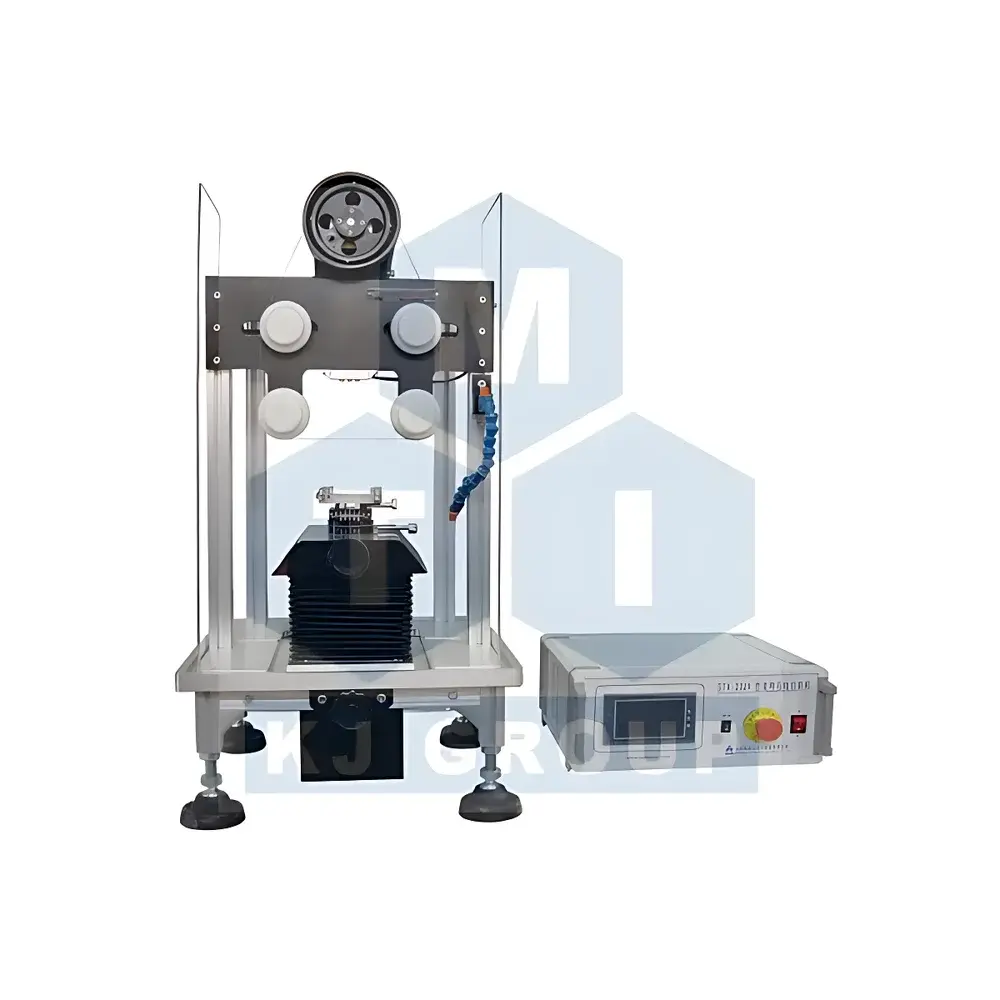
Hefei Kejing STX-202A Precision Diamond Wire Saw
| Brand | Hefei Kejing |
|---|---|
| Model | STX-202A |
| Type | Precision Diamond Wire Cutting Machine |
| Certification | CE Certified |
| Power Supply | 220 V, 50 Hz |
| Spindle Speed | 2–260 rpm (adjustable) |
| Wire Length | 20 m |
| Distance Between Guide Wheel Inner Edges | 100 mm |
| Y-Axis Travel | ≤50 mm |
| Z-Axis Travel | ≤60 mm |
| Rotary Stage | 0–360° horizontal rotation, ±15° tilt |
| Sample Stage Dimensions | 75 mm × 50 mm |
| Max. Cutting Depth | ≤50 mm |
| Max. Sample Size | Φ50 mm × 50 mm |
| Overall Dimensions | 414 mm × 500 mm × 750 mm |
| Weight | 20 kg |
| Standard Accessories | 2 tensioning pulleys, 2 guide wheels, 1 cross-stage fixture, 3 spools diamond wire, 1 cooling pump, 2 resin-ceramic blocks, 4 wax rods |
| Optional Diamond Wires | Φ0.14 mm, Φ0.2 mm, Φ0.3 mm, Φ0.4 mm |
| Warranty | 12 months (parts & labor), lifetime technical support (excludes consumables) |
Overview
The Hefei Kejing STX-202A Precision Diamond Wire Saw is a CE-certified, benchtop wire saw engineered for high-accuracy sectioning of brittle and heterogeneous materials in academic, industrial, and quality control laboratories. It operates on the principle of abrasive cutting using a continuously moving diamond-impregnated wire under controlled tension and linear feed—enabling low-stress, minimal-kerf slicing without inducing thermal or mechanical damage to sensitive microstructures. Unlike rotary saws or abrasive cut-off machines, this system minimizes material loss and subsurface cracking, making it especially suitable for preparing transmission electron microscopy (TEM) lamellae precursors, X-ray diffraction (XRD) specimens, and thin-section samples for petrographic or metallurgical analysis. Its compact footprint (414 × 500 × 750 mm) and lightweight aluminum extrusion frame (20 kg) allow seamless integration into fume hoods, gloveboxes, or shared instrumentation labs.
Key Features
- Motorized Y-axis feed driven by a stepper motor—replacing manual micrometer adjustment—to ensure repeatable, programmable advancement with sub-millimeter resolution and reduced operator variability.
- Adjustable spindle speed (2–260 rpm) enables optimization across material classes: low speeds for hard ceramics or sapphire; higher speeds for polymers or soft composites—preserving wire life and surface integrity.
- Two-axis rotational sample stage (0–360° azimuth, ±15° tilt) facilitates angled cuts, cross-sectional profiling, and anisotropic crystallographic plane selection—critical for orientation-sensitive characterization techniques.
- Integrated cooling pump delivers consistent coolant flow to the cutting zone, suppressing localized heating and preventing diamond grain pull-out or resin bond degradation during extended runs.
- Modular diamond wire compatibility (Φ0.14–0.4 mm) supports trade-offs between kerf width (~0.18 mm minimum achievable), cutting speed, and surface finish—validated for sub-80 µm slice thicknesses on single-crystal silicon and fused quartz.
- CE-compliant electrical architecture with overload protection, emergency stop circuitry, and insulated wire path routing ensures compliance with IEC 61000-6-2/6-4 EMC and safety directives for laboratory environments.
Sample Compatibility & Compliance
The STX-202A demonstrates broad applicability across material science disciplines. It routinely processes single crystals (Si, GaAs, LiNbO₃), polycrystalline ceramics (Al₂O₃, ZrO₂), optical glasses (BK7, fused silica), metallic alloys (Ti-6Al-4V, Inconel), geological specimens (granite, basalt, shale), electronic substrates (PCB laminates, SiC wafers), and composite matrices (CFRP, GFRP). All cutting protocols adhere to ASTM E3–22 (Standard Guide for Preparation of Metallographic Specimens) and ISO 14487:2015 (Fine ceramics — Determination of fracture toughness by single-edge notched beam method), where precise geometry control directly impacts mechanical test validity. The system’s mechanical repeatability supports GLP-aligned documentation workflows when paired with external metrology tools.
Software & Data Management
While the STX-202A operates via intuitive front-panel controls (no embedded software or touchscreen), its stepper-driven Y-axis is compatible with optional external motion controllers (e.g., Arduino-based or OEM-compatible pulse generators) for script-driven batch cutting sequences. Users may log operational parameters—including feed rate, spindle rpm, total wire travel, and coolant duty cycle—in standardized CSV templates aligned with ISO/IEC 17025 documentation requirements. Raw dimensional data from post-cut inspection (e.g., caliper or optical profilometer measurements) can be linked to sample IDs in LIMS platforms, supporting traceability in accredited testing labs.
Applications
- Preparation of wafer-level semiconductor cross-sections for SEM/FIB site-specific analysis.
- Sectioning of mineral thin sections (≤30 µm) for polarized light microscopy and electron probe microanalysis (EPMA).
- Cutting oriented single-crystal coupons for synchrotron XRD strain mapping and Laue diffraction.
- Isolation of representative volumes from additively manufactured metal parts for porosity quantification via micro-CT.
- Production of uniform slices from battery electrode stacks (cathode/anode/coating layers) for cross-sectional electrochemical impedance spectroscopy (EIS) correlation studies.
- Routine QC slicing of refractory brick samples per ASTM C20–23 (Standard Test Methods for Apparent Porosity, Water Absorption, Apparent Specific Gravity, and Bulk Density of Burned Refractory Brick and Shapes).
FAQ
What is the minimum achievable slice thickness, and what factors influence it?
Under optimized conditions—using Φ0.14 mm diamond wire, 15 rpm spindle speed, 0.02 mm/rev Y-feed, and glycol-based coolant—the STX-202A consistently achieves nominal slice thicknesses of 80–100 µm. Actual thickness reproducibility depends on wire wear, sample hardness homogeneity, and clamping stability—not instrument resolution limits.
Can the machine cut conductive materials without short-circuit risk?
Yes. The entire cutting mechanism is electrically isolated; no part of the wire path or stage contacts live voltage. Coolant circulation uses non-conductive polymer tubing and a brushless DC pump, eliminating galvanic corrosion or arcing concerns during metal cutting.
Is alignment calibration required before each use?
No routine recalibration is needed. The dual-guide-wheel geometry and rigid aluminum frame maintain coaxial wire trajectory over time. A one-time laser alignment check (using optional red-dot collimator accessory) is recommended after initial installation or relocation.
How is compliance with regulatory documentation standards supported?
The system includes a CE Declaration of Conformity (DoC) referencing Directive 2006/42/EC (Machinery Directive) and EN 61000-6-2/6-4. Maintenance logs, spare part traceability (e.g., wire lot numbers), and operational parameter records satisfy FDA 21 CFR Part 11 audit trail prerequisites when maintained externally.



