
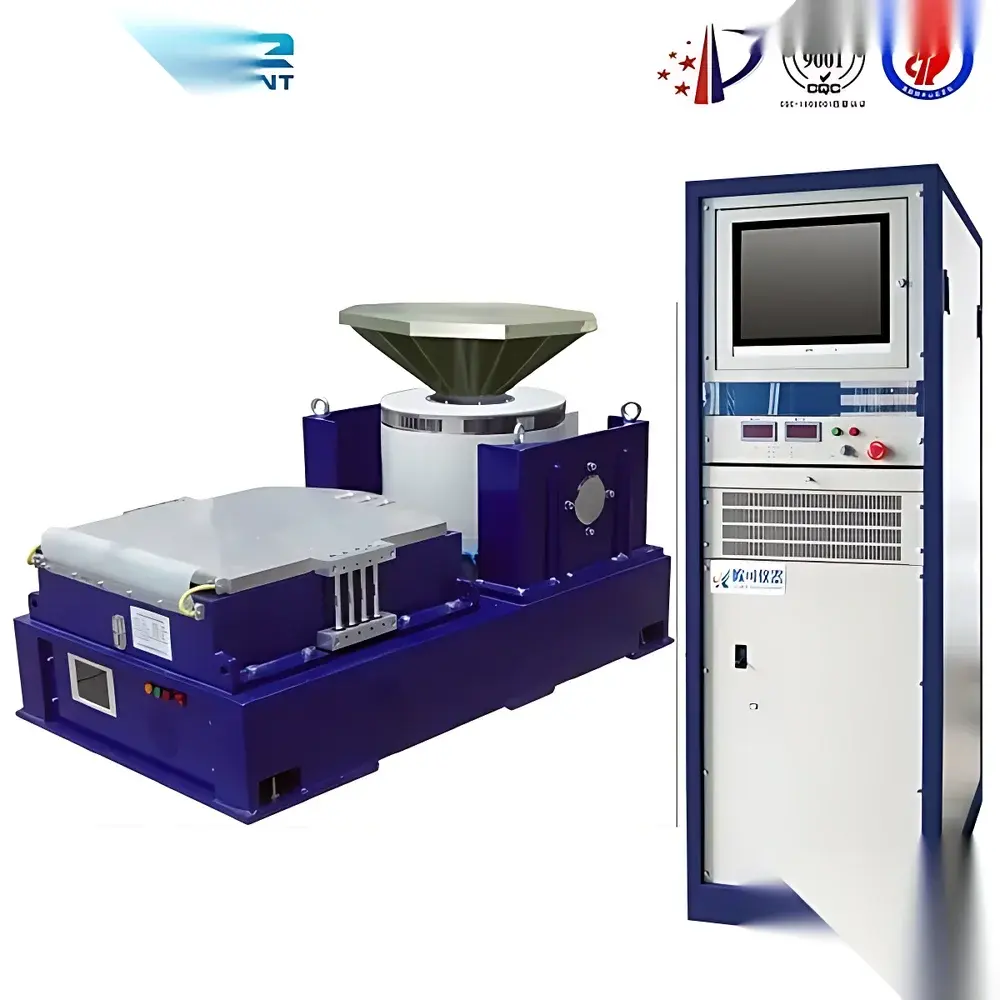
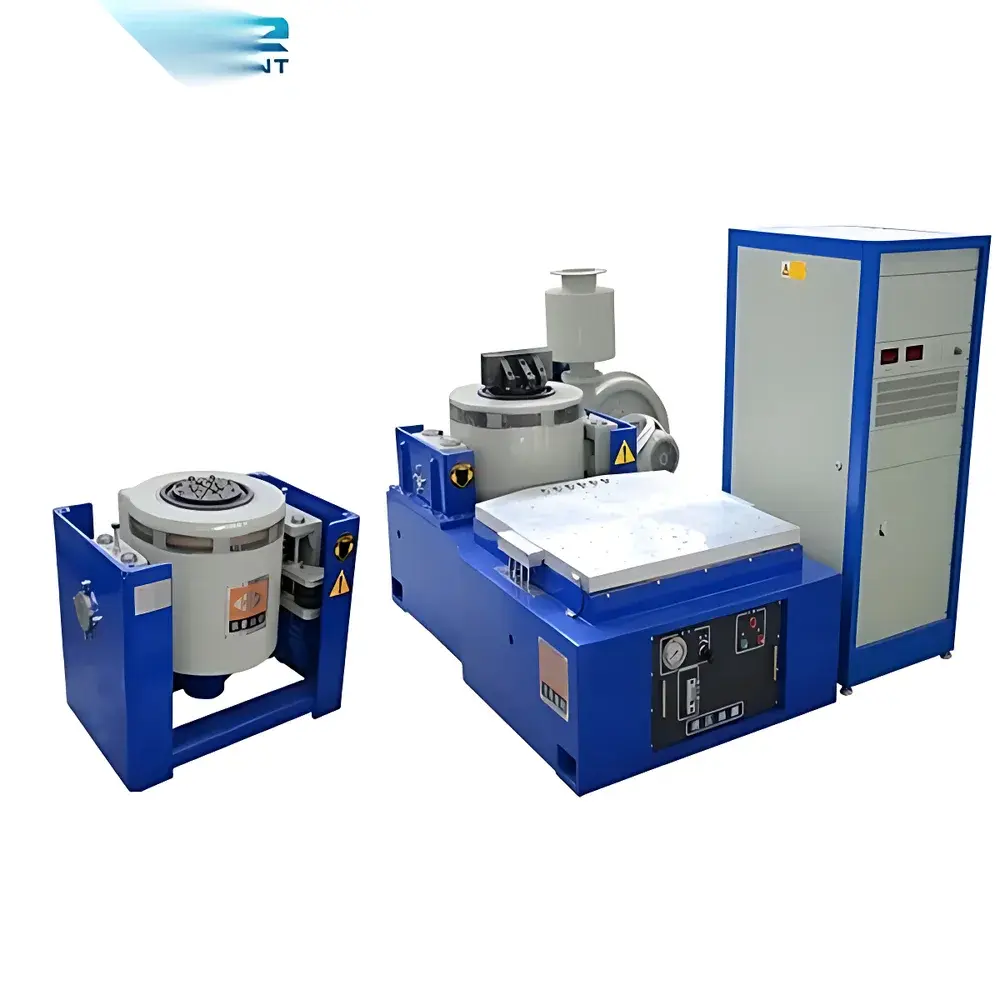
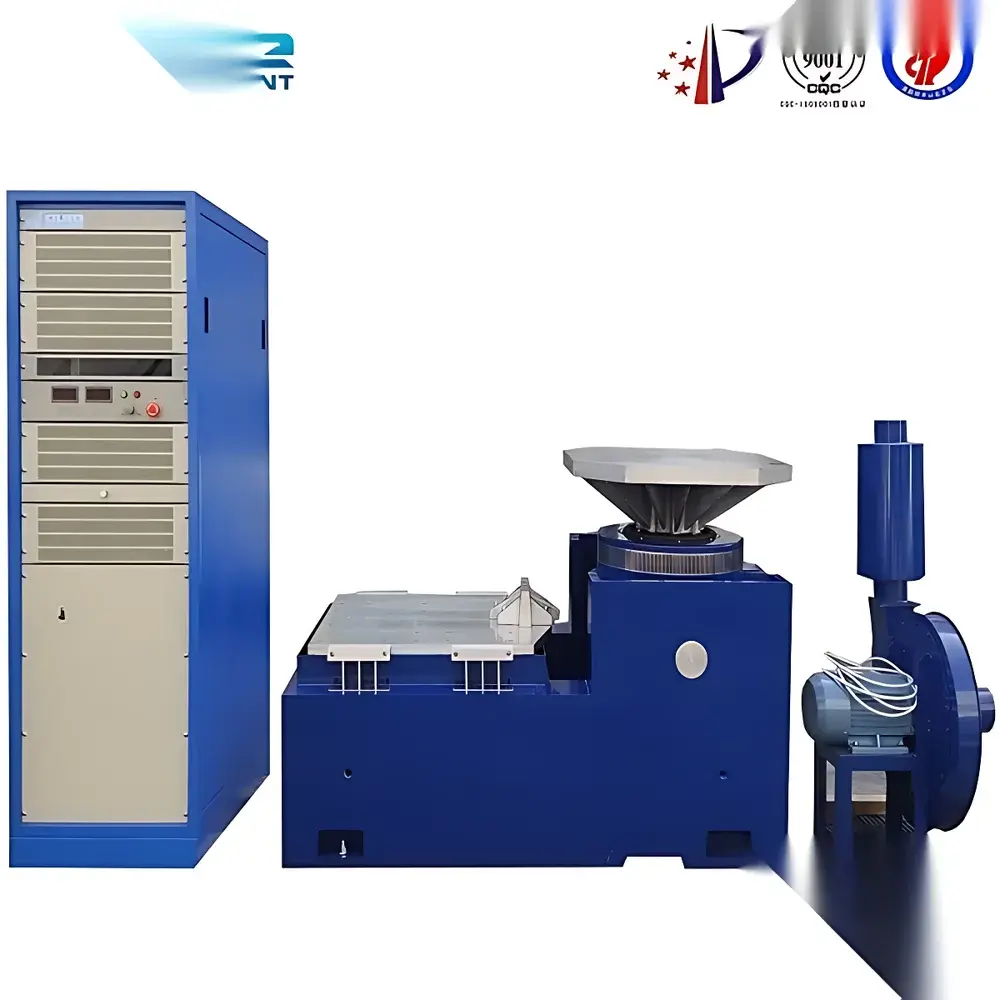
OK-ES-10 Random Vibration Test System
| Brand | OK Instruments |
|---|---|
| Frequency Range | 2–2000 Hz |
| Max Acceleration | 20 g (peak) |
| Peak-to-Peak Amplitude | 5 mm (adjustable per frequency limit) |
| Load Capacity | 50 kg |
| Effective Table Surface | 1000 × 1000 mm |
| Speed Control | DC adjustable |
| Motor Power | 1 HP (0.75 kW) |
| Power Supply | 380 V, 50 Hz |
| Timer Range | 0 s – 99 h 59 min |
| Display Resolution | 0.1 rpm |
| Compliance Standards | EN 60068-2-64, ANSI S2.18, ASTM D999, ISTA 3A/3E/3H, UL 60950, ISO 10326-1 |
| Weight | ~300 kg |
| Dimensions (W×D×H) | 1100 × 1300 × 650 mm |
Overview
The OK-ES-10 Random Vibration Test System is a high-fidelity electrodynamic shaker engineered for controlled mechanical excitation of test specimens under statistically defined broadband vibration spectra. Unlike sinusoidal or swept-sine excitations, this system generates true random vibration profiles—characterized by Gaussian amplitude distribution and user-defined power spectral density (PSD) shaping—enabling realistic simulation of field-induced dynamic stresses encountered during transportation, operational deployment, or environmental qualification. Its design adheres to the physical principles of linear electromechanical transduction, where coil current modulates Lorentz-force-driven armature motion, delivering reproducible acceleration waveforms across the 2–2000 Hz bandwidth. The system is calibrated to meet traceable metrological requirements for laboratory-grade reliability and supports both closed-loop control (with optional accelerometer feedback) and open-loop operation for standardized test execution.
Key Features
- Electrodynamic shaker architecture with DC speed regulation and real-time digital signal processing for stable amplitude and phase response
- Programmable timer with 0-second to 99-hour-59-minute resolution, supporting multi-step test sequencing and automatic shutdown
- High-stiffness aluminum alloy table surface (1000 × 1000 mm), precision-machined for flatness ≤ ±0.05 mm over full area
- Dual-mode operation: random vibration mode (PSD-based) and fixed-frequency mode (150–300 rpm range, resolution 0.1 rpm)
- Integrated thermal protection and overload monitoring circuitry compliant with IEC 60034-1 safety standards
- Front-panel LCD interface with real-time display of frequency, acceleration (gpk), displacement (mm p-p), and elapsed time
- Structural frame designed for floor mounting; base plate includes M12 threaded inserts for rigid anchoring and anti-resonant isolation
Sample Compatibility & Compliance
The OK-ES-10 accommodates payloads up to 50 kg on its rigid horizontal table surface, with center-of-gravity constraints recommended within ±150 mm of table center for optimal modal balance. It supports standard mounting configurations including through-hole fixtures, T-slots (M6), and custom adapter plates. The system is validated against multiple international transport and reliability testing standards—including EN 60068-2-64 (random vibration), ASTM D999 (shipping container testing), ISTA 3-series protocols (e.g., 3A for parcel delivery, 3H for unitized loads), and UL 60950-1 mechanical stress clauses. All calibration certificates are issued per ISO/IEC 17025-accredited procedures, and the device meets electromagnetic compatibility requirements per EN 61326-1 for laboratory environments.
Software & Data Management
While the OK-ES-10 operates as a standalone instrument, it features RS-232 and analog output interfaces (±10 V) for integration with external data acquisition systems and PC-based control software (e.g., VibrationVIEW, m+p VibControl, or LabVIEW-compatible drivers). Optional firmware upgrades enable real-time PSD editing, test profile recall (up to 100 stored sequences), and GLP-compliant audit trails—including operator ID, timestamped start/stop events, and deviation alerts. For regulated industries, the system supports 21 CFR Part 11–compliant electronic signatures when paired with validated third-party software platforms, ensuring full traceability in GMP/GLP audit contexts.
Applications
- Early-life failure detection in PCB assemblies, connectors, and solder joints via accelerated random vibration screening
- Structural integrity validation of automotive ECUs, infotainment modules, and ADAS sensors under road-spectrum replication
- Qualification testing of aerospace avionics enclosures per DO-160 Section 8 requirements
- Package performance evaluation for e-commerce logistics (ISTA 3E, 3H) and military shipping (MIL-STD-810H Method 514.8)
- Material fatigue characterization of polymer housings, elastomeric mounts, and composite brackets
- Calibration verification of accelerometers, piezoelectric sensors, and MEMS inertial measurement units (IMUs)
FAQ
What is the maximum allowable peak acceleration at 100 Hz?
At 100 Hz, the theoretical maximum peak acceleration is limited to 20 g (≈196.2 m/s²), constrained by the system’s mechanical stroke and thermal limits. Actual achievable acceleration depends on payload mass and mounting rigidity.
How is peak-to-peak displacement calculated from PSD specifications?
Displacement is derived from the integral of the PSD over frequency, using the relationship: δp-p = 2 × √(2 × ∫f1f2 PSD(f) × (1/(2πf)²) df). The OK-ES-10 enforces a hard limit of 5 mm p-p, dynamically reduced per frequency per the formula δmax = 20 / (0.002 × f²) mm.
Does the system support closed-loop control with accelerometer feedback?
Yes—optional闭环 control module enables real-time acceleration correction using IEPE-type reference accelerometers, meeting Class 1 accuracy per ISO 5347-13 for metrological applications.
Is the unit supplied with calibration documentation?
Each unit ships with a factory calibration report traceable to NIST-equivalent national standards, covering frequency response (2–2000 Hz), acceleration linearity (±2% FS), and displacement repeatability (±0.02 mm p-p).
Can the shaker be integrated into an environmental chamber?
The OK-ES-10 is compatible with external thermal chambers when used with non-magnetic extension rods and feedthrough-rated cabling; chamber interface must maintain ambient temperature (15–30°C) and relative humidity <80% RH non-condensing.
Related Products



