
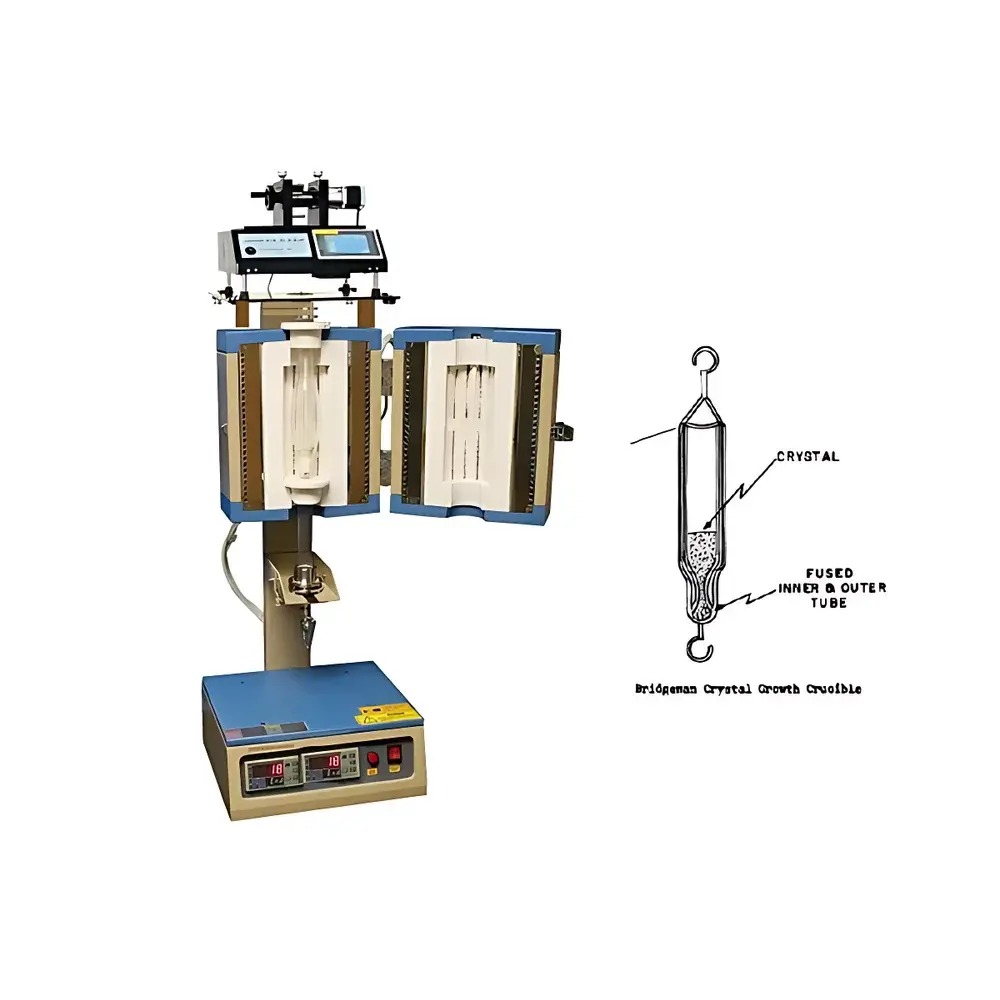
Kejing PTL-HT-B Small-Scale Bridgman Crystal Growth Furnace
| Brand | Kejing |
|---|---|
| Origin | Anhui, China |
| Manufacturer Type | Authorized Distributor |
| Origin Category | Domestic (China) |
| Model | PTL-HT-B |
| Instrument Type | Vertical Dual-Zone Tube Furnace |
| Max Temperature | 1200°C |
| Continuous Operating Temperature | 1100°C |
| Temperature Control Accuracy | ±1°C |
| Max Power | 1.5 kW |
| Heating Rate to Max Temp | 10°C/min |
| Heating Method | PID-Controlled Digital Temperature Controller |
| Internal Chamber Dimensions | 50 mm O.D. × 44 mm I.D. × 450 mm L |
| Dual Heating Zones | 2 × 100 mm length, total 200 mm heated length |
| Max Achievable Axial Temperature Gradient | 1°C/cm |
| Lift Mechanism | Touchscreen-Controlled DC Motor with Programmable Speed (1–500 µm/sec, ±0.05% accuracy), 450 mm total travel |
| Standard Suspension Wires | 3 × Ni-SS (up to 800°C) |
| Quartz Tube | 50 mm O.D. × 44 mm I.D. × 450 mm L |
| Enclosure | CE-certified |
| Warranty | 1 year parts & labor (excludes quartz tubes, seals, heating elements, and suspension wires) |
Overview
The Kejing PTL-HT-B is a vertically oriented, dual-zone tube furnace engineered specifically for small-scale directional solidification of crystalline materials using the vertical Bridgman method. It operates on the principle of controlled axial thermal gradient formation—where two independently regulated heating zones generate a precisely tunable temperature profile along the length of a sealed or gas-purged quartz ampoule. This enables reproducible crystal nucleation and growth under defined thermal boundary conditions, critical for synthesizing high-quality single crystals of oxides, chalcogenides, intermetallics, and thermoelectric compounds. Designed for laboratory-scale R&D in solid-state chemistry, condensed matter physics, and materials science, the PTL-HT-B supports both open-atmosphere inert-gas purging (via inlet/outlet flanges) and fully sealed ampoule processing—making it suitable for air-sensitive or volatile compositions. Its compact footprint and modular architecture allow integration into glovebox-compatible workflows or standard fume-hood environments.
Key Features
- Dual independent PID-controlled heating zones (each 100 mm long), enabling programmable axial temperature gradients up to 1°C/cm—essential for optimizing crystal growth kinetics and minimizing constitutional supercooling.
- High-stability temperature regulation with ±1°C accuracy across the full operating range (room temperature to 1200°C), validated per ASTM E220 for thermocouple calibration traceability.
- Integrated precision lifting mechanism featuring a touchscreen interface (6″ × 4″) for real-time control of crucible translation speed (1–500 µm/sec, ±0.05% repeatability), with three user-defined velocity profiles per growth cycle.
- Standard 450 mm travel range accommodates standard 2-inch quartz tubes (50 mm O.D. × 44 mm I.D. × 450 mm L), with optional high-temperature suspension wire kits (Ni-Cr-Al or Pt) for extended thermal compatibility.
- Robust mechanical design with CE-compliant electrical safety architecture, including over-temperature cutoff, ground-fault protection, and thermal insulation optimized for energy efficiency at sustained 1100°C operation.
- Front-access vertical orientation simplifies loading/unloading of sealed ampoules and facilitates in-situ observation port integration (optional).
Sample Compatibility & Compliance
The PTL-HT-B accommodates cylindrical samples up to 44 mm in diameter and 450 mm in length, typically encapsulated in fused silica ampoules. It supports growth under static inert atmospheres (Ar, N₂), dynamic gas flow, or vacuum-sealed conditions—enabling synthesis of oxygen-sensitive phases (e.g., Fe-based superconductors, rare-earth manganites) without oxidation. All wetted components—including flanges, O-rings, and quartz tubing—are compatible with standard laboratory-grade gases and conform to ISO 8573-1:2010 for compressed air purity when used with external gas manifolds. The system meets CE marking requirements under the Low Voltage Directive (2014/35/EU) and Electromagnetic Compatibility Directive (2014/30/EU). While not GMP-certified out-of-the-box, its programmable temperature and motion profiles are fully audit-trail ready when paired with validated third-party data logging software compliant with FDA 21 CFR Part 11.
Software & Data Management
Temperature setpoints, ramp rates, hold times, and lift speeds are configured via an embedded touchscreen HMI running a deterministic real-time control kernel. All parameters are stored in non-volatile memory with timestamped event logging (start/stop, alarms, manual overrides). Exportable CSV logs include time-stamped thermocouple readings from both zones and motor position feedback. For GLP/GMP-aligned labs, the system supports RS-485 Modbus RTU communication for integration into centralized SCADA or LIMS platforms. Optional PC-based software provides enhanced graphing, multi-cycle recipe management, and automated report generation aligned with ISO/IEC 17025 documentation standards.
Applications
- Growth of model single crystals for X-ray diffraction reference standards (e.g., LiNbO₃, BaTiO₃, Bi₂Te₃).
- Directional solidification studies of eutectic and peritectic systems in metallurgy and ceramic science.
- Development of scintillator crystals (e.g., CsI:Tl, LaBr₃:Ce) requiring low thermal stress and high compositional homogeneity.
- In-situ annealing and phase transformation analysis of thin-film precursors deposited on substrates mounted inside quartz boats.
- Calibration and validation of thermophysical property models (e.g., segregation coefficients, interface kinetics) under controlled gradient conditions.
FAQ
What maximum crystal diameter can be grown in this furnace?
Crystals up to 44 mm in diameter may be accommodated within the standard quartz tube (44 mm I.D.), though typical research-scale growth targets diameters ≤25 mm for optimal thermal uniformity and defect control.
Is the furnace compatible with reducing atmospheres such as H₂/N₂ mixtures?
Yes—provided appropriate gas-handling accessories (stainless steel tubing, leak-tested fittings, and compatible O-rings) are used. Hydrogen service requires additional safety interlocks and ventilation verification per NFPA 55 guidelines.
Can the temperature gradient be reversed (i.e., cold-to-hot direction)?
No—the furnace is configured for top-down solidification (hot zone above cold zone). Reversal would require hardware reconfiguration and is not supported by default firmware.
Does the system include thermocouple calibration certificates?
Standard delivery includes factory-calibrated K-type thermocouples traceable to NIST standards; certified calibration reports are available as an optional add-on.
What maintenance intervals are recommended for sustained 1100°C operation?
Heating elements and quartz tubes should be inspected every 200 operational hours; O-rings replaced every 6 months or after 50 thermal cycles above 800°C. Full preventive maintenance is advised annually per ISO 55001 asset management principles.



