
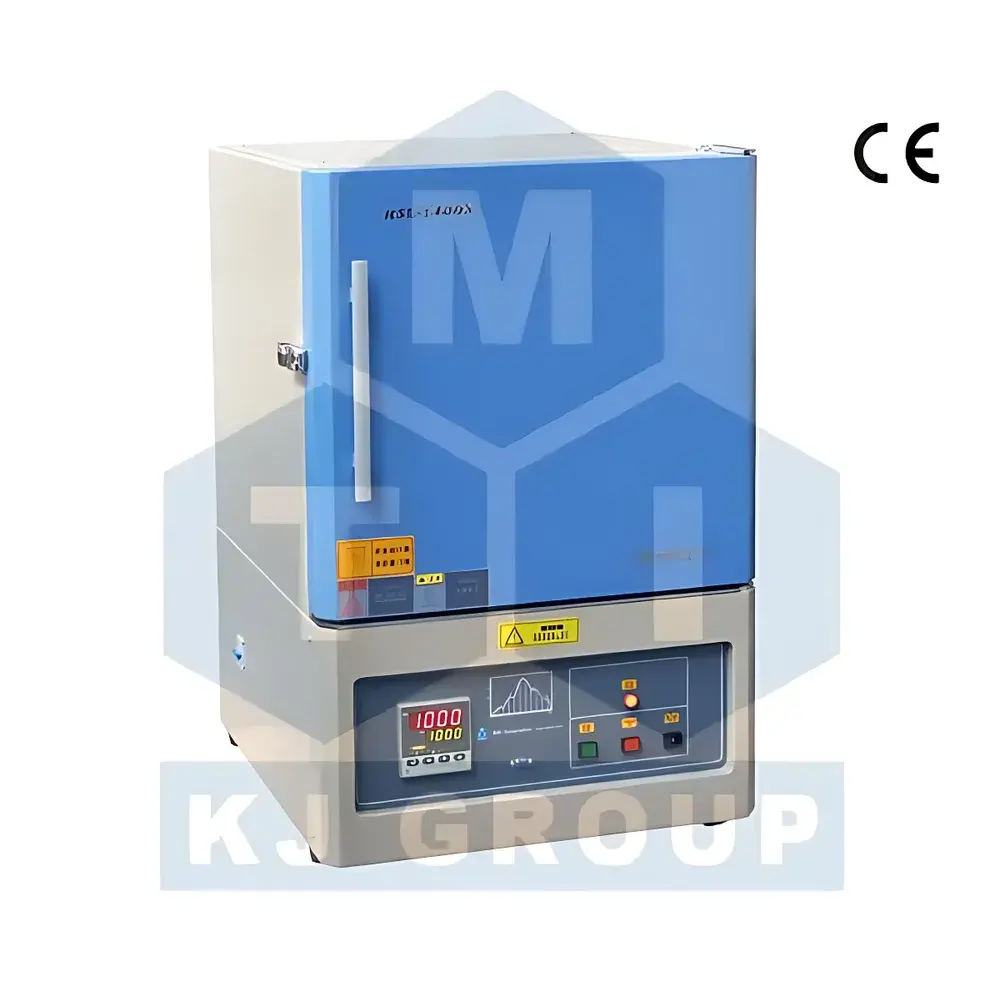
KSL-1400X-A3 19-Liter 1400°C Benchtop Muffle Furnace (250 × 300 × 250 mm Internal Chamber)
| Brand | Hefei Kejing |
|---|---|
| Origin | Anhui, China |
| Model | KSL-1400X-A3 |
| Max Temperature | 1400°C |
| Temperature Uniformity | ±1°C |
| Max Power | 9 kW |
| Heating Rate (to max temp) | 10°C/min |
| Heating Element | Silicon Carbide Rods |
| Internal Dimensions | 250 × 300 × 250 mm |
| Chamber Volume | 19 L |
| Control System | 30-Stage Programmable PID Controller with S-Type Platinum-Rhodium Thermocouple |
| Insulation | High-Purity Alumina Fiber + US-Sourced 1750°C Al₂O₃ Reflective Coating |
| Safety Certification | CE |
Overview
The KSL-1400X-A3 is a CE-certified, benchtop muffle furnace engineered for precise high-temperature thermal processing in academic research laboratories, materials science R&D facilities, and quality control environments. It operates on the principle of resistive heating via silicon carbide (SiC) rods—providing stable, uniform radiant heat distribution within a fully insulated chamber. Designed for continuous operation up to 1300°C and intermittent use at 1400°C, this furnace supports critical thermal treatments including sintering, annealing, ashing, calcination, and pre-oxidation of advanced ceramics, battery electrode materials, and metal oxides. Its dual-layer steel housing, combined with high-purity alumina fiber insulation and a proprietary 1750°C-rated aluminum oxide reflective coating, ensures surface temperatures remain below 60°C during operation—meeting IEC 61000-3-2 harmonic emission standards and minimizing ambient thermal load in shared lab spaces.
Key Features
- Robust 19-liter internal chamber (250 × 300 × 250 mm) constructed from vacuum-formed alumina fiber board with high emissivity and low thermal mass
- High-stability S-type platinum-rhodium (Pt–10%Rh / Pt–6%Rh) thermocouple integrated into the furnace wall for accurate, drift-resistant temperature measurement per ASTM E230/E230M
- 30-segment programmable PID controller (Shimaden FP53 or equivalent) enabling complex thermal profiles—including ramp-hold-cool sequences—with real-time deviation logging
- Dual-shell structural design with forced-air cooling channels between layers to maintain safe external surface temperature (<60°C) under full-load conditions
- Side-opening door with ceramic fiber gasket and mechanical latch system ensuring repeatable sealing integrity and operator safety during hot insertion/extraction
- Compliance with EN 60519-1:2012 for electrical safety in industrial electroheating equipment and EN 61000-6-3:2019 for electromagnetic compatibility
Sample Compatibility & Compliance
The KSL-1400X-A3 accommodates standard crucibles (alumina, quartz, silicon nitride) and sample boats up to Ø80 mm × 60 mm height. It is not rated for vacuum or inert gas purging beyond atmospheric pressure; therefore, operation under reducing or flammable atmospheres (e.g., H₂, CO, CH₄) is strictly prohibited without factory-modified gas-tight sealing and additional explosion-proof interlocks. For corrosive gas applications—including Cl₂, NH₃, HF, or SO₂—the furnace must be ordered with optional chemically resistant chamber lining (e.g., yttria-stabilized zirconia coating) and upgraded thermocouple sheathing. All standard configurations meet GLP documentation requirements when paired with validated calibration records and audit-trail-enabled software (optional). The unit conforms to ISO/IEC 17025 traceability guidelines when calibrated using NIST-traceable reference standards.
Software & Data Management
An optional RS485/USB interface enables integration with third-party SCADA systems or custom LabVIEW/Python-based data acquisition platforms. The bundled PC software (v3.2+) provides full profile editing, real-time temperature graphing, automatic CSV export, and electronic signature support compliant with FDA 21 CFR Part 11 Annex 11 requirements—including user-level access control, change history logs, and non-erasable audit trails. Raw thermocouple voltage data is recorded at 1 Hz resolution, and derivative metrics (dT/dt, cumulative energy consumption) are computed post-acquisition for process optimization studies.
Applications
- Sintering of solid-state electrolytes (e.g., LLZO, LATP) and cathode precursors (NMC, LFP) under controlled air or dry O₂ flow
- Thermal gravimetric analysis (TGA) pre-conditioning of catalyst supports and MOFs prior to BET surface area measurement
- Ash content determination in pharmaceutical excipients per USP and AOAC 942.05 methodologies
- Heat treatment of dental zirconia blanks and orthopedic bioceramics per ISO 13356:2015
- Pre-oxidation of titanium alloys for oxide layer stabilization in implant manufacturing
- Calibration verification of thermocouples and RTDs using fixed-point reference materials (e.g., Ag, Cu, Al freezing points)
FAQ
What is the recommended maximum heating and cooling rate for long-term reliability?
The manufacturer specifies 10°C/min as the optimal ramp rate for both heating and cooling to minimize thermal stress on SiC elements and fiber insulation. Exceeding this rate may accelerate degradation of heating elements and reduce service life.
Can this furnace be used under inert gas atmosphere?
Yes—but only with optional gas inlet/outlet ports and verified leak-tightness testing. Standard units lack gas seals and are rated for ambient air operation only.
Is the 1400°C rating suitable for continuous operation?
No. Continuous operation is rated to 1300°C. The 1400°C specification applies to short-duration (≤30 min), intermittent use under strict adherence to cooling protocols.
How often should the S-type thermocouple be recalibrated?
Per ISO/IEC 17025, annual calibration against a certified reference thermocouple is required. In high-usage labs (>50 cycles/month), quarterly verification is advised.
Are replacement SiC heating elements available with NIST-traceable calibration certificates?
Yes—Kejing supplies OEM SiC rods with individual calibration reports traceable to NIST SRM 1749, including resistance vs. temperature curves and aging factor data.



