
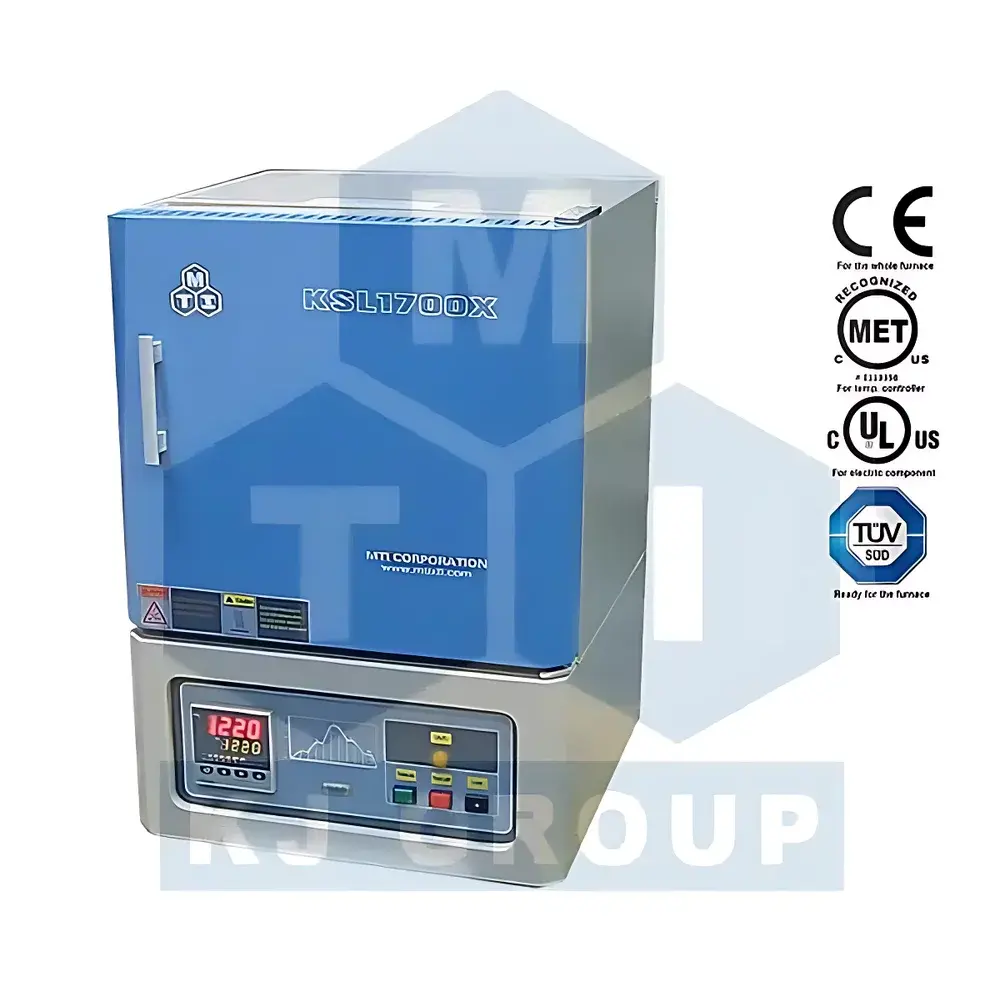
Hefei Kejing KSL-1750X-A2 High-Temperature Box Furnace
| Brand | Hefei Kejing |
|---|---|
| Origin | Anhui, China |
| Model | KSL-1750X-A2 |
| Max Temperature | 1750 °C |
| Temperature Uniformity | ±1 °C |
| Rated Power | 5.2 kW |
| Heating Rate (to max temp) | 10 °C/min |
| Chamber Dimensions | 200 L × 200 W × 200 D mm |
| Heating Element | Silicon Molybdenum (MoSi₂) Rods |
| Thermocouple Type | Type B (Pt–30%Rh / Pt–6%Rh) |
| Controller | 30-Stage Programmable PID with 708P Interface |
| Insulation | Polycrystalline Alumina Fiber with US-Imported 1750 °C Al₂O₃ Reflective Coating |
| External Dimensions | 820 × 460 × 545 mm |
| Net Weight | 140 kg |
| Certification | CE |
| Compliance | Designed per IEC 61000-6-3 (EMC), IEC 61000-6-2 (Immunity), and EN 60519-1 (Electrical Safety for Industrial Electroheating Equipment) |
Overview
The Hefei Kejing KSL-1750X-A2 is a high-temperature box furnace engineered for precision thermal processing in materials science laboratories, ceramic R&D facilities, and advanced metallurgy applications. Operating on the principle of resistive heating via silicon molybdenum (MoSi₂) rods, it delivers stable, repeatable temperatures up to 1750 °C within a fully insulated chamber. Unlike conventional resistance-heated furnaces using Fe-Cr-Al alloys, the MoSi₂ heating elements provide superior oxidation resistance above 1500 °C and extended service life under cyclic thermal loading. The furnace integrates a Type B (Pt–30%Rh / Pt–6%Rh) thermocouple—certified to ASTM E230/E230M—for accurate temperature sensing in the ultra-high-temperature range, coupled with a 30-segment programmable PID controller (708P series interface) enabling precise ramp-hold-cool thermal profiles. Its polycrystalline alumina fiber insulation, enhanced with a proprietary 1750 °C-rated alumina reflective coating (imported from the U.S.), minimizes radial heat loss and improves energy efficiency while maintaining structural integrity during prolonged operation at peak temperature.
Key Features
- Ultra-high temperature capability: Continuous operation up to 1700 °C, with short-term excursions to 1750 °C
- High-accuracy thermal control: ±1 °C uniformity across the 200 × 200 × 200 mm effective chamber volume, verified per ASTM C1040
- Robust thermal architecture: Double-layer insulation system comprising high-purity polycrystalline alumina fiber and a sintered Al₂O₃ reflective surface coating
- Programmable thermal profiling: 30-stage ramp/soak sequences with user-defined rate limits (0.1–10 °C/min), dwell times, and cooling protocols
- Side-opening door design with reinforced ceramic fiber gasket ensures rapid sample access while minimizing thermal leakage
- Compliance-ready electrical subsystem: All components rated above 24 V certified to UL 61000-1, MET Lab Report No. 2312-1876, and CSA C22.2 No. 61010-1
- Integrated safety interlocks: Door-open cutoff, overtemperature cutout (independent of main controller), and ground-fault circuit interruption
Sample Compatibility & Compliance
The KSL-1750X-A2 is designed for inert-atmosphere or air-based thermal treatments only. It is not vacuum-rated and must not be operated under reducing, flammable, or explosive gas environments (e.g., H₂, CO, CH₄). While compatible with standard alumina, zirconia, and graphite crucibles, exposure to highly corrosive atmospheres—including Cl₂, NH₃, HF, SO₂, or sulfidizing agents—requires prior consultation for optional chamber lining upgrades (e.g., yttria-stabilized zirconia cladding or quartz-lined variants). The furnace complies with EN 60519-1:2015 for industrial electroheating equipment safety and meets electromagnetic compatibility requirements per IEC 61000-6-3 (emission) and IEC 61000-6-2 (immunity). CE marking confirms conformity with the EU Machinery Directive 2006/42/EC and Low Voltage Directive 2014/35/EU. Optional third-party certification—including TÜV Rheinland or CSA Group validation—is available upon request and client-funded testing.
Software & Data Management
The 708P controller supports RS485 Modbus RTU communication for integration into centralized lab data acquisition systems. Optional PC software (Kejing FurnaceLink™ v3.2) enables real-time temperature logging, profile export in CSV/Excel format, audit trail generation, and electronic signature support aligned with FDA 21 CFR Part 11 requirements for regulated environments. All thermal cycles are timestamped and stored internally (≥1000 profiles), with non-volatile memory retention during power interruption. GLP/GMP-compliant operation is supported via configurable user access levels, password-protected parameter modification, and automated report generation including operator ID, batch ID, and deviation flags.
Applications
- Sintering of advanced ceramics (Al₂O₃, SiC, ZrO₂, Si₃N₄) and refractory composites
- Heat treatment of high-performance alloys (Inconel, Hastelloy, Ni-based superalloys)
- Crystal growth annealing and phase transformation studies (e.g., solid-state synthesis of Li-ion cathode precursors)
- Ash content determination per ASTM D3174 and ISO 1171 for coal, biomass, and mineral samples
- Thermal gravimetric analysis (TGA) pre-conditioning and residue stabilization
- Calibration reference furnace for thermocouple verification up to 1750 °C (per ISO/IEC 17025-accredited labs)
FAQ
Can this furnace operate under vacuum or controlled atmosphere?
No. The KSL-1750X-A2 is an open-air, non-sealed design. Vacuum or inert-gas purging requires external manifold integration and is not supported by default.
What is the expected service life of the MoSi₂ heating elements?
Under recommended operating conditions (≤1700 °C continuous, ≤10 °C/min ramp/cool rates), MoSi₂ elements typically exceed 2,000 hours of cumulative use before replacement.
Is furnace calibration traceable to NIST or other national standards?
Yes—optional factory calibration includes NIST-traceable Type B thermocouple verification with uncertainty reporting per ISO/IEC 17025 guidelines.
How should minor surface cracks in the furnace chamber be addressed?
Microfissures in the alumina fiber insulation are normal after thermal cycling and do not compromise performance; they may be sealed using the supplied high-temperature Al₂O₃ coating kit.
Does the furnace support remote monitoring via Ethernet or Wi-Fi?
Standard configuration uses RS485 Modbus; Ethernet/Wi-Fi gateway modules (e.g., Moxa EDS-205A-SS-SC) are available as accessories for networked lab infrastructure integration.



