
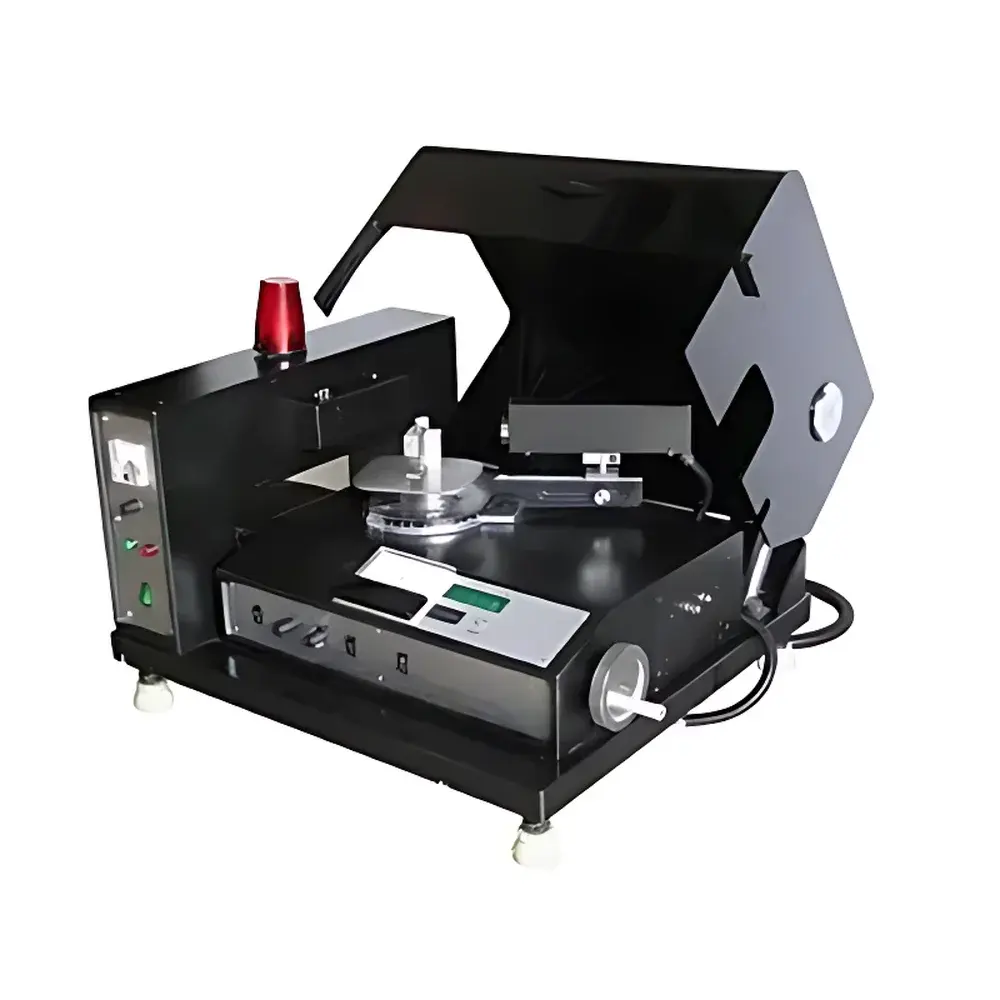
Hefei Kejing DX-100 X-ray Single-Crystal Orienting Diffractometer
| Brand | Hefei Kejing |
|---|---|
| Model | DX-100 |
| Origin | Anhui, China |
| Power Supply | 220 V AC, 50 Hz, 0.5 kW |
| X-ray Tube | Cu anode, air-cooled, grounded anode |
| Max. Operating Voltage/Current | 30 kV / 5 mA (continuously adjustable) |
| Detector | Geiger-Müller counter |
| Detector Bias Voltage | up to 1050 V |
| Time Constant Settings | Fast (1 s) and Slow (2 s) |
| Angular Readout | Mechanical scale (2θ/θ resolution: 1°), digital display in degrees-minutes-seconds (minimum digital resolution: 10″) |
| Angular Range | 2θ = –10° to +140° |
| Collimator Slits | 4′, 5′, 6′ |
| Peak Position Accuracy | ±30″ |
| Primary Beam Shutter | Motorized |
| Dimensions (Main Unit) | 628 × 512 × 428 mm |
| Dimensions (Control Box) | 520 × 520 × 468 mm |
| Net Weight | 45 kg |
Overview
The Hefei Kejing DX-100 X-ray Single-Crystal Orienting Diffractometer is a compact, modular Bragg-angle diffractometer engineered for precise crystallographic orientation determination of single-crystal specimens. Based on the fundamental principle of Bragg diffraction—where monochromatic X-rays incident upon a crystalline lattice produce constructive interference at specific angles governed by nλ = 2d sinθ—the DX-100 enables rapid identification of crystallographic planes relative to sample surfaces. Its split architecture separates the goniometric X-ray optics module from the electronic control unit, minimizing thermal and electromagnetic coupling while facilitating installation in space-constrained laboratories or production cleanrooms. Designed for routine use in materials R&D labs, crystal growth facilities, and semiconductor wafer fabrication support units, the instrument delivers repeatable angular alignment with mechanical stability optimized for manual or semi-automated operation. The Cu-target X-ray tube provides characteristic Kα radiation (λ = 1.5418 Å), suitable for orienting common inorganic crystals including Si, GaAs, sapphire (Al₂O₃), LiNbO₃, and quartz.
Key Features
- Modular design with physically decoupled X-ray head and control electronics for enhanced thermal stability and serviceability
- Adjustable Cu-anode X-ray source operating at up to 30 kV / 5 mA, with fan-assisted cooling and grounded anode configuration for consistent output and operator safety
- Dual-time-constant pulse processing (1 s fast / 2 s slow) to optimize signal-to-noise ratio across varying count rates and crystal quality
- Mechanical goniometer with dual-scale readout: engraved angular ring (1° resolution) plus digital display calibrated to arcsecond-level precision (10″ minimum readout)
- Motorized primary beam shutter for controlled exposure timing and reproducible measurement sequences
- Interchangeable collimating slits (4′, 5′, 6′) to balance beam divergence, intensity, and angular resolution per application requirement
- Full angular coverage: 2θ from –10° to +140° and θ from –10° to +70°, supporting both forward- and back-reflection geometries
Sample Compatibility & Compliance
The DX-100 accommodates standard crystal mounts—including pin-type holders, vacuum chucks, and kinematic stages—for specimens ranging from 5 mm to 75 mm in diameter. It supports orientation verification of bulk crystals, boules, wafers, and epitaxial substrates without requiring polishing or metallization. While not certified for GLP/GMP environments out-of-the-box, its mechanical repeatability (±30″ peak position accuracy) and stable tube output meet baseline requirements for internal process control per ISO 17025–accredited laboratories performing crystallographic QC. The instrument complies with IEC 61000-6-3 (EMC emission limits) and IEC 61010-1 (safety for electrical equipment for measurement), and its radiation shielding meets national Class II X-ray device regulations in China (GBZ 138–2002). Users are required to implement local radiation safety protocols, including interlocked enclosures and dosimetry monitoring, in accordance with applicable national regulatory frameworks.
Software & Data Management
The DX-100 operates via dedicated front-panel controls and real-time digital angle readout, with no embedded PC or proprietary software stack. All measurement data—including 2θ/θ positions, count rates, time constants, and slit configurations—are manually recorded or logged externally using standardized lab notebooks or LIMS-integrated spreadsheets. This minimalist architecture ensures long-term operational continuity, eliminates software obsolescence risks, and simplifies validation for regulated environments where audit trails must remain traceable to physical instrument settings. For users requiring digital acquisition, third-party DAQ systems compatible with TTL pulse outputs from the Geiger-Müller detector may be integrated via standard BNC interfaces, enabling custom scripting (e.g., Python or LabVIEW) for automated scan routines and CSV-based reporting aligned with ASTM E975 or ISO 11639 documentation standards.
Applications
- Pre-growth orientation verification of seed crystals in Czochralski and Bridgman furnaces
- Post-cutting alignment validation of optical and laser-grade crystals prior to polishing
- Quality assurance of substrate orientation in compound semiconductor manufacturing (e.g., GaN-on-sapphire, InP wafers)
- Educational demonstration of Bragg’s law and Laue symmetry in undergraduate solid-state physics laboratories
- Failure analysis of misoriented domains in piezoelectric or ferroelectric single crystals
- Calibration reference for high-resolution XRD systems requiring known orientation standards
FAQ
What X-ray wavelength does the DX-100 generate?
The Cu-anode tube emits characteristic Kα radiation at λ = 1.5418 Å, optimal for orienting most common inorganic single crystals.
Is the instrument capable of automated scanning?
No—the DX-100 is manually operated with digital angle readout; it does not include motorized goniometer axes or scan automation firmware.
Can the Geiger-Müller detector be replaced with a scintillation counter?
The detector interface is proprietary and not user-serviceable; replacement or upgrade requires factory recalibration and mechanical alignment.
Does the system include radiation shielding?
The main unit incorporates lead-lined housing meeting Class II leakage limits per GBZ 138–2002, but external shielding (e.g., lead acrylic panels) must be installed per site-specific safety assessments.
What maintenance is required for long-term reliability?
Annual inspection of X-ray tube filament integrity, collimator alignment verification, and GM counter plateau testing are recommended per manufacturer guidelines.
Related Products





