
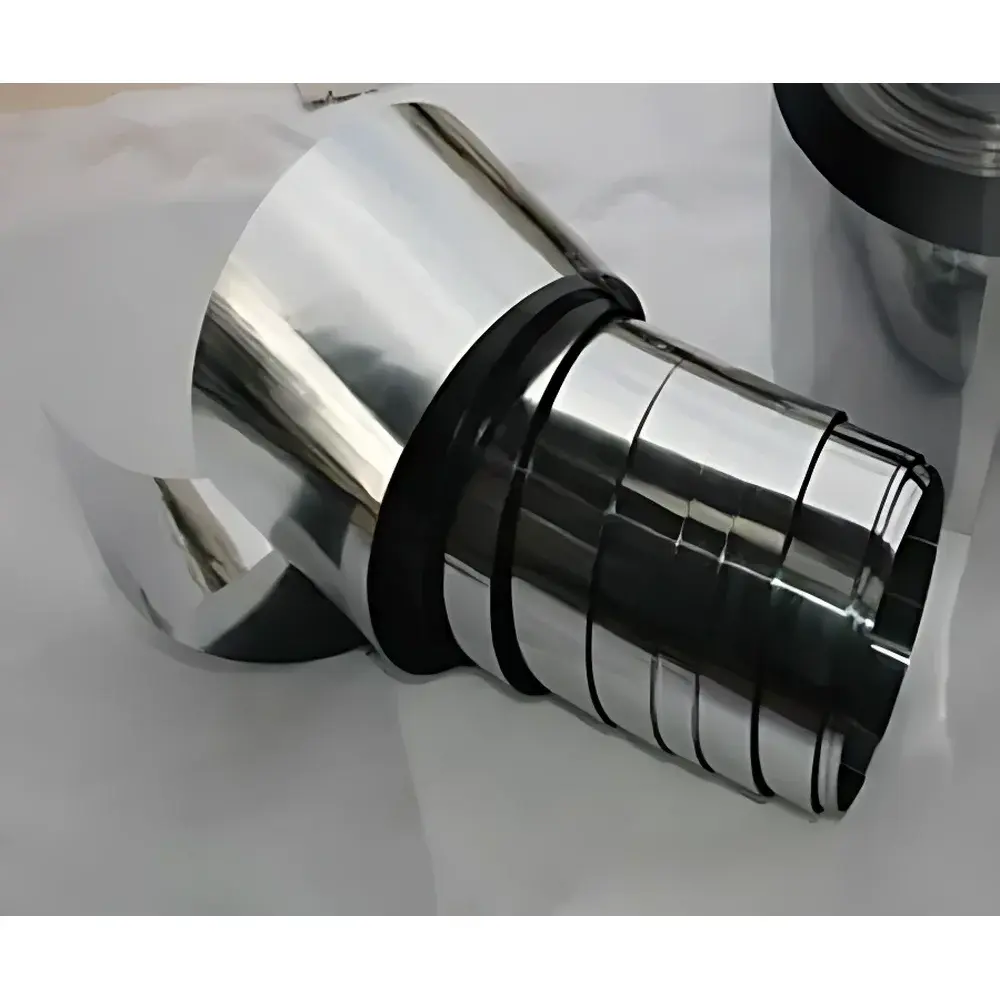
Mo Foil for Quartz Crystal Microbalance (QCM) Sensors – Hefei Kejing
| Brand | Hefei Kejing |
|---|---|
| Origin | Anhui, China |
| Manufacturer Type | Authorized Distributor |
| Origin Classification | Domestic |
| Model | Mo Foil |
| Price Range | USD 0.15–1,500 (FOB) |
| Thickness | 0.01–1 mm |
| Packaging | Vacuum-sealed in Class 100 cleanroom bags, stored and shipped from Class 1000 cleanroom environment |
Overview
Molybdenum (Mo) foil is a high-purity, ultra-thin metallic substrate engineered specifically for fabrication and functionalization of quartz crystal microbalance (QCM) sensor electrodes. As a critical consumable in electrochemical QCM (EQCM) systems, Mo foil serves as both an electrode material and a robust, chemically stable transducer interface—enabling real-time, nanogram-level mass change detection via the piezoelectric resonance frequency shift (Δf) of AT-cut quartz crystals. Its low intrinsic stress, high melting point (2,623 °C), excellent vacuum compatibility, and resistance to oxidation below 400 °C make it ideal for in situ monitoring of thin-film deposition, interfacial redox reactions, polymer electrosynthesis, and corrosion processes under controlled electrochemical environments.
Key Features
- High-purity molybdenum (≥99.95% Mo, trace elements per ASTM B386-22 specifications)
- Controlled thickness tolerance: ±5% across nominal range (0.01 mm to 1.0 mm), with surface roughness Ra < 0.05 µm (as measured by contact profilometry)
- Electrochemically inert baseline in non-aqueous electrolytes (e.g., LiPF6/EC:DMC, TBAPF6/ACN) and stable in acidic aqueous media (pH ≥ 2)
- Compatible with standard QCM electrode patterning techniques including photolithography, sputtering mask alignment, and laser micromachining
- Thermally stable up to 800 °C in inert atmosphere—suitable for post-deposition annealing without delamination or interdiffusion
- Supplied with full material certification (CoA) including ICP-MS trace metal analysis and tensile strength data (UTS ≥ 700 MPa for 0.1 mm foil)
Sample Compatibility & Compliance
This Mo foil meets the dimensional and purity requirements for integration into ISO/IEC 17025-accredited EQCM workflows. It is routinely used in laboratories adhering to ASTM E2312-21 (Standard Guide for Electrochemical Quartz Crystal Microbalance Measurements) and supports GLP-compliant sensor fabrication protocols. The Class 1000 cleanroom handling and Class 100 vacuum bag packaging ensure particulate contamination < 10 particles/m³ (≥0.5 µm), satisfying SEMI F57-1107 standards for microelectronic-grade metallic foils. While not certified to FDA 21 CFR Part 11, its documentation traceability—including lot-specific CoA, handling logs, and storage temperature records—enables audit-ready data lineage for regulated R&D environments.
Software & Data Management
As a passive sensor substrate, Mo foil does not incorporate embedded firmware or require proprietary software. However, it is fully interoperable with industry-standard QCM data acquisition platforms including Q-Sense Analyzer (Biolin Scientific), GAMRY Interface 1010E + QCM module, and Stanford Research Systems SR830 lock-in amplifiers paired with custom LabVIEW-based frequency tracking routines. Raw Δf vs. time datasets generated using Mo-coated crystals are compatible with open-source analysis toolkits such as QCM-D Analysis Toolbox (Python) and QCMfit (MATLAB), supporting harmonic fitting, Voigt modeling, and Sauerbrey-to-viscoelastic conversion per ISO 14738:2022 Annex C guidelines.
Applications
- In situ monitoring of electrodeposited metal–organic frameworks (MOFs) on Mo/QCM electrodes during cyclic voltammetry
- Real-time quantification of Li-ion intercalation mass uptake in Mo-supported anode model systems (e.g., Mo/Si, Mo/TiS2)
- Surface-confined polymerization kinetics of polyaniline and polythiophene derivatives under potentiostatic control
- Corrosion inhibitor film formation studies on Mo surfaces in chloride-containing electrolytes (ASTM G102-89 methodology)
- Template-assisted synthesis of 2D transition metal dichalcogenides (TMDs) via sulfurization of Mo foil substrates
FAQ
Is this Mo foil pre-patterned or supplied as blank stock?
Blank foil only—no lithographic patterning, etching, or adhesion layer deposition is performed. Customers perform electrode definition using their own cleanroom or lab-based microfabrication infrastructure.
Can Mo foil be bonded directly to AT-cut quartz without intermediate adhesion layers?
No. A Cr or Ti adhesion layer (5–10 nm) is required prior to Mo sputtering or evaporation to ensure mechanical integrity and acoustic coupling. Direct bonding results in delamination under resonant shear stress.
What is the typical QCM sensitivity when using 0.05 mm Mo foil at 5 MHz fundamental frequency?
Theoretical Sauerbrey sensitivity remains ~17.7 ng·cm−2·Hz−1; however, effective sensitivity is reduced by ~12–18% due to Mo’s higher acoustic impedance mismatch versus Au—requiring calibration against reference monolayers (e.g., thiolated alkanes).
Do you provide cut-to-size samples for feasibility testing?
Yes—custom-cut coupons (min. 10 × 10 mm) are available upon request with no MOQ; lead time is 3–5 business days from order confirmation.
Is hydrogen annealing recommended prior to use in UHV-EQCM systems?
Yes. A 2-hour anneal at 600 °C under 5×10⁻⁷ mbar H2 atmosphere removes native oxide and improves electrochemical reversibility, particularly for oxygen evolution reaction (OER) studies.





