
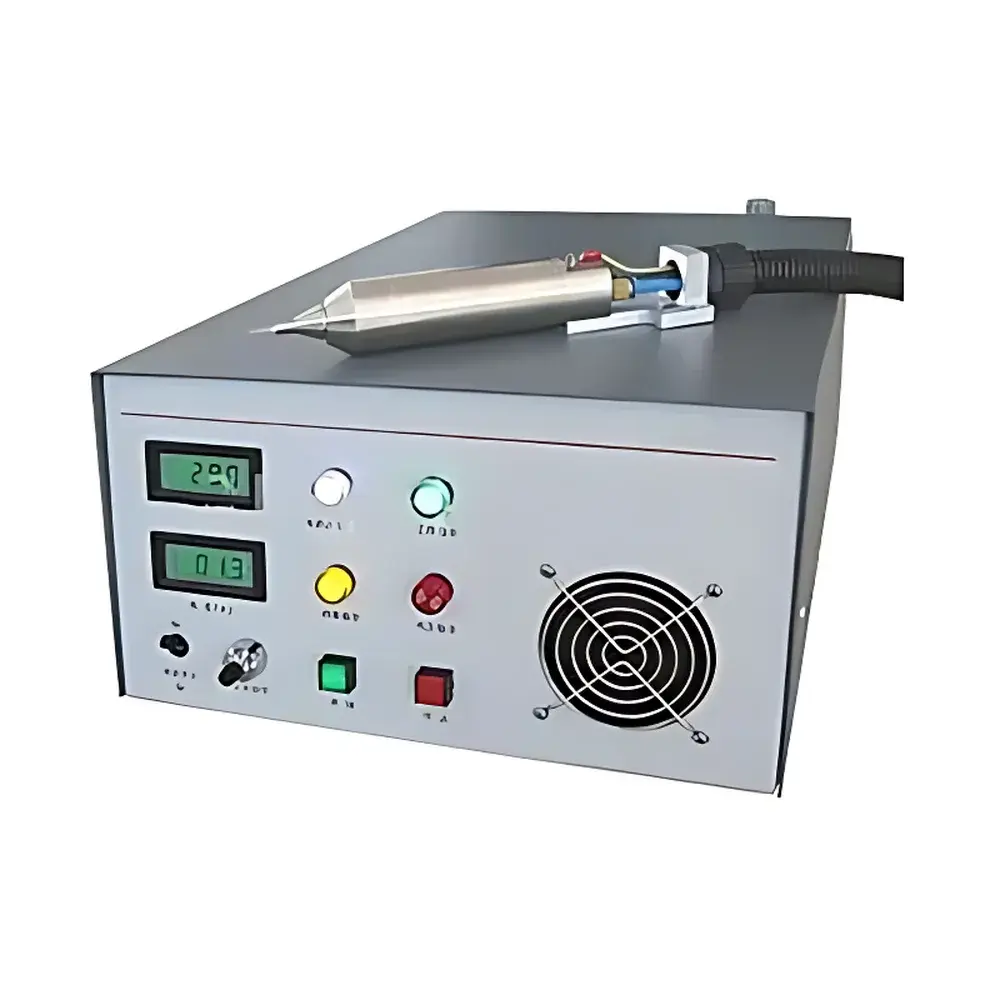
Ketjim GSL1100X-PJF Atmospheric Pressure Plasma Surface Treater
| Brand | Ketjim |
|---|---|
| Origin | Anhui, China |
| Model | GSL1100X-PJF |
| Input Power | 110/220 V, 50/60 Hz, <1000 W |
| Output Frequency | 20–23 kHz |
| Plasma Jet Nozzles | 2 units (round: Ø10–12 mm |
| rectangular | 15–18 mm) |
| Gas Supply Pressure | ≥0.275 MPa |
| Operating Plasma Pressure | 0.048–0.068 MPa |
| Ambient Temperature | <42 °C |
| Relative Humidity | ≤40 %RH |
| Dimensions (W×H×L) | 380×210×500 mm |
| Net Weight | 10 kg |
| Certification | CE |
Overview
The Ketjim GSL1100X-PJF Atmospheric Pressure Plasma Surface Treater is an engineered solution for non-thermal, vacuum-free surface activation and cleaning of solid substrates. Unlike low-pressure plasma systems requiring evacuated chambers, this device generates stable, low-temperature plasma jets directly in ambient air or controlled gas environments—enabling real-time, localized treatment without thermal damage to heat-sensitive materials. Its operation relies on radio-frequency (RF) excitation (20–23 kHz) of process gases (e.g., air, N₂, Ar, or custom mixtures), producing reactive species—including atomic oxygen, nitrogen radicals, and metastable ions—that chemically modify surface topography and energy within seconds. This principle supports reproducible enhancement of wettability, adhesion promotion, removal of organic contaminants (e.g., oils, photoresist residues), and micro-scale etching—critical pre-treatment steps prior to thin-film deposition, bonding, coating, or microfabrication.
Key Features
- Atmospheric-pressure operation eliminates the need for vacuum pumps, chambers, or complex evacuation cycles—reducing footprint, operational overhead, and maintenance requirements.
- Dual interchangeable plasma nozzles: a round-tip nozzle (Ø10–12 mm) for precision spot treatment and a rectangular nozzle (15–18 mm) for uniform linear coverage—supporting flexible integration into manual or semi-automated workflows.
- Compact, portable design (380 × 210 × 500 mm; 10 kg net weight) enables benchtop use, cleanroom deployment, or on-site processing in R&D labs, pilot lines, or quality control environments.
- RF generator with stable frequency output ensures consistent plasma density and ion flux across varying gas compositions and flow rates—essential for process repeatability between batches.
- Integrated safety architecture includes over-temperature protection, gas pressure interlock, and CE-compliant electrical isolation—meeting IEC 61000-6-3 (EMC) and IEC 61000-6-4 emission standards.
Sample Compatibility & Compliance
The GSL1100X-PJF treats a broad spectrum of non-conductive and conductive substrates—including silicon wafers, fused silica optics, PET/PVC polymers, PDMS elastomers, alumina ceramics, and metal foils—without inducing bulk heating or surface ablation. It complies with CE marking requirements for electromagnetic compatibility and low-voltage directive (2014/35/EU). While not certified to ISO 13485 or FDA 21 CFR Part 11 out-of-the-box, its deterministic, parameter-locked operation supports documentation of treatment parameters (gas type, pressure, exposure time, nozzle distance) for GLP/GMP-aligned process validation. Users may integrate it into ASTM D7490-compliant surface energy measurement workflows or ISO 8502-4–based cleanliness verification protocols.
Software & Data Management
This unit operates via front-panel controls with analog/digital indicators for RF power status, gas pressure, and thermal load—designed for simplicity and reliability in regulated environments where firmware updates or network connectivity are unnecessary or undesirable. All operational parameters (input voltage, frequency, gas pressure setpoints) are mechanically and electrically stabilized to ensure batch-to-batch consistency without software dependency. For traceability, users are advised to log treatment conditions manually or via external data acquisition systems interfaced through analog output signals (0–5 V or 4–20 mA options available upon request). The absence of embedded software simplifies 21 CFR Part 11 compliance when paired with validated electronic lab notebooks (ELNs) or LIMS platforms.
Applications
- Pre-deposition activation of Si, GaAs, or sapphire substrates to improve epitaxial film nucleation and reduce interfacial defects in MBE or MOCVD processes.
- Surface hydrophilization of polymer microfluidic chips prior to plasma bonding or protein immobilization.
- Cleaning of optical lenses and laser windows to remove sub-monolayer hydrocarbon contamination without solvent residue or mechanical abrasion.
- Enhancing ink adhesion on flexible packaging films (e.g., BOPP, metallized PET) in printed electronics prototyping.
- Modification of biomedical device surfaces (e.g., catheter tubing, implant coatings) to support covalent grafting of bioactive molecules under ISO 10993-5 cytocompatibility guidelines.
FAQ
Can this system operate continuously for extended periods?
Yes—designed for intermittent or sustained operation up to 8 hours per shift, provided ambient temperature remains below 42 °C and relative humidity does not exceed 40 %RH.
Is nitrogen the only recommended process gas?
No—air, argon, and binary mixtures (e.g., Ar/O₂, N₂/H₂) are compatible; however, flammable, corrosive, or toxic gases (e.g., H₂ >5 %, Cl₂, NH₃) must be avoided per safety specifications.
What is the minimum recommended standoff distance between nozzle and sample?
Optimal treatment occurs at 5–15 mm; closer distances increase localized energy density but risk arcing on conductive surfaces—empirical calibration is advised per material class.
Does the unit include gas flow control instrumentation?
No—external mass flow controllers (MFCs) or regulated pressure sources must be supplied by the user to maintain stable inlet pressure ≥0.275 MPa.
How is process reproducibility ensured without digital feedback control?
Through fixed-frequency RF generation, calibrated nozzle geometry, and pressure-regulated gas delivery—enabling operator-defined, repeatable treatment windows validated via contact angle or XPS surface analysis.
Related Products



