
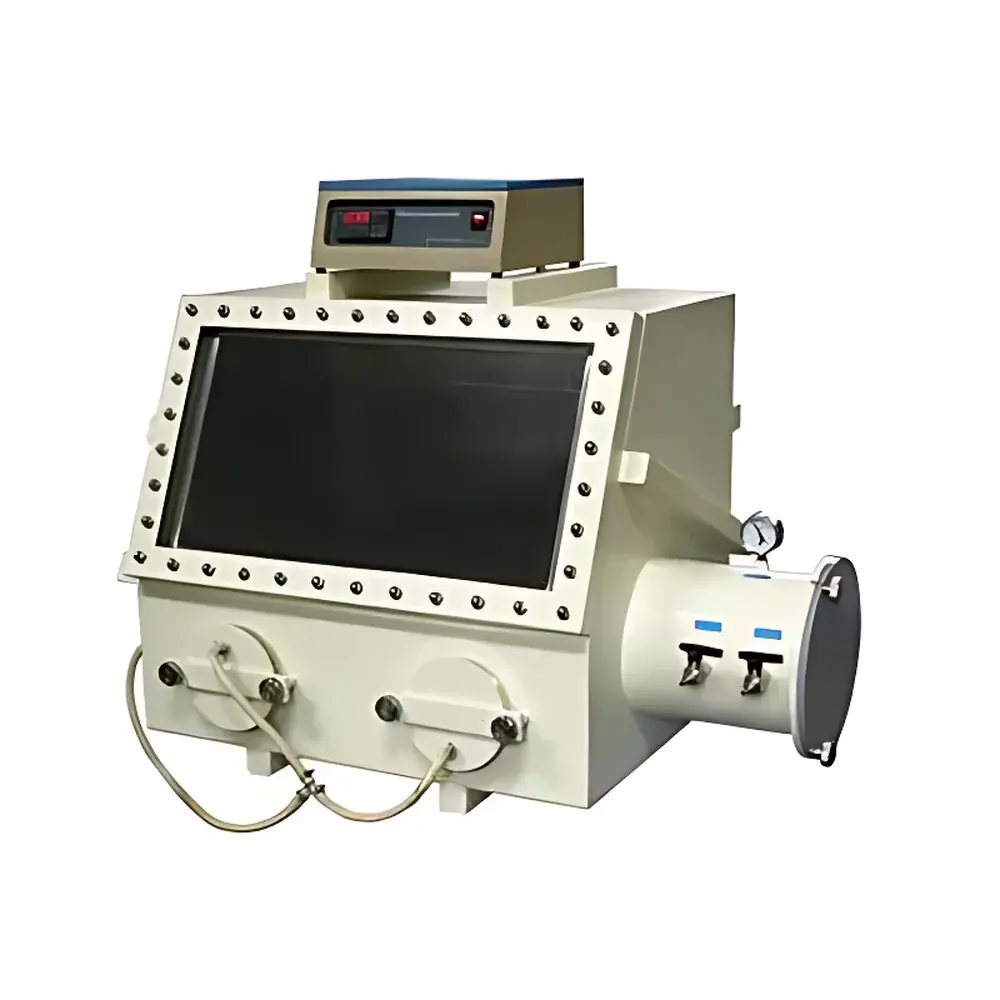
Kejing VGB-4 Automated Pressure-Controlled Stainless Steel Glove Box
| Brand | Kejing |
|---|---|
| Model | VGB-4 |
| Construction | 304 Stainless Steel |
| Chamber Dimensions (W×D×H) | 800 × 600 × 700 mm |
| Antechamber Diameter × Length | 280 × 350 mm |
| Glove Port Diameter | 145 mm |
| Operating Pressure Range | 64–110 kPa (483–825 Torr) |
| Pressure Control Accuracy | ±0.8 kPa (±6 Torr) |
| Antechamber Ultimate Vacuum | ≤0.05 Torr (≤0.067 mbar) |
| Main Chamber Ultimate Vacuum | ≤0.5 Torr (≤0.67 mbar) |
| Positive Pressure Limit | ≤111.5 kPa (≤1.1 atm) |
| Inert Gas Retention Time | >12 h |
| Net Weight | 110 kg |
| External Footprint (W×D×H) | 1200 × 1200 × 1000 mm |
| Power Supply | AC 220 V, 50 Hz |
| Integrated Components | Digital Pressure Controller, Piezoresistive Pressure Sensor, Dual Solenoid Valves, Vacuum & Gas Inlet Interfaces |
Overview
The Kejing VGB-4 Automated Pressure-Controlled Stainless Steel Glove Box is an engineered inert-atmosphere workstation designed for reproducible handling of air-sensitive, moisture-sensitive, or oxygen-sensitive materials in research and development laboratories. Built to ISO 14644-1 Class 5 cleanroom-compatible specifications, the system operates on a closed-loop pressure regulation principle using a feedback-controlled dual-valve architecture—enabling precise maintenance of overpressure or subatmospheric conditions within the main chamber. Unlike passive glove boxes reliant on manual gas purging, the VGB-4 integrates real-time pressure monitoring and automated actuation to sustain stable internal environments during extended experiments in materials science, battery electrode synthesis, organometallic chemistry, and semiconductor precursor handling. Its 304 stainless steel construction ensures long-term corrosion resistance against nitrogen, argon, and forming gas mixtures, while the transparent acrylic front panel provides full optical access without compromising structural integrity or leak-tightness (tested to ≤1 × 10⁻⁵ mbar·L/s He leak rate).
Key Features
- Integrated digital pressure control system with programmable setpoint ranging from 64 kPa to 110 kPa (483–825 Torr), achieving ±0.8 kPa repeatability under dynamic load conditions
- Dual-solenoid valve manifold enabling coordinated vacuum evacuation (via right-side port) and inert gas introduction (via left-side port), both routed through dedicated stainless steel tubing with VCR fittings
- Front-mounted antechamber (Ø280 mm × 350 mm L) featuring interlocked door sequencing and automatic pressure equalization logic to prevent cross-contamination during sample transfer
- Main chamber equipped with two 145 mm diameter glove ports fitted with butyl rubber gloves rated for continuous operation at ≤111.5 kPa (1.1 atm); glove mounting flanges conform to ISO 10648-2 sealing standards
- Modular controller unit mounted atop the enclosure—designed for field relocation without recalibration—and powered by standard AC 220 V / 50 Hz supply with built-in surge protection
- Structural frame optimized for rigidity under differential pressure; chamber walls fabricated from 2 mm thick 304 SS with TIG-welded seams and helium-leak-tested joints
Sample Compatibility & Compliance
The VGB-4 supports safe manipulation of pyrophoric reagents (e.g., alkyl lithiums), water-reactive catalysts (e.g., Grignard reagents), lithium-metal anodes, and sulfur-based cathode precursors. Its pressure-regulated architecture meets functional requirements outlined in ASTM E509-21 (Standard Guide for Design and Operation of Inert Atmosphere Glove Boxes) and aligns with GLP-compliant workflow documentation practices. While not certified for explosive atmospheres (IEC 60079), the system incorporates grounding lugs, static-dissipative flooring interface, and non-sparking hardware per NFPA 484 guidelines for combustible metal handling. All electrical components comply with CE marking directives (EMC Directive 2014/30/EU and Low Voltage Directive 2014/35/EU). The absence of ultra-high vacuum capability (i.e., no turbomolecular pumping stage) reflects its intended use case: controlled inert processing—not surface science analysis.
Software & Data Management
The VGB-4 operates as a standalone electromechanical system with no embedded firmware or cloud connectivity. Pressure setpoints, current readings, and valve status are displayed via a local LED interface with tactile push-button navigation. For audit-trail compliance in regulated environments (e.g., battery R&D labs operating under IATF 16949 or ISO 9001), users may integrate external data loggers via the analog 0–10 V pressure sensor output (4–20 mA option available upon request). All operational parameters—including cumulative run time, number of antechamber cycles, and maximum/minimum pressure excursions—can be manually recorded in laboratory notebooks aligned with 21 CFR Part 11 principles when paired with electronic signature-capable LIMS platforms.
Applications
- Electrode fabrication for solid-state batteries under argon atmosphere with controlled dew point (< −40 °C)
- Synthesis and crystallization of air-sensitive MOFs and perovskite precursors
- Handling of sodium- and potassium-metal anodes in next-generation energy storage research
- Precise weighing and dispensing of hygroscopic catalysts prior to catalytic testing
- Preparation of sensitive organometallic complexes requiring <1 ppm O2/H2O environments
- Controlled oxidation studies via calibrated O2 admixture into N2 carrier gas streams
FAQ
What vacuum level can the VGB-4 achieve in the main chamber?
The main chamber reaches ≤0.5 Torr (≤0.67 mbar) when connected to a suitable two-stage rotary vane pump. This performance is sufficient for solvent removal and preliminary degassing—but not for surface-sensitive analytical techniques requiring UHV conditions.
Can the glove box maintain positive pressure with gases other than nitrogen or argon?
Yes—provided the feed gas is compatible with 304 stainless steel and butyl gloves (e.g., forming gas [N2/H2], synthetic air, or CO2). Gas purity must meet ISO 8573-1 Class 2:2:2 specifications to avoid sensor fouling.
Is the pressure controller programmable for ramped profiles?
No—the VGB-4 implements fixed-setpoint proportional control only. It does not support time-based pressure ramps or multi-step sequences; such functionality requires integration with external PLC systems.
How often should the gloves be replaced?
Under typical usage (8 h/day, moderate chemical exposure), butyl gloves exhibit service life of 6–12 months. Visual inspection for cracking, swelling, or loss of elasticity is recommended before each use per manufacturer’s maintenance schedule.



