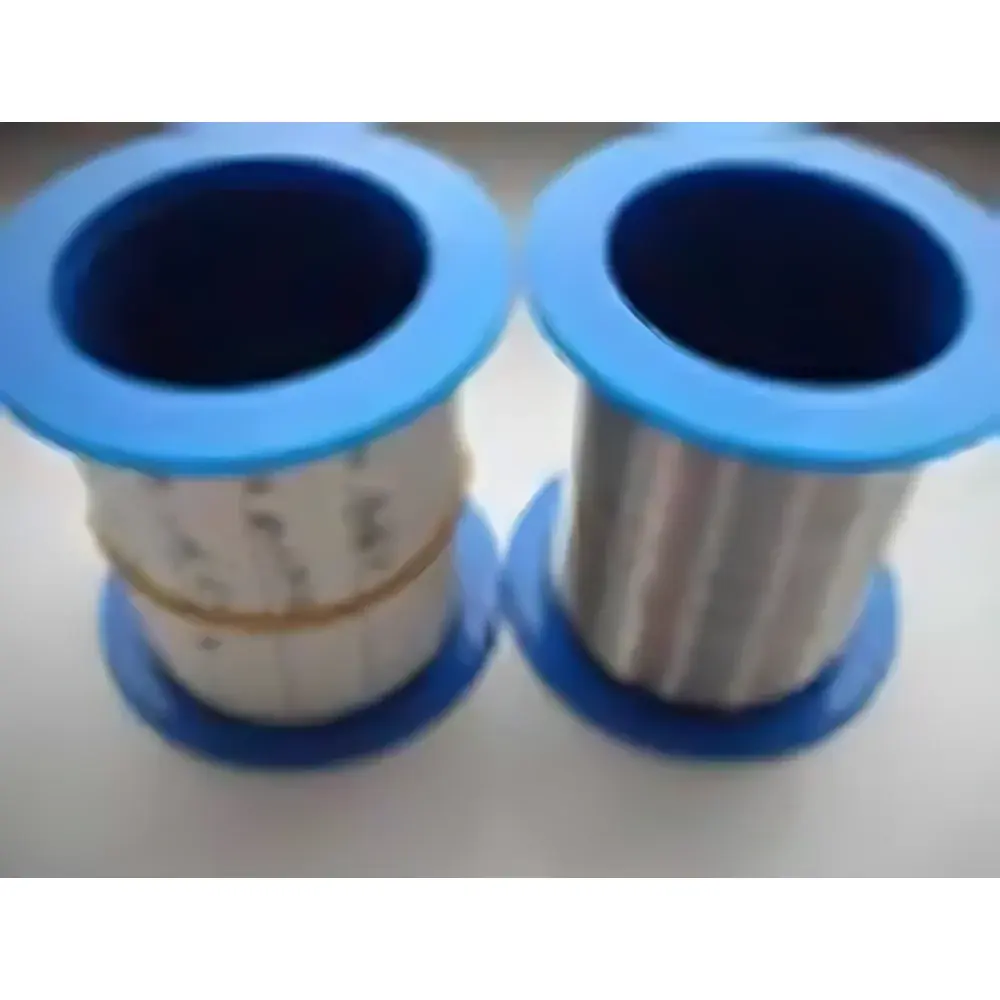
Pt Wire (Platinum Filament) – Hefei Kejing High-Purity Instrument Component
| Brand | Hefei Kejing |
|---|---|
| Origin | Anhui, China |
| Purity Options | 3N5 (99.95%) and 4N (99.99%) |
| Standard Diameters | φ0.05 mm, φ0.1 mm, φ0.2 mm, φ0.4 mm, φ0.5 mm |
| Standard Lengths | Custom length (L) or fixed lengths (e.g., 100 m, 2 m, 3 m) |
| Packaging | Class 1000 cleanroom environment |
| Compliance | Suitable for high-precision thermal, electrical, and catalytic applications requiring trace-metal-free metallic elements |
Overview
Pt Wire (Platinum Filament) is a high-purity metallic component engineered for critical roles in scientific instrumentation, calibration standards, high-temperature sensing, resistance thermometry, catalytic substrates, and thin-film deposition processes. Manufactured by Hefei Kejing, this platinum wire conforms to stringent purity specifications—3N5 (99.95% Pt) and 4N (99.99% Pt)—ensuring minimal interference from impurities such as Fe, Ni, Cu, and Cr that could compromise thermal stability, resistivity linearity, or catalytic selectivity. Platinum’s intrinsic properties—including a near-linear temperature-resistance relationship (per IEC 60751), exceptional oxidation resistance up to 1000 °C in air, and chemical inertness toward most acids and molten glasses—make it indispensable in reference-grade RTDs, furnace windings, microelectrode fabrication, and sputtering targets. This product is not a standalone instrument but a precision-engineered consumable element integrated into OEM systems, laboratory-built sensors, and metrology-grade assemblies.
Key Features
- Controlled Purity Grades: Available in two certified purity levels—3N5 (99.95% minimum Pt) for general-purpose thermal and electrical applications, and 4N (99.99% minimum Pt) for ultra-sensitive catalysis, semiconductor process monitoring, and primary-standard thermometry.
- Dimensional Consistency: Precision-drawn filaments with tight tolerances on diameter (±0.5 µm for φ0.05 mm; ±1.0 µm for φ0.5 mm), verified via laser micrometry and SEM cross-section analysis.
- Thermal Stability: Maintains structural integrity and resistivity repeatability after repeated thermal cycling between −200 °C and +900 °C under inert or oxidizing atmospheres.
- Contamination-Controlled Packaging: Processed and packaged in ISO Class 6 (1000) cleanrooms; final sealing occurs in ISO Class 5 (100) laminar-flow environments using static-dissipative, low-outgassing clean bags and oxygen-barrier aluminum foil—minimizing surface adsorption of hydrocarbons, particulates, and moisture.
- Traceability & Documentation: Each spool or coil is supplied with a Certificate of Analysis (CoA) listing elemental impurity profiles (ICP-MS data), dimensional verification records, and handling instructions compliant with ASTM E1862 and ISO/IEC 17025 guidelines for reference material producers.
Sample Compatibility & Compliance
This Pt wire is compatible with standard wire-bonding tools (e.g., ultrasonic wedge bonders), electron-beam evaporation sources, and ceramic tube furnace windings. It meets material requirements for use in GLP-compliant analytical laboratories and GMP-aligned sensor manufacturing facilities. While not itself a regulated medical device or IVD component, its purity and packaging support compliance with USP , ISO 10993-1 (biocompatibility screening basis), and ASTM F2857 (for platinum used in biomedical electrode applications). For applications involving direct human contact or implantation, users must perform full biocompatibility validation per ISO 10993 series.
Software & Data Management
As a passive physical component, Pt wire does not incorporate embedded firmware or require driver software. However, its metrological performance directly impacts data integrity in systems where it serves as the active element—for example, in resistance-based temperature measurement circuits governed by ITS-90 algorithms. Users integrating this wire into custom RTD assemblies are advised to log lot-specific resistivity coefficients (α, δ, β per IEC 60751 Annex B) and thermal hysteresis curves into their calibration management databases. Traceable CoA data can be imported into LIMS platforms supporting ASTM E2714 or ISO/IEC 17025 audit trails.
Applications
- Construction of Class A and Class B platinum resistance thermometers (PRTs) per IEC 60751 and DIN EN 60751.
- Heating elements and thermocouple extension wires in high-stability vacuum furnaces and crystal growth systems.
- Substrate electrodes for electrochemical impedance spectroscopy (EIS) and cyclic voltammetry in corrosive electrolytes.
- Catalytic mesh supports in gas-phase oxidation reactors and exhaust gas analyzers.
- Target material for DC/RF magnetron sputtering of Pt thin films used in MEMS piezoresistors and fuel cell catalyst layers.
- Reference filaments in optical pyrometer calibration and blackbody cavity construction.
FAQ
Is this Pt wire suitable for use in ultra-high-vacuum (UHV) systems?
Yes—when properly baked out at ≤400 °C under ≤1×10⁻⁷ mbar, this wire exhibits low outgassing rates (<1×10⁻¹² Pa·m³/s·cm²) consistent with ASTM E595 requirements for space-qualified materials.
Can I request custom diameters or annealing treatments?
Hefei Kejing offers OEM services including controlled-diameter drawing (φ0.01–φ1.0 mm), hydrogen-annealed soft temper, and argon-atmosphere stress-relief heat treatment—subject to minimum order quantities and extended lead times.
What documentation accompanies each shipment?
Each order includes a Certificate of Analysis (CoA) with ICP-MS impurity data, dimensional inspection report, cleanroom packaging certification, and handling guidance aligned with IPC-J-STD-033 for moisture-sensitive metallic components.