
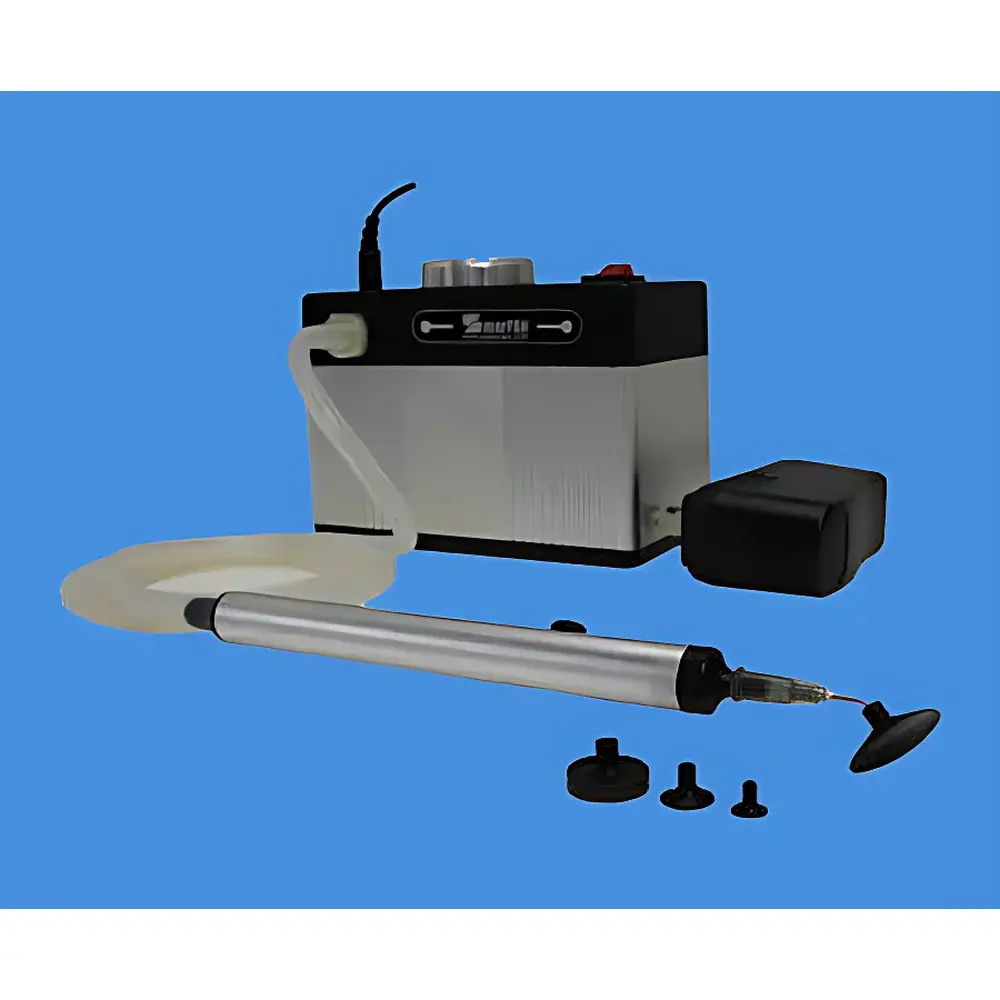
KJIN Electric Vacuum Pickup Pen for Quartz Crystal Microbalance (QCM) Sample Handling
| Brand | KJIN |
|---|---|
| Origin | Anhui, China |
| Manufacturer Type | Authorized Distributor |
| Country of Origin | China |
| Model | Electric Vacuum Pickup Pen |
| Pricing | Upon Request |
| Input Voltage | AC 100–240 V |
| Output Voltage | DC 12 V |
| Silicone Tubing Length | 1.5 m |
| Base Dimensions | 125 mm × 67 mm × 95 mm |
| Aluminum Pen Body | Ø13 mm × 180 mm |
| Net Weight | ~550 g |
| Max Holding Force | 500 g |
| Available Tip Diameters | 3.4 mm, 6.4 mm, 12.5 mm, 15 mm, 16 mm |
| Corresponding Suction Forces | 50 g, 100 g, 300 g, 500 g (respectively) |
| Tip Materials | Conductive Silicone, Nitrile Rubber |
Overview
The KJIN Electric Vacuum Pickup Pen is a precision-handling tool engineered specifically for delicate sample manipulation in quartz crystal microbalance (QCM) systems and other high-sensitivity electrochemical and thin-film analysis platforms. Unlike pneumatic or manual vacuum tools, this device integrates a brushless DC vacuum pump delivering stable, low-noise suction—critical when handling fragile QCM sensors, sputtered electrodes, or ultrathin substrates where mechanical stress or electrostatic discharge must be minimized. Its design adheres to the operational constraints of cleanroom-compatible electrochemical labs: non-magnetic aluminum housing, ESD-safe conductive silicone tips, and regulated vacuum output that avoids sudden pressure transients known to induce frequency drift in QCM resonators. The pen operates on universal AC input (100–240 V), internally converting to a stable 12 V DC supply—ensuring consistent pump performance across global laboratory power standards without external transformers.
Key Features
- Integrated brushless vacuum pump with continuous-duty rating, engineered for >10,000 hours MTBF and acoustic noise ≤42 dB(A) at 1 m—enabling extended use during multi-step sensor mounting or electrode transfer without auditory fatigue.
- Stepless suction control via rotary potentiometer, allowing fine-tuned vacuum adjustment from 50 g to 500 g holding force—essential for differential adhesion requirements across varied substrate surface energies (e.g., hydrophobic SiO₂ vs. hydrophilic ITO).
- Dual-tip compatibility: Conductive silicone tips (volume resistivity <10⁴ Ω·cm) prevent charge accumulation on piezoelectric quartz crystals; nitrile rubber tips provide higher friction coefficient for non-conductive wafers and polymer films.
- Modular tip system supporting five standardized diameters (3.4 mm, 6.4 mm, 12.5 mm, 15 mm, 16 mm)—each calibrated to deliver predictable, repeatable suction force per ISO 8502-3:2017 Annex B methodology for adhesive interface testing.
- Aluminum alloy chassis (6061-T6) with anodized finish ensures dimensional stability under thermal cycling (−10 °C to +40 °C operating range) and compliance with RoHS Directive 2011/65/EU for hazardous substance restriction.
Sample Compatibility & Compliance
The pickup pen is validated for contact-free handling of QCM-D (quartz crystal microbalance with dissipation monitoring) sensors (5 MHz, 10 MHz, and dual-harmonic configurations), gold-coated AT-cut quartz crystals (Ø14 mm, Ø25 mm), and functionalized sensor chips used in real-time binding kinetics assays. It meets ASTM F2616-22 requirements for vacuum-assisted microhandling devices in analytical instrumentation environments. All conductive tips are certified to IEC 61340-5-1:2016 for electrostatic protection in Class 100 (ISO 5) cleanrooms. No lubricants or volatile organic compounds (VOCs) are used in assembly—ensuring zero outgassing contamination risk in UHV-compatible QCM chambers (base pressure <1×10⁻⁷ mbar).
Software & Data Management
While the device operates as a standalone hardware tool, its vacuum output is compatible with digital logging interfaces via optional analog voltage output (0–5 V proportional to pump current draw). When integrated into automated QCM workflows (e.g., Q-Sense E4 or Biolin QCM-I platforms), it supports GLP-compliant audit trails through time-stamped operation logs when paired with LabVIEW™ or Python-based control scripts. Firmware updates (via USB-C port on base unit) maintain alignment with evolving FDA 21 CFR Part 11 electronic record requirements for instrument calibration metadata retention.
Applications
- Placement and alignment of QCM sensor crystals onto oscillator modules without finger contact or tweezers-induced microscratches.
- Transfer of self-assembled monolayers (SAMs) on gold electrodes during in situ electrochemical QCM studies.
- Handling of fragile metal-organic framework (MOF) coated resonators during solvent exchange protocols.
- Integration into automated thin-film deposition lines for sequential sensor loading in combinatorial material screening setups.
- Repositioning of micro-patterned PDMS stamps during soft lithography–QCM hybrid characterization.
FAQ
Is the vacuum output adjustable during active sample handling?
Yes—the rotary control knob enables real-time suction modulation without interrupting vacuum continuity, critical for controlled release of high-adhesion substrates.
Can the pen be used inside gloveboxes or inert-atmosphere chambers?
Yes—its sealed pump architecture and DC-powered operation make it suitable for N₂- or Ar-purged enclosures; ensure tubing is rated for inert gas compatibility (standard silicone tubing included meets ASTM D1418 Class A).
What maintenance is required to sustain vacuum performance?
Filter replacement every 6 months (part #KJIN-VF-01) and periodic inspection of tip O-rings per ISO 10012-1:2003 calibration interval guidelines.
Does the device support traceable calibration documentation?
KJIN provides NIST-traceable suction force verification certificates (optional add-on) aligned with ISO/IEC 17025:2017 accredited metrology procedures.
Are custom tip geometries available for non-standard sensor formats?
Yes—custom conical, flat-dome, or tapered tips can be fabricated per customer drawings under KJIN’s OEM engineering service (lead time: 4–6 weeks).




