
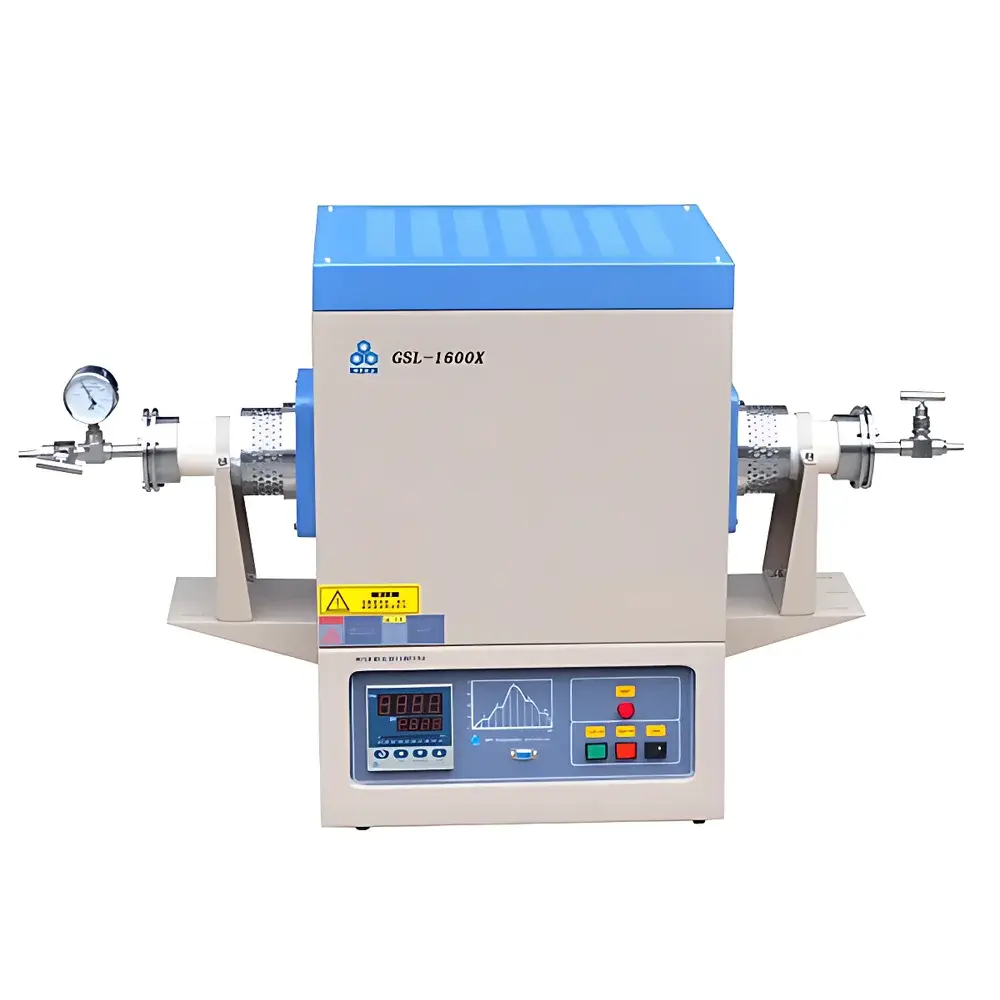
KEJING GSL-1600X High-Temperature Horizontal Tube Furnace (1600 °C, CE-Certified)
| Brand | KEJING |
|---|---|
| Model | GSL-1600X |
| Max Operating Temperature | 1600 °C (2912 °F) |
| Continuous Working Range | 800–1500 °C |
| Heating Element | MoSi₂ (Silicon Molybdenum) Rods, Rated to 1750 °C |
| Temperature Uniformity | ±1 °C over 150 mm Hot Zone |
| Heating Rate | 10 °C/min below 1200 °C |
| Cooling Rate (Natural) | ~3–5 °C/min (1200→300 °C) |
| Tube Dimensions (Std.) | OD 60 mm × ID 52 mm × L 1000 mm (99.8% Al₂O₃) |
| Optional Tube | OD 80 mm × ID 72 mm × L 1000 mm |
| Vacuum Capability | 10⁻³ Torr (with dual-stage rotary pump) |
| Power Supply | 220 V AC, 50/60 Hz, Single Phase |
| Max Power Output | 5 kW |
| External Dimensions | 590 L × 490 W × 760 H mm |
| Net Weight | 150 kg |
| Certifications | CE |
Overview
The KEJING GSL-1600X is a horizontally oriented, high-temperature tube furnace engineered for precision thermal processing under controlled atmospheres—vacuum, inert (N₂, Ar), or reducing (H₂/N₂) environments. It operates on the principle of resistive heating via high-purity molybdenum disilicide (MoSi₂) elements, which deliver stable, oxidation-resistant performance up to 1600 °C in air and sustained operation between 800 °C and 1500 °C. The furnace features a dual-layer steel shell with integrated forced-air cooling, ensuring external surface temperatures remain below 55 °C during continuous operation—a critical safety and energy-efficiency design consideration for laboratory integration. Its hot zone is thermally insulated using high-purity polycrystalline alumina fiber (≥99.9% Al₂O₃), minimizing radial heat loss while enabling rapid thermal response. A proprietary US-sourced high-emissivity alumina coating applied to the inner furnace chamber enhances radiative heat transfer efficiency and extends structural integrity over repeated thermal cycles.
Key Features
- MoSi₂ heating elements rated to 1750 °C, providing long service life and minimal resistance drift across thermal cycling
- 30-segment programmable PID temperature controller with ±1 °C accuracy at 1600 °C, supporting ramp-hold-cool profiles with user-defined rate limits
- 150 mm isothermal zone (±1 °C) within a 457 mm total heated length—validated per ASTM E220 calibration methodology
- Dual-stage vacuum compatibility: base pressure of 10⁻³ Torr with standard mechanical pump; upgradeable to 10⁻⁵ Torr with optional turbomolecular pumping system
- Stainless steel flanges (KF25-compatible outlet, 1/8″ VCR inlet) with high-temp silicone O-rings and Al₂O₃ end plugs ensure repeatable sealing integrity and thermal stability
- Standard 60 mm OD × 52 mm ID × 1000 mm high-purity alumina tube (99.8% Al₂O₃); optional 80 mm OD configuration available for larger sample loads
- Integrated air-cooled double-wall housing and front-panel digital vacuum gauge interface (optional digital vacuum meter support)
Sample Compatibility & Compliance
The GSL-1600X accommodates diverse sample forms—including powders, pellets, thin films, fibers, and small crucibles—within its horizontal tube geometry, enabling uniform gas flow distribution and consistent thermal exposure. It complies with CE safety directives (2014/35/EU Low Voltage Directive and 2014/30/EU EMC Directive) and conforms to IEC 61000-6-2/6-4 immunity and emission standards. For regulated environments, the furnace supports GLP/GMP-aligned operation when paired with validated temperature mapping protocols (e.g., ASTM E742), and its programmable controller retains audit-trail-capable event logs (power-on, setpoint changes, alarm triggers) when configured with optional data-logging firmware. While not inherently 21 CFR Part 11 compliant, the system’s deterministic control architecture allows integration into validated workflows via third-party electronic lab notebook (ELN) or LIMS platforms.
Software & Data Management
The embedded temperature controller operates independently without PC dependency, but supports RS485 Modbus RTU communication for remote monitoring and script-based profile execution. Optional software packages enable real-time graphing of thermocouple inputs (K-type standard), export of time-stamped CSV datasets, and synchronization with auxiliary sensors (e.g., vacuum transducers, gas flow meters). All temperature programs are stored non-volatilely and retain settings after power interruption. Firmware updates are delivered via USB interface, with version history traceable per ISO/IEC 17025 documentation requirements.
Applications
- Sintering of advanced ceramics (ZrO₂, SiC, AlN), battery cathode materials (NMC, LFP), and metal-organic frameworks (MOFs)
- Controlled-atmosphere annealing of semiconductor wafers, graphene substrates, and transition metal dichalcogenides (TMDs)
- Thermal decomposition studies (TGA-coupled pre-treatment), carbothermal reduction, and nitridation reactions
- Crystal growth precursor treatments and solid-state reaction kinetics under reproducible thermal gradients
- Pre- and post-characterization thermal conditioning for XRD, SEM-EDS, and XPS sample preparation
FAQ
What is the recommended maintenance schedule for MoSi₂ heating elements?
MoSi₂ rods require no routine calibration but should be visually inspected for warping or surface scaling before each high-temperature run (>1400 °C); replacement is typically needed after 200–300 hours at 1600 °C.
Can the furnace operate continuously at 1600 °C?
Yes—rated for continuous duty at 1600 °C in air; however, extended operation above 1500 °C accelerates element aging and reduces service life.
Is the alumina tube included with the system?
Yes—the standard 60 mm OD × 52 mm ID × 1000 mm tube is supplied; optional 80 mm OD tubes and quartz alternatives are available as accessories.
Does the system include vacuum pump and gas lines?
No—mechanical vacuum pumps, gas manifolds, mass flow controllers, and associated tubing are optional accessories selected based on process requirements.
How is temperature uniformity verified across the hot zone?
Uniformity is certified using a 5-point axial/radial thermocouple mapping procedure per ASTM E220 Annex A2; a certificate of conformance is provided with each unit.



