
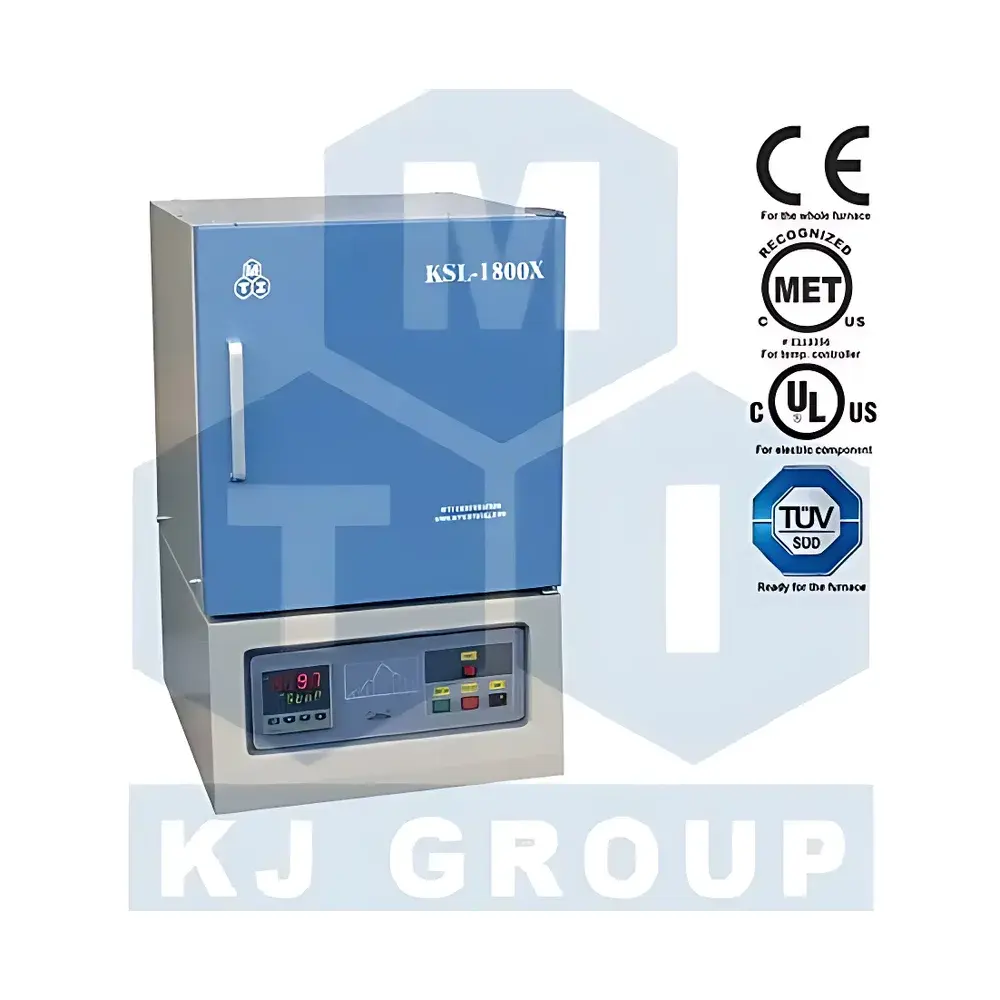
KSL-1800X-A1 High-Temperature Box Furnace (250 × 300 × 250 mm)
| Brand | Hefei Kejing |
|---|---|
| Origin | Anhui, China |
| Manufacturer Type | Authorized Distributor |
| Country of Origin | China |
| Model | KSL-1800X-A1 |
| Instrument Type | Box-Type Muffle Furnace |
| Maximum Temperature | 1800 °C (≤2 h) |
| Temperature Uniformity | ±1 °C |
| Max. Power | 4 kW |
| Heating Rate to Max Temp | 10 °C/min |
| Heating Element | Kanthal Super-1900 Silicon-Molybdenum Rods |
| Internal Chamber Dimensions | 250 × 300 × 250 mm |
| Chamber Lining | Stabilized Zirconia-Reinforced Alumina Polycrystalline Fiber |
| Thermocouple Type | Type B Dual Platinum-Rhodium (Pt–Rh/Pt–Rh) |
| Control System | 30-Stage Programmable PID Controller |
| Safety Certifications | CE |
| External Dimensions | 500 × 490 × 700 mm |
| Net Weight | 120 kg |
Overview
The KSL-1800X-A1 is a high-temperature box furnace engineered for precision thermal processing in materials science laboratories, ceramic R&D facilities, and advanced powder metallurgy applications. It operates on the principle of resistive heating via silicon-molybdenum (MoSi2) elements—specifically Kanthal Super-1900 rods—which provide stable, oxidation-resistant performance up to 1800 °C in air. Unlike conventional resistance-heated furnaces using Fe-Cr-Al alloys, this design eliminates low-temperature oxidation degradation and ensures reproducible thermal profiles across extended service life. The furnace chamber is lined with a proprietary stabilized zirconia-reinforced alumina polycrystalline fiber insulation, offering superior thermal retention, low heat loss, and enhanced resistance to thermal shock during rapid ramping or cycling. Its dual-layer steel housing maintains external surface temperatures below 60 °C under full-load operation, satisfying occupational safety requirements per ISO 13732-1 and IEC 61000-6-3.
Key Features
- Side-opening door design for ergonomic sample loading and unloading—optimized for routine handling of crucibles, sintering boats, and substrate holders
- Stabilized zirconia-enhanced polycrystalline fiber chamber lining, rated for continuous operation at 1750 °C and intermittent use up to 1800 °C
- High-stability Type B dual platinum-rhodium thermocouples (Pt–30%Rh / Pt–6%Rh), calibrated to NIST-traceable standards, ensuring measurement uncertainty ≤ ±1.5 °C over 1500–1800 °C range
- 30-segment programmable PID temperature controller with ramp-hold capability, data logging, and user-defined safety limits (e.g., over-temperature cutoff, rate-of-change alarms)
- Integrated gas inlet/outlet ports (M6 threaded) compatible with regulated O2, N2, Ar, or forming gas lines—configured for atmospheric or slightly positive-pressure inert/oxygen atmospheres
- Compliance-ready architecture: All internal electronics (>24 V) certified to UL 61010-1, MET 61010-1, and CSA C22.2 No. 61010-1; CE-marked per EMC Directive 2014/30/EU and Low Voltage Directive 2014/35/EU
Sample Compatibility & Compliance
The KSL-1800X-A1 accommodates standard high-purity alumina, zirconia, or graphite crucibles (up to Ø100 mm × 120 mm height). Its uniform hot zone—verified per ASTM E220–22 Annex A3—covers ≥90% of the usable chamber volume (250 × 300 × 250 mm), enabling consistent sintering, annealing, ashing, and calcination of ceramics, battery cathode precursors, refractory metals, and rare-earth oxides. While not vacuum-rated, the furnace supports controlled-atmosphere processing compliant with ISO 8502-9 (atmosphere classification for thermal treatment) and ASTM C1171 (sintering of advanced ceramics). For corrosive gas environments (e.g., Cl2, NH3, HF), optional zirconia-coated chamber liners and quartz-glass viewport upgrades are available upon engineering review. Note: Flammable or explosive gases (H2, CH4, CO) must not be introduced due to lack of explosion-proof enclosure.
Software & Data Management
The embedded controller supports RS485 Modbus RTU communication for integration into centralized lab monitoring systems (e.g., LabVIEW, Ignition SCADA). Optional USB data logger firmware enables timestamped export of temperature profiles, setpoints, and alarm events in CSV format—fully traceable for GLP/GMP documentation. Audit trail functionality meets FDA 21 CFR Part 11 requirements when paired with validated user access control (password-protected operator/admin modes) and electronic signature workflows. Firmware updates are delivered via secure HTTPS portal with SHA-256 integrity verification.
Applications
- Sintering of ultra-high-temperature ceramics (UHTCs), including ZrB2, HfC, and SiC-based composites
- Thermal stabilization of Li-ion battery cathode materials (e.g., NMC811, LNMO) under oxygen-controlled conditions
- Crucible-based ashing of geological or biological samples per EPA Method 3050B
- Heat treatment of tungsten, molybdenum, and niobium alloys under inert atmosphere
- Preparation of single-crystal substrates via high-temperature annealing (e.g., sapphire, SiC)
- Calibration reference source for infrared pyrometers operating above 1500 °C
FAQ
What is the recommended maximum ramp rate for long-term reliability?
We recommend limiting heating and cooling rates to ≤10 °C/min to minimize thermal stress on the MoSi2 elements and chamber lining—consistent with Kanthal’s published lifetime guidelines for Super-1900 rods.
Can this furnace be used under vacuum?
No. The KSL-1800X-A1 lacks vacuum-tight seals, flanges, or pumping interfaces. It is rated exclusively for ambient-pressure or slightly over-pressurized gas atmospheres.
Is the ±1 °C temperature accuracy maintained across the entire chamber?
The ±1 °C specification refers to control stability at the thermocouple measurement point. Spatial uniformity within the hot zone is ±5 °C (per ASTM E220–22), verified at three axial positions during factory calibration.
How often should the heating elements be replaced?
Under continuous operation at ≤1750 °C, Kanthal Super-1900 rods typically exceed 2,000 hours of service life. Replacement intervals depend on thermal cycling frequency, atmosphere purity, and peak temperature exposure history.
Does the furnace include software for remote monitoring?
The base unit includes Modbus-compatible firmware. Dedicated PC software (Kejing FurnaceLink™) is available separately for real-time graphing, recipe management, and automated reporting—validated for Windows 10/11 and macOS 12+.



