
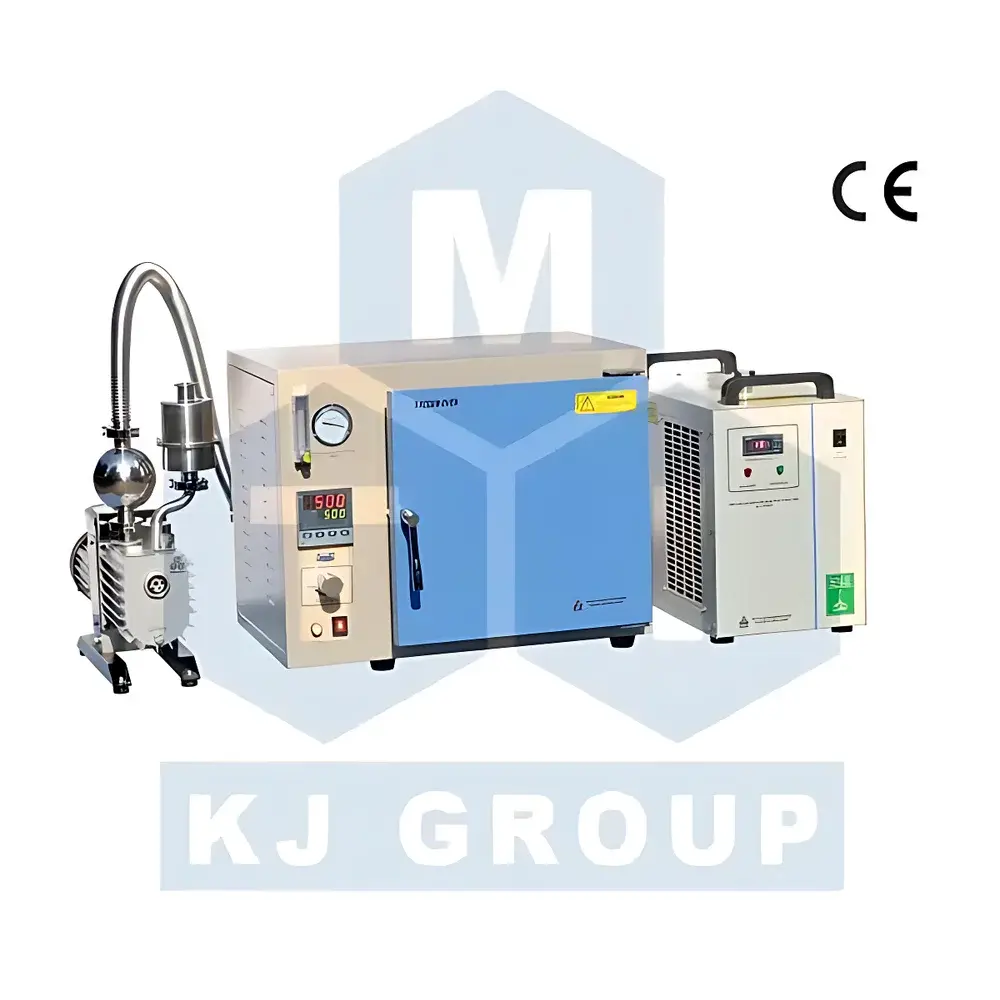
Hefei Kejing DZF-6020-HT High-Temperature Vacuum Drying Oven (25 L, 500 °C) with Rotameter
| Brand | Hefei Kejing |
|---|---|
| Model | DZF-6020-HT |
| Chamber Volume | 25 L |
| Max Operating Temperature | 500 °C |
| Temperature Range | 50–500 °C |
| Temperature Uniformity | ±3 °C |
| Vacuum Interface | KF-25 |
| Inlet Port | 1/4″ stainless steel tube with shut-off valve |
| Gas Flow Control | 50–500 mL/min glass tube rotameter |
| Heating Power | 1800 W |
| Cooling | External recirculating water cooling (Φ6.35 mm hose) |
| Vacuum Pump Compatibility | Dual-stage rotary vane pump (optional, ≤133 Pa) |
| Chamber Material | Mirror-finish 304 stainless steel |
| Insulation | High-purity alumina fiber |
| Sealing | Fluoroelastomer (FKM) gasket |
| Controller | 30-segment PID programmable temperature controller with over-temperature protection |
| Certification | CE Certified |
| External Dimensions (L×W×H) | 590 × 490 × 450 mm |
| Net Weight | Approx. 68 kg |
Overview
The Hefei Kejing DZF-6020-HT is a high-temperature vacuum drying oven engineered for controlled thermal processing under reduced pressure and inert or reactive atmospheres. Designed for applications requiring precise thermal treatment up to 500 °C—such as solvent removal from heat-sensitive nanomaterials, pre-sintering of ceramic precursors, degassing of metal alloys, and moisture-free annealing of thin-film substrates—the system integrates robust vacuum integrity, programmable thermal profiles, and gas-flow compatibility. Its measurement principle relies on convective heating within a sealed, insulated chamber, where vacuum lowers the boiling point of volatiles and suppresses oxidation, while optional gas purging enables controlled ambient chemistry (e.g., N₂, Ar, H₂, or forming gas). The chamber’s mirror-finish 304 stainless steel interior ensures low outgassing, high emissivity, and resistance to thermal cycling-induced surface degradation—though minor discoloration and micro-deformation may occur above 450 °C, consistent with ASTM E2776 guidelines for high-temperature furnace qualification.
Key Features
- High-temperature capability up to 500 °C with ±3 °C temperature uniformity across the 25 L working volume (300 × 300 × 275 mm internal dimensions)
- Alumina fiber insulation (≥99.5% Al₂O₃ purity) providing low thermal conductivity and minimal volatile residue during ramping
- Double-sealed fluorocarbon (FKM) gasket system compatible with vacuum and chemically aggressive atmospheres
- 30-segment PID programmable controller supporting complex ramp-soak-cool cycles, with independent over-temperature cutoff and alarm relay output
- Integrated 50–500 mL/min calibrated glass-tube rotameter for real-time visual flow monitoring and manual regulation of inlet gas
- KF-25 vacuum flange (ISO-K standard) enabling direct coupling to dual-stage rotary vane pumps achieving ≤133 Pa base pressure (2 torr)
- Water-cooled door seal interface (Φ6.35 mm inlet/outlet) designed for continuous operation at >400 °C; compatible with external recirculating chillers (e.g., KJ-5000)
- CE-compliant electrical architecture (220 VAC, 1800 W), including grounded chassis, thermal fusing, and EMI-filtered power input
Sample Compatibility & Compliance
The DZF-6020-HT accommodates diverse sample forms—including powder-filled crucibles, coated wafers, battery electrode rolls, and sintered green bodies—within its removable stainless steel trays. Chamber geometry supports uniform heat distribution per ISO 8573-1:2010 (compressed air purity) and ASTM D2857 (vacuum drying of polymers). The system meets CE marking requirements under the EU Machinery Directive 2006/42/EC and Low Voltage Directive 2014/35/EU. While not inherently GLP/GMP validated, its programmable controller logs setpoint history and includes hardware-based over-temperature interlock—features supporting IQ/OQ documentation per FDA 21 CFR Part 11 when integrated into validated lab workflows. Optional pump configurations allow compliance with ISO 27422:2011 (vacuum drying of pharmaceutical intermediates).
Software & Data Management
The embedded controller provides local data logging of setpoint, actual temperature, and elapsed time for each segment. USB export (via optional adapter) enables CSV-formatted traceability for audit trails. No proprietary software is required; exported files are compatible with LabVIEW, MATLAB, or LIMS platforms. For enhanced compliance, users may integrate third-party SCADA systems via 4–20 mA analog output (temperature signal) and dry-contact alarm relays. All firmware updates are performed via secure SD card—no internet connectivity required—ensuring data sovereignty in regulated environments.
Applications
- Thermal debinding of MIM (metal injection molding) parts under nitrogen purge
- Pre-oxidation of Ni-based superalloy powders prior to HIP processing
- Moisture removal from Li-ion cathode precursors (e.g., NMC, LFP) without lithium loss
- Outgassing of optical components and vacuum chamber subassemblies
- Controlled pyrolysis of polymer-derived ceramics under argon atmosphere
- Residual solvent extraction from spin-coated perovskite films for photovoltaic R&D
FAQ
What vacuum level can be achieved with the standard configuration?
With a compatible dual-stage rotary vane pump, the system achieves ≤133 Pa (2 torr); ultimate vacuum depends on pump performance, chamber cleanliness, and seal integrity.
Is the chamber suitable for hydrogen atmosphere operation?
Yes—when equipped with appropriate gas-handling accessories (leak-tested tubing, H₂-rated rotameter, and explosion-proof pump), and operated within certified safety protocols per CGA G-5.5.
Does the unit include a vacuum gauge?
No—vacuum measurement requires an external Pirani or capacitance manometer; KF-25 port allows direct mounting.
Can the rotameter be replaced with a mass flow controller (MFC)?
Yes—the 1/4″ stainless steel inlet accepts ISO-standard MFCs with compatible fittings and 0–5 V analog input integration.
What maintenance is recommended for long-term reliability at 500 °C?
Annual inspection of FKM gaskets, verification of thermocouple calibration (Type K, Class 1), and cleaning of alumina fiber surfaces with dry nitrogen to prevent dust accumulation.



