
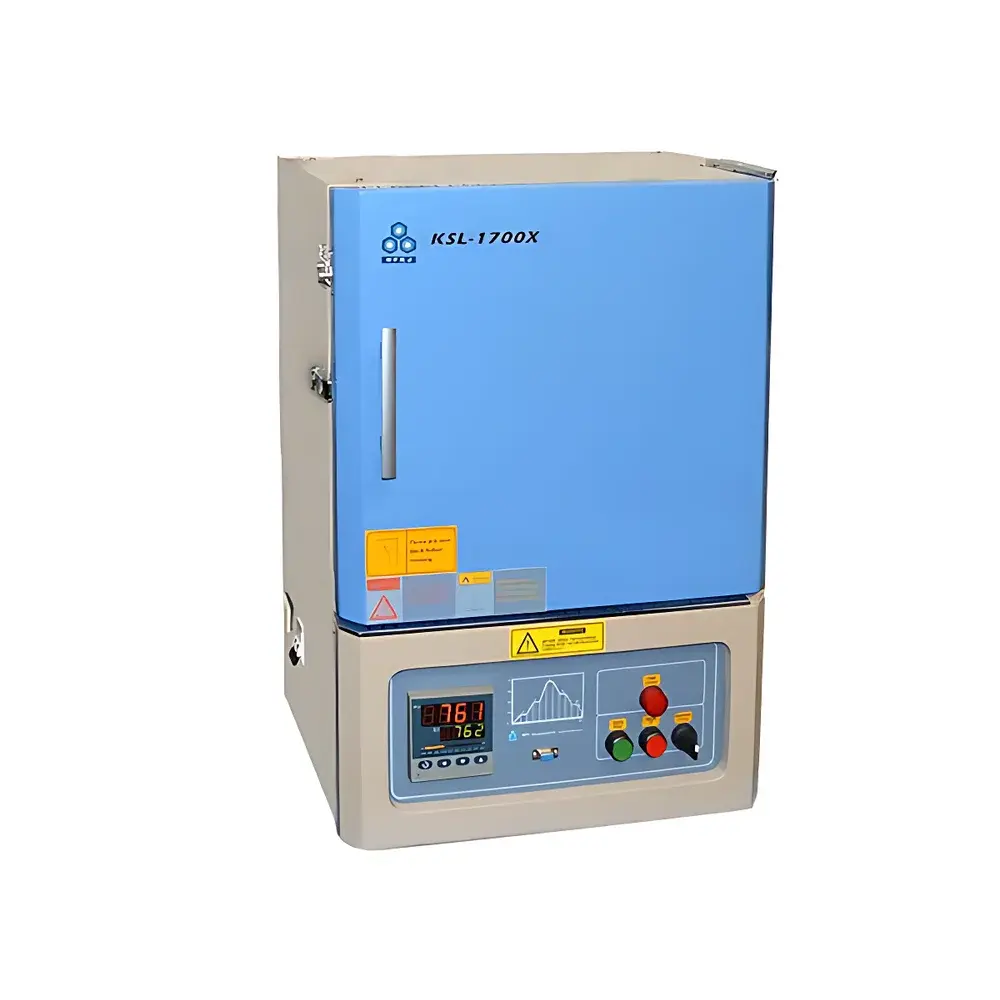
KSL-1700X High-Temperature Box Furnace by Hefei Kejing
| Brand | Hefei Kejing |
|---|---|
| Origin | Anhui, China |
| Model | KSL-1700X |
| Heating Element | Silicon Molybdenum (MoSi₂) Rods |
| Max Temperature | 1700 °C |
| Temperature Uniformity | ±1 °C at setpoint |
| Max Power | 13 kW |
| Ramp Rate to Max Temp | 10 °C/min |
| Internal Chamber Dimensions | 120 × 120 × 120 mm |
| Control System | 30-Stage Programmable PID Controller (518P) with Type B Dual Platinum-Rhodium Thermocouple |
| Chamber Lining | Polycrystalline Alumina Fiber |
| Surface Temp (Outer Shell) | <60 °C |
| Safety Feature | Door-Interlocked Power Cut-off |
| Certification | CE Compliant |
| Compliance | Designed for GLP-aligned laboratory environments |
Overview
The KSL-1700X High-Temperature Box Furnace is a precision-engineered thermal processing instrument designed for demanding laboratory and materials research applications requiring stable, repeatable heating up to 1700 °C. Built on a dual-layer steel shell architecture with polycrystalline alumina fiber insulation, the furnace achieves exceptional thermal efficiency and surface safety—outer casing temperature remains below 60 °C during operation. Its core heating system employs high-purity silicon molybdenum (MoSi₂) rods, known for long-term stability and oxidation resistance in air atmospheres above 1400 °C. Temperature measurement and regulation are performed using a calibrated Type B (PtRh30–PtRh6) dual-wire thermocouple integrated with a 30-segment programmable 518P digital controller, enabling precise ramp-hold-cool profiles with ±1 °C steady-state accuracy at target temperatures. The furnace is CE-certified and constructed to support Good Laboratory Practice (GLP) workflows, including traceable temperature logging, reproducible thermal cycles, and fail-safe mechanical interlocks.
Key Features
- Dual-shell structural design with low-thermal-conductivity polycrystalline alumina fiber insulation ensures minimal heat loss and safe external surface temperatures (<60 °C).
- Internally coated with U.S.-sourced 1750 °C-rated alumina reflective coating to enhance radiant efficiency and extend furnace life.
- Programmable 30-stage temperature profile capability supports complex thermal treatments—including sintering, annealing, ashing, and crystal growth protocols.
- Door-activated power cutoff mechanism provides intrinsic electrical safety during loading/unloading operations.
- Optimized ramp rate control: ≤10 °C/min below 1400 °C, ≤5 °C/min between 1400–1600 °C, and ≤2 °C/min above 1600 °C—ensuring thermal stress mitigation for sensitive samples and refractory components.
- Standard configuration includes B-type thermocouple, two spare MoSi₂ heating elements, alumina crucible stand, high-temperature tongs, heat-resistant gloves, and ceramic plug for chamber sealing.
Sample Compatibility & Compliance
The KSL-1700X operates exclusively in ambient air or inert gas (e.g., Ar, N₂) environments. It is not vacuum-rated nor rated for flammable, explosive, or strongly corrosive atmospheres (e.g., Cl₂, NH₃, HF, SO₂). For specialized corrosive gas applications, optional pre-treated chamber linings—such as yttria-stabilized zirconia (YSZ)-enhanced alumina fiber—are available upon engineering consultation. The furnace complies with CE Directive 2014/35/EU (Low Voltage Directive) and 2014/30/EU (EMC Directive), and its control architecture supports audit-ready operation under GLP and ISO/IEC 17025 frameworks. While not inherently 21 CFR Part 11 compliant, data export via RS485/USB enables integration with validated third-party LIMS or ELN systems where electronic record integrity is required.
Software & Data Management
The embedded 518P controller supports real-time temperature display, manual setpoint adjustment, and non-volatile storage of up to 10 user-defined programs. Temperature profiles can be uploaded/downloaded via USB interface using Kejing’s proprietary configuration utility (Windows-compatible). Raw thermocouple output and stage timestamps are logged internally and exportable as CSV files for post-processing in MATLAB, Python, or statistical analysis platforms. Optional analog voltage output (0–5 V) enables connection to external chart recorders or PLC-based monitoring systems. All firmware updates are delivered through secure, version-controlled releases—documented in the device’s technical manual and traceable to ISO 9001-certified manufacturing records.
Applications
- Sintering of advanced ceramics (e.g., Al₂O₃, ZrO₂, SiC) and ultra-high-temperature composites.
- Heat treatment of metallic alloys and intermetallics requiring phase transformation studies above 1500 °C.
- Thermal gravimetric analysis (TGA) sample preparation and pre-oxidation conditioning.
- Crystal growth support—including flux growth, solid-state reaction synthesis, and precursor decomposition.
- Calibration reference source for high-temperature pyrometers and infrared thermography systems (within 1650–1700 °C range).
- Material stability testing per ASTM C865 (Standard Test Method for Determining the Thermal Stability of Refractories).
FAQ
Is the KSL-1700X suitable for vacuum or reducing atmospheres?
No. This model is designed for atmospheric air or inert gas purging only. Vacuum or hydrogen-forming atmospheres require custom modifications and are not supported out-of-the-box.
What maintenance is required for long-term reliability?
Annual inspection of MoSi₂ rod integrity, thermocouple calibration verification, and reapplication of high-emissivity alumina coating on cracked fiber surfaces are recommended. Heating elements and thermocouples are classified as consumables and excluded from standard warranty coverage.
Can I integrate this furnace into an automated lab workflow?
Yes—via RS485 Modbus RTU or analog 0–5 V output, the furnace supports bidirectional communication with SCADA, PLC, or centralized process control systems for synchronized multi-instrument thermal protocols.
Why does minor cracking appear in the furnace lining over time?
Polycrystalline alumina fiber undergoes benign microcracking due to thermal cycling; this does not compromise insulation performance and can be restored using manufacturer-supplied alumina slurry coating.
Does the unit include documentation for regulatory audits?
Yes—the shipped package includes CE Declaration of Conformity, factory calibration certificate for the installed thermocouple, and full electrical safety test report—all traceable to batch-specific serial numbers.



