
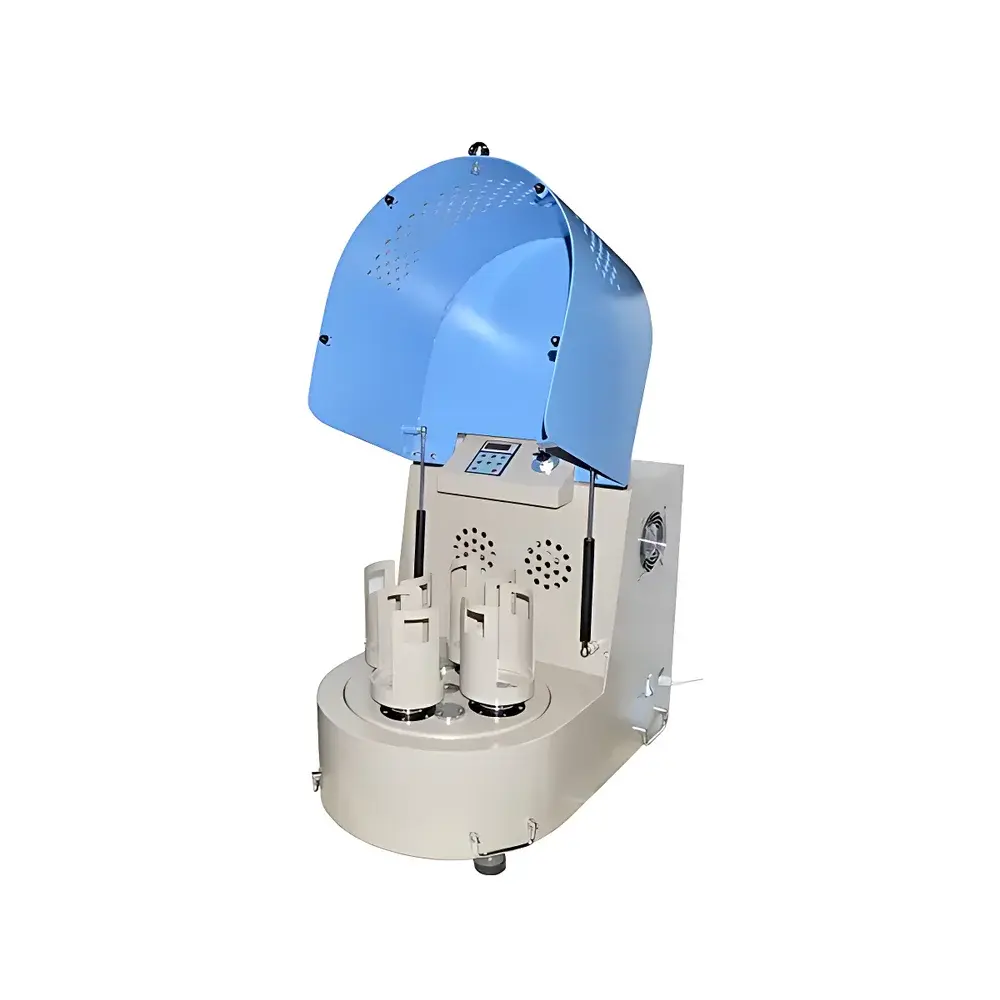
Horizontal Planetary Ball Mill
| Brand | Hefei Kejing |
|---|---|
| Model | SFM-1 |
| Type | Planetary Ball Mill |
| Drive | Belt-driven |
| Power Supply | AC 220 V |
| Rated Power | 300 W |
| Speed Control | PID-based continuous speed regulation |
| Revolution Speed (turntable) | 290 rpm ±10% |
| Rotation Speed (jar) | 580 rpm ±10% |
| Dimensions (W×D×H) | 450 × 700 × 550 mm |
| Net Weight | 80 kg |
| Standard Accessories | V-type mounting bracket, drive belt, tightening wrench |
| Jar Materials | Stainless steel, agate, alumina ceramic, nylon, polyurethane, PTFE, tungsten carbide |
| Jar Capacities | ~100 mL, 250 mL, 500 mL (PTFE jar: 400 mL) |
| Grinding Media Diameters | Φ6, Φ10, Φ12, Φ15, Φ20 mm |
| Minimum Achievable Particle Size | ≤0.1 µm (1.0×10⁻⁴ mm) |
| Vacuum Compatibility | Yes (with optional vacuum-sealed jars) |
| Loading Requirement | Symmetrical loading of 2 or 4 jars with matched mass to ensure dynamic balance |
| Compliance | Designed for GLP-compliant laboratory environments |
Overview
The Horizontal Planetary Ball Mill SFM-1 is a precision-engineered laboratory-scale grinding and mixing system designed for high-energy mechanical alloying, particle size reduction, homogenization, and solid-state reaction initiation. Operating on the principle of planetary motion—where sample-containing jars rotate on their own axes while simultaneously revolving around a central turntable—the SFM-1 generates intense centrifugal and Coriolis forces that accelerate impact, shear, and compression between grinding media and material. This dual-motion kinematics enables efficient comminution of hard, brittle, fibrous, or temperature-sensitive materials without external heating elements. Unlike muffle furnaces or tube furnaces (which are misclassified in the source taxonomy), the SFM-1 is fundamentally a mechanical processing instrument—not a thermal device—making its inclusion under “Constant Temp/Heating/Drying Equipment” technically inaccurate. Its compact footprint (450 × 700 × 550 mm), low acoustic emission (<65 dB(A)), and absence of radiant heat generation render it suitable for shared lab spaces, fume hoods, and cleanroom-adjacent workflows.
Key Features
- Belt-driven transmission ensures smooth torque delivery and minimizes vibration-induced wear, enhancing long-term repeatability across repeated batch cycles.
- PID-controlled variable-speed drive allows precise, stepless adjustment of both revolution (0–290 rpm) and rotation (0–580 rpm) speeds—critical for optimizing energy input per unit mass during mechanochemical synthesis.
- Four-jar configuration enables parallel processing of up to four independent samples under identical kinetic conditions, improving statistical robustness in method development and DOE studies.
- Vacuum-compatible jar options (e.g., PTFE-lined or stainless-steel sealed vessels) support oxygen- or moisture-sensitive reactions, including lithium-ion cathode precursor synthesis and air-stable MOF preparation.
- Dynamically balanced turntable design mandates symmetrical loading (2 or 4 jars of equal mass); this requirement is enforced by mechanical interlocks and documented in operational SOPs to prevent bearing fatigue and shaft deflection.
- Modular jar and grinding media selection—including agate (for ultra-low contamination), tungsten carbide (for high-hardness alloys), and PTFE (for acid-resistant processing)—facilitates material-specific protocol adaptation.
Sample Compatibility & Compliance
The SFM-1 accommodates diverse feedstock categories: metallic powders (e.g., Fe, Al, Ni alloys), oxides (TiO₂, ZnO, LiCoO₂), polymers, pharmaceutical actives, geological matrices, and composite precursors. Jar material selection directly influences contamination thresholds—agate jars yield <1 ppm metal leaching in ICP-MS analysis, while stainless-steel variants introduce measurable Fe/Cr/Ni traces. The system complies with ISO 13320:2020 (laser diffraction particle sizing pre-processing requirements) and ASTM E1155 (standard practice for verifying grinding uniformity). When deployed in regulated environments (e.g., pharmaceutical R&D labs), users may integrate timestamped operation logs and jar weight verification steps to satisfy ALCOA+ data integrity principles. Though not intrinsically 21 CFR Part 11 compliant, its mechanical operation permits straightforward validation of critical process parameters (CPPs) such as rotational symmetry, speed stability, and jar sealing integrity.
Software & Data Management
The SFM-1 operates via an embedded digital controller with LED display—no proprietary software is bundled. However, its analog/digital I/O interface supports third-party data acquisition systems (e.g., LabVIEW, MATLAB) for real-time RPM logging, thermal monitoring (via optional surface-mount thermocouples), and duty-cycle tracking. Users implementing electronic lab notebooks (ELNs) such as LabArchives or Benchling can manually record parameters—including jar mass distribution, grinding time, media-to-powder ratio (MPR), and post-milling BET surface area—to establish traceable processing histories. For GMP-aligned workflows, laboratories commonly develop supplementary checklists documenting jar calibration, media sphericity inspection (per ASTM E11-22), and post-run visual inspection for jar deformation or seal degradation.
Applications
- Mechanochemical synthesis of layered double hydroxides (LDHs) and metal–organic frameworks (MOFs) without solvents.
- Preparation of nanocrystalline electrode materials (e.g., Si@C anodes, NMC cathodes) for battery prototyping.
- Homogenization of heterogeneous catalyst formulations prior to XRD or TEM characterization.
- Size reduction of geological core samples for geochemical assay reproducibility (ASTM D5744).
- Rapid blending of polymer composites containing nanofillers (CNTs, graphene oxide) to assess dispersion quality via SEM-EDS mapping.
- Pharmaceutical solid-form screening: cocrystal generation via liquid-assisted grinding (LAG) using ethanol or water droplets.
FAQ
Can the SFM-1 operate continuously for extended durations (e.g., >24 hours)?
Yes—provided ambient temperature remains below 35°C and jars are loaded symmetrically. Thermal buildup in the motor housing is mitigated by forced-air cooling; however, uninterrupted operation beyond 48 hours requires periodic inspection of belt tension and bearing lubrication status.
Is agate jar certification available for trace-metal analysis?
No formal certificate is issued, but batch-tested agate jars are supplied with ICP-OES screening reports upon request, confirming elemental impurity levels below detection limits for Al, Fe, Cr, Ni, and Cu.
What safety interlocks prevent operation with unbalanced loads?
The unit lacks automatic imbalance detection; compliance relies on procedural controls—users must verify jar mass equivalence (±0.5 g) using calibrated analytical balances before initiating runs, as specified in the operator manual’s Section 4.2.
How does jar geometry affect grinding efficiency?
Cylindrical jars (standard) maximize media cascade height, whereas octagonal designs increase wall collisions. Empirical studies show 15–20% higher d₅₀ reduction rates in octagonal jars for brittle ceramics, though wear rates increase correspondingly.
Can SFM-1 process biological tissues?
Not recommended—cryogenic pre-treatment (liquid N₂ immersion) is required to embrittle organic matrices, and standard jars lack cryo-rated seals. Dedicated cryo-mills with liquid nitrogen feed lines are preferred for such applications.



