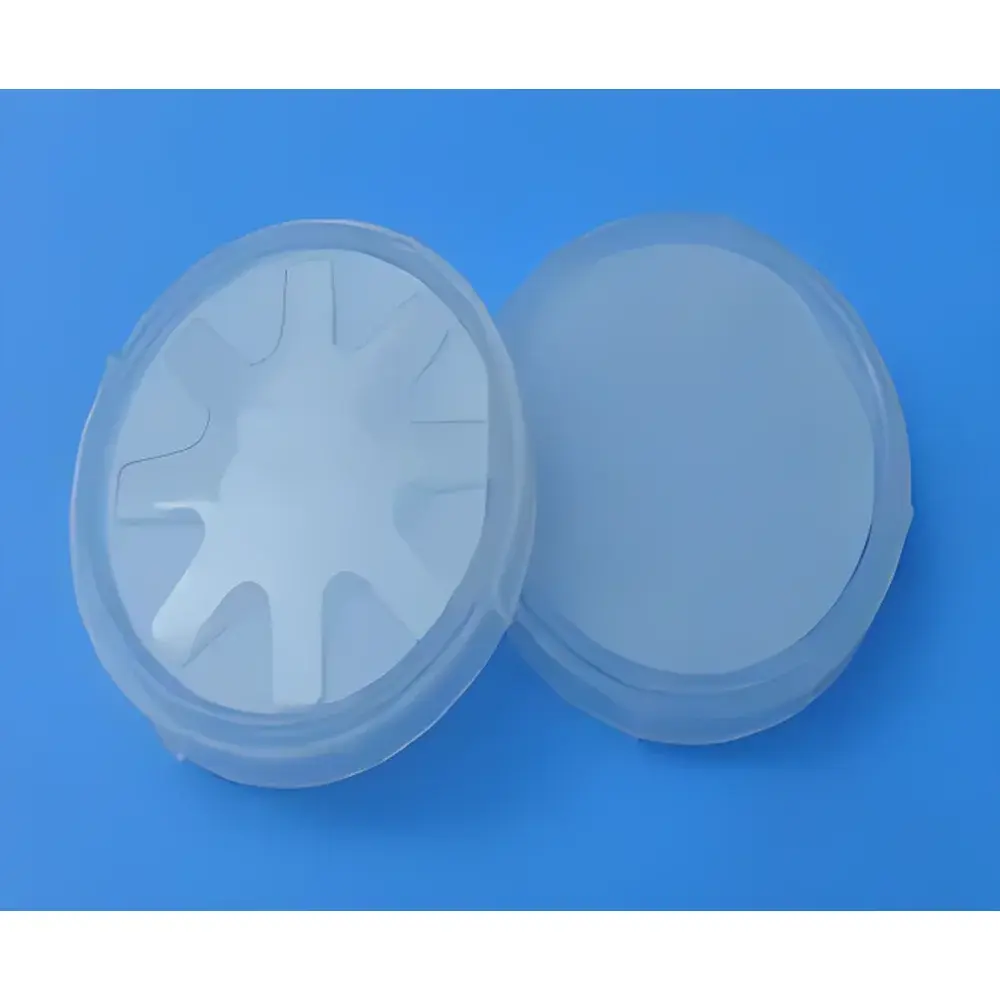
Al2O3-Coated Si-Doped GaN Epitaxial Template on Sapphire Substrate
| Brand | Hefei Kejing |
|---|---|
| Origin | Anhui, China |
| Manufacturer Type | Authorized Distributor |
| Origin Category | Domestic |
| Model | Al2O3-Coated GaN Epitaxial Template |
| GaN Type | n-type, Si-doped |
| GaN Thickness | 5 µm ±1 µm (c-plane, <0001>) |
| GaN Resistivity | <0.02 Ω·cm |
| Carrier Concentration | 5×10¹⁷–1×10¹⁹ cm⁻³ |
| Surface Orientation | Ga-face |
| Sapphire Miscut | 0.3° ±0.1° toward m-plane, single-side polished |
| Diameter | 4 inch (101.6 mm) ±0.25 mm |
| Packaging | Vacuum-sealed in Class 100 cleanroom bags inside Class 1000 cleanroom environment, or individual cassette packaging |
Overview
The Al2O3-Coated Si-Doped GaN Epitaxial Template on Sapphire Substrate is a high-performance semiconductor heterostructure engineered for advanced optoelectronic and power electronic device fabrication. This template integrates a crystalline, n-type silicon-doped gallium nitride (GaN) epitaxial layer grown via metal-organic chemical vapor deposition (MOCVD) on c-plane (0001) sapphire substrates, followed by a conformal, stoichiometric aluminum oxide (Al2O3) capping layer deposited under controlled atomic-layer conditions. The Al2O3 overlayer serves dual functional roles: it passivates surface states at the GaN/vacuum interface to suppress Fermi-level pinning and enhances thermal and chemical stability during subsequent high-temperature processing steps—including dielectric deposition, metallization, and annealing—without inducing interfacial diffusion or phase segregation. The underlying GaN layer exhibits precise crystallographic alignment with the sapphire substrate, as confirmed by X-ray diffraction (XRD) rocking curve full-width at half-maximum (FWHM) values typically below 300 arcsec for both GaN (0002) and sapphire (0006) reflections.
Key Features
- High-purity, n-type GaN epitaxial layer with carrier concentration tunable between 5×10¹⁷ and 1×1019 cm−3, enabling optimization for high-electron-mobility transistor (HEMT) channel design or light-emitting diode (LED) active region integration.
- Uniform GaN thickness of 5 µm ±1 µm across 4-inch wafers, verified by cross-sectional scanning electron microscopy (SEM) and spectroscopic ellipsometry, ensuring reproducible etch depth control and stress management in device patterning.
- Low resistivity (<0.02 Ω·cm) achieved through controlled Si dopant incorporation, minimizing series resistance in vertical conduction paths and supporting high-current-density operation.
- Precise sapphire substrate miscut (0.3° ±0.1° toward the m-plane) promotes step-flow growth mode, reducing threading dislocation density (TDD) to ≤5×108 cm−2—a critical parameter for achieving high internal quantum efficiency (IQE) in UV/blue emitters.
- Ga-face termination ensures compatibility with standard MOCVD and molecular beam epitaxy (MBE) regrowth protocols, while the Al2O3 cap provides native oxide stability and mitigates surface oxidation during ambient exposure prior to lithography.
Sample Compatibility & Compliance
This template is fully compatible with industry-standard semiconductor processing toolsets, including plasma-enhanced chemical vapor deposition (PECVD), sputtering, e-beam evaporation, photolithography (i-line and KrF), and reactive ion etching (Cl2/BCl3 chemistries). All wafers are fabricated and packaged in ISO Class 5 (Class 100) cleanroom environments, adhering to SEMI F47-0218 specifications for wafer cleanliness and particle contamination. Each lot undergoes rigorous metrological screening—including surface roughness (Ra <0.2 nm, measured by AFM), defect density mapping (via dark-field optical inspection), and electrical uniformity profiling (four-point probe sheet resistance mapping)—and is supplied with full traceability documentation compliant with ISO 9001:2015 and IATF 16949 quality management systems. The Al2O3 layer meets ASTM E2127-21 requirements for dielectric integrity in compound semiconductor substrates.
Software & Data Management
While this is a passive epitaxial template—not an instrument with embedded firmware—the accompanying Certificate of Conformance (CoC) includes a digital data package accessible via secure download portal. This package contains wafer-level characterization reports (XRD θ–2θ scans, Hall effect mobility/resistivity maps, SIMS dopant depth profiles), process history logs (growth temperature ramp rates, V/III ratio settings, post-growth cooling profiles), and SEM cross-section image archives. All datasets comply with ASTM E2911-22 guidelines for semiconductor material data formatting and are structured for direct import into yield management platforms such as PDF Solutions Yield Ramp™ or Synopsys Yield Explorer™. Audit trails support GLP-compliant R&D workflows and pre-fab qualification under JEDEC JESD22-A108G reliability standards.
Applications
- Baseline platform for fabricating normally-off GaN-on-sapphire HEMTs with enhanced gate reliability and reduced current collapse.
- Substrate for monolithic integration of UV-C photodetectors and AlGaN-based deep-ultraviolet LEDs requiring low-dislocation-density templates.
- Research-grade test vehicle for investigating Al2O3/GaN interface trap density (Dit) using conductance-frequency analysis and capacitance-voltage hysteresis measurements.
- Calibration reference for in-situ monitoring tools (e.g., reflectance anisotropy spectroscopy, RAS) used during GaN regrowth processes.
- Enabling layer for heterogeneous integration schemes involving transfer printing or direct bonding of GaN devices onto silicon or SiC carriers.
FAQ
Is the Al2O3 layer thermally stable during rapid thermal annealing (RTA) up to 900°C?
Yes—the Al2O3 capping remains amorphous and adherent after RTA at 900°C for 60 seconds in N2, with no detectable interdiffusion or Ga outgassing, as confirmed by XPS depth profiling and secondary ion mass spectrometry (SIMS).
Can the Ga-face surface be directly used for ohmic contact formation without additional cleaning?
A brief (30-second) dilute HF dip (0.5% v/v) followed by deionized water rinse and N2 dry is recommended to remove native oxide prior to Ti/Al/Ni/Au metallization; full removal of the Al2O3 cap is not required for contact formation.
What is the maximum allowable backside grinding thickness reduction for thin-wafer processing?
The sapphire substrate can be safely ground to ≥120 µm total thickness without compromising mechanical yield, provided chemical-mechanical polishing (CMP) is performed with pH-neutral slurries to avoid edge chipping.