
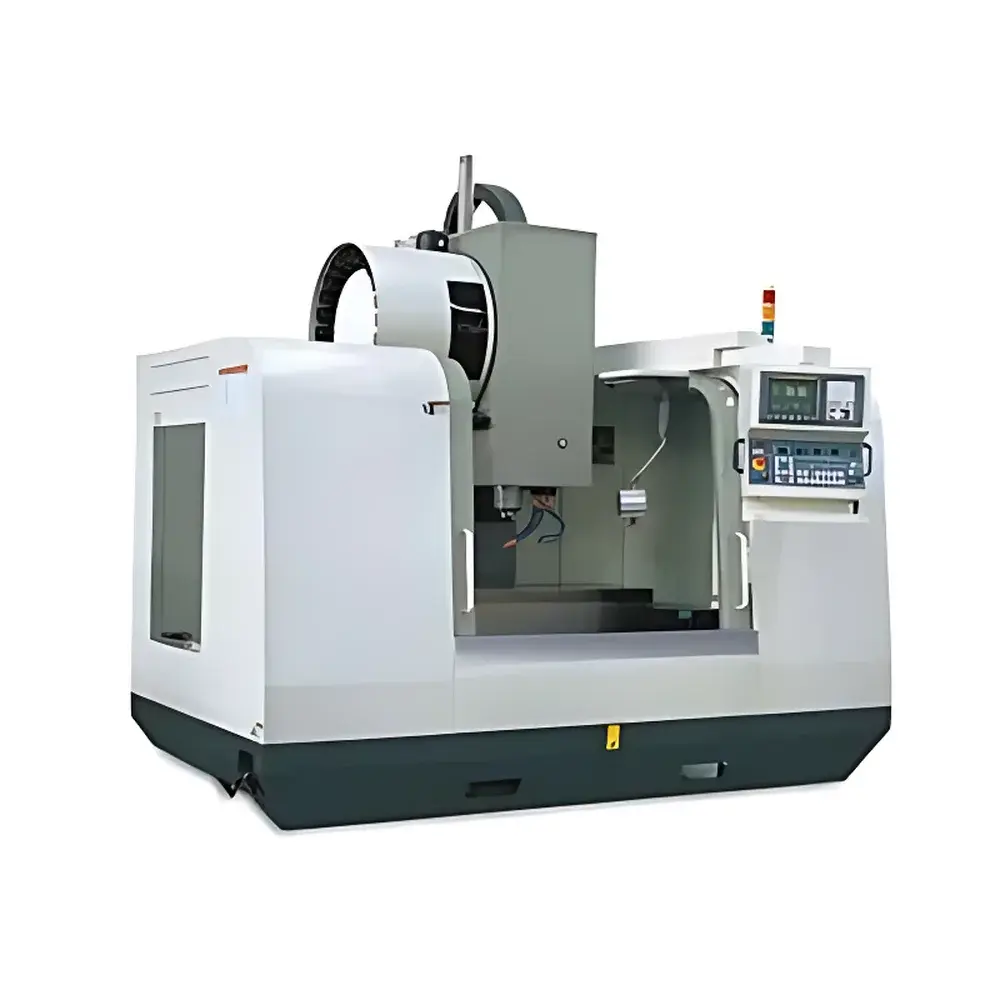
Hefei Kejing Sapphire Rod Extraction Machine
| Brand | Hefei Kejing |
|---|---|
| Origin | Anhui, China |
| Manufacturer Type | Authorized Distributor |
| Country of Origin | China |
| Model | Rod Extraction Machine for Sapphire |
| Spindle Motor Power | 7.5 kW |
| Servo Motors (X/Y/Z) | 2.5 kW / 2.5 kW / 2.5 kW |
| X-Axis Travel | 1020 mm |
| Y-Axis Travel | 510 mm |
| Z-Axis Travel | 635 mm |
| Spindle Nose to Table Distance | 100–735 mm |
| Table Size | 1220 mm × 520 mm |
| T-Slot Specification | 18 mm × 5 slots × 100 mm pitch |
| Maximum Load Capacity | 800 kg |
| Rapid Traverse Rates (X/Y/Z) | 20 / 20 / 18 m/min |
| Machine Dimensions | 2880 mm × 2540 mm × 2756 mm |
| Footprint | 4500 mm × 3000 mm |
| Net Weight | 6000 kg |
| Cutting Speed | 3–5 mm/min (sapphire-specific) |
| Compatible Tool Length | up to 360 mm |
Overview
The Hefei Kejing Sapphire Rod Extraction Machine is a precision CNC-based material removal system engineered specifically for the controlled extraction of cylindrical sapphire rods from bulk boules. Unlike general-purpose lathes or grinding systems, this machine implements a fixed-axis rotational cutting strategy combined with synchronized linear feed motion—optimized for the extreme hardness (Mohs 9), low thermal conductivity, and anisotropic fracture behavior of single-crystal sapphire (Al2O3). Its mechanical architecture is designed to minimize vibration-induced microcracking during rod separation, ensuring high yield rates and dimensional integrity required for LED substrate manufacturing. The system operates within a closed-loop coolant delivery framework to manage localized heat generation and suppress abrasive wear on diamond-impregnated tooling. It is not a furnace or thermal processing device; rather, it functions as a dedicated cold-machining platform positioned upstream of slicing, lapping, and polishing in the sapphire wafer fabrication workflow.
Key Features
- High-rigidity cast-iron base and column structure with finite-element-optimized ribbing to dampen resonant frequencies during high-force sapphire machining.
- Integrated high-pressure coolant system delivering ≥8 bar flow at the cutting zone, enabling effective chip evacuation and thermal mitigation without compromising crystal lattice stability.
- Three-axis servo-driven motion control (X/Y/Z) with absolute encoders and real-time position feedback, supporting repeatable positioning accuracy ≤±5 µm over full travel range.
- Sapphire-optimized spindle configuration featuring variable-speed AC vector drive, delivering torque-rich low-RPM operation (typically 100–600 rpm) aligned with diamond tool engagement requirements.
- Dedicated tool-holding interface accommodating custom-length sapphire-cutting tools up to 360 mm, with hydraulic clamping force calibrated to prevent tool slippage under radial cutting loads exceeding 12 kN.
- Reinforced worktable with five T-slots (18 mm wide, spaced at 100 mm intervals) rated for static loads up to 800 kg, compatible with vacuum chucks and mechanical fixturing for boule stabilization.
Sample Compatibility & Compliance
The machine processes monolithic sapphire boules ranging from 100 mm to 200 mm in diameter and up to 450 mm in length. It accommodates both c-plane and r-plane oriented crystals, with programmable feed strategies accounting for crystallographic anisotropy. All structural components comply with ISO 230-2 (machine tool testing – positional accuracy) and ISO 10791-1 (test conditions for machining centers). Electrical safety conforms to IEC 60204-1. While not certified for cleanroom use out-of-the-box, the coolant containment design meets ISO 14644-1 Class 8 particulate limits when operated with filtered recirculating fluid. No direct regulatory certification (e.g., FDA, CE Machinery Directive Annex I) is claimed; users are responsible for validating process compliance per internal quality management systems (e.g., ISO 9001, IATF 16949) and customer-specific technical agreements.
Software & Data Management
Control is executed via an industrial-grade CNC controller running proprietary G-code interpreter firmware optimized for sapphire material removal algorithms. The interface supports offline program editing, tool offset management, and cycle time estimation based on boule geometry and tool wear compensation tables. All operational parameters—including spindle load, axis current draw, coolant pressure, and emergency stop events—are logged with timestamped entries in non-volatile memory. Data export is available in CSV format via USB or Ethernet; no cloud connectivity or remote access functionality is embedded. Audit trail capabilities meet basic GLP documentation requirements, though full 21 CFR Part 11 compliance requires third-party validation of user authentication, electronic signature, and data integrity protocols.
Applications
- Primary rod extraction from Czochralski-grown sapphire boules for subsequent wafering into LED substrates (e.g., 2-inch, 4-inch, 6-inch wafers).
- Preparation of optical-grade sapphire rods for laser host materials, watch crystals, and high-pressure cell windows.
- Manufacture of sapphire tubing blanks via concentric hollow-core extraction (with optional internal support mandrels).
- Research-scale prototyping of doped or composite sapphire geometries where precise core-to-boule ratio control is critical.
- Recycling of off-spec boules by extracting salvageable rod sections prior to repolishing or re-melting.
FAQ
Is this machine classified as a muffle furnace or thermal processing equipment?
No. The Sapphire Rod Extraction Machine is a cold-cutting CNC machine tool. It does not provide heating, annealing, or sintering functions. Its classification falls under precision material removal equipment—not thermal processing devices.
What type of cutting tools are compatible?
Only diamond-impregnated or polycrystalline diamond (PCD) tools with standardized shank geometries (e.g., ISO 7388-1) are recommended. Hefei Kejing supplies application-specific tooling with optimized bond matrix and grit size for sapphire’s Knoop hardness (~2000 kgf/mm²).
Can the machine be integrated into an automated production line?
Yes—via standard digital I/O signals (24 V DC) and Modbus TCP communication. Integration requires external robotic handling for boule loading/unloading and is subject to site-specific safety interlocking per ISO 13857.
Does the system include vibration monitoring or predictive maintenance features?
No. Vibration analysis and tool wear prediction are not built-in. Users may connect third-party accelerometers or acoustic emission sensors to the auxiliary analog input ports for condition monitoring.
What level of operator training is required?
Operators must hold formal CNC machining certification and demonstrate proficiency in sapphire-specific cutting parameter selection (feed rate, depth of cut, coolant flow). Hefei Kejing provides on-site commissioning and basic programming training, but advanced process optimization remains the responsibility of the end-user’s process engineering team.



