
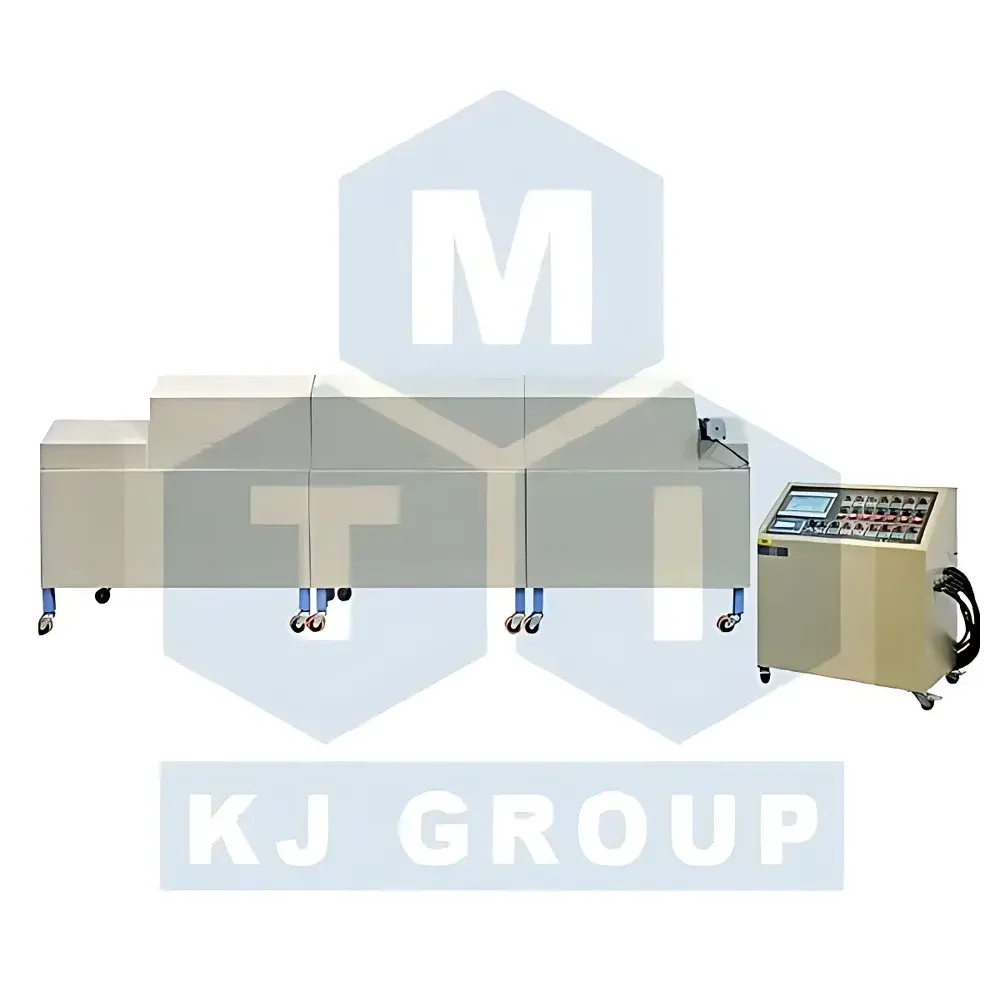
KSL-1200X-BF6 Seven-Zone Belt Conveyor Furnace (900 °C Max, 150 mm Belt Width)
| Brand | Hefei Kejing |
|---|---|
| Origin | Anhui, China |
| Model | KSL-1200X-BF6 |
| Furnace Type | Belt-Type Continuous Muffle Furnace |
| Max Operating Temperature | 900 °C |
| Temperature Uniformity | ±1 °C |
| Total Power Rating | 18 kW |
| Max Ramp Rate | 10 °C/min |
| Heating Element Material | Mo-doped Fe–Cr–Al Alloy (Kanthal® AF-grade equivalent) |
| Internal Chamber Dimensions (Inlet) | 150 mm W × 50 mm H |
| Belt Width | 150 mm |
| Belt Speed Range | 0–100 mm/s |
| Heating Zone Count | 7 × 300 mm zones (2100 mm total heated length) |
| Cooling Zone Length | 300 mm |
| Insulation | High-Purity Al₂O₃ Fiber Modules |
| Shell Construction | Dual-layer steel with forced-air cooling |
| Certified | CE, UL (components >24 V), TÜV/UL/CSA optional |
Overview
The KSL-1200X-BF6 is a precision-engineered seven-zone continuous belt conveyor furnace designed for controlled thermal processing of thin-film, electronic, photovoltaic, and ceramic substrates under reproducible atmospheric conditions. Unlike batch-type muffle furnaces, this system implements a true horizontal convection-driven thermal profile across seven independently regulated heating zones—each thermally isolated by high-purity alumina fiber baffles—to enable precise thermal ramping, soaking, and controlled cooling in a single pass. The furnace operates on the principle of dynamic thermal equilibrium: samples mounted on a ceramic-rod-supported stainless-steel mesh belt traverse sequentially through pre-programmed temperature gradients, ensuring consistent dwell time per zone (adjustable via belt speed). Its maximum continuous operating temperature of 900 °C is sustained using Mo-doped Fe–Cr–Al resistance heating elements (commercially equivalent to Kanthal® AF), selected for oxidation resistance and long-term stability at elevated temperatures in air or inert atmospheres. The dual thermocouple architecture—separate control and monitoring sensors per zone—supports closed-loop PID regulation compliant with ISO/IEC 17025 traceability requirements for thermal validation.
Key Features
- Seven independent heating zones (300 mm each), totaling 2100 mm of controllable thermal length, with individual PID controllers and dual K-type thermocouples (7 for control, 8 for monitoring)
- High-stability Mo-doped Fe–Cr–Al alloy heating elements rated for >5000 h service life at 900 °C in ambient air
- Alumina fiber insulation (≥99.5% Al₂O₃) with low thermal conductivity (<0.12 W/m·K at 800 °C) and zero outgassing below 1100 °C
- Forced-air-cooled double-wall steel enclosure maintaining external surface temperature <70 °C during full-power operation
- Integrated 300 mm forced-air cooling section downstream of the final heating zone for rapid quenching or controlled cooldown
- Touchscreen HMI (10.1″ color LCD) supporting multi-step thermal profiles, real-time zone-by-zone temperature logging, and password-protected parameter locking
- Ceramic rod–driven belt transport system (150 mm width × 10 mm thickness × 6200 mm length) accommodating substrates up to 150 mm wide × 25 mm thick
- Compliance-ready architecture: all electrical components >24 V UL-listed; CE-marked per EN 61000-6-4 (EMC) and EN 61000-6-2 (immunity); optional TÜV/UL/CSA certification support
Sample Compatibility & Compliance
The KSL-1200X-BF6 accommodates rigid and semi-flexible planar substrates including silicon wafers, glass slides, metal foils (Cu, Ni, Ti), ceramic tapes (Al₂O₃, ZrO₂), and polymer-coated films—provided dimensional constraints (≤150 mm width, ≤25 mm thickness, ≤50 mm inlet height) are observed. Its open-belt geometry eliminates cross-contamination risks associated with crucibles or boats and enables direct integration into inline manufacturing lines for photovoltaic metallization, MLCC binder burnout, or thin-film annealing. From a regulatory standpoint, the furnace meets baseline requirements for GLP-compliant thermal validation when paired with external data loggers and calibrated reference thermocouples. Its modular design supports optional gas purging (N₂, Ar, forming gas) and exhaust ducting to meet OSHA PEL and ISO 14644-1 cleanroom interface specifications. All thermal profiles are exportable in CSV format for audit trails aligned with FDA 21 CFR Part 11 electronic record requirements.
Software & Data Management
Control and monitoring are managed via an embedded industrial touchscreen HMI running deterministic real-time firmware. Users define up to 20 multi-segment thermal programs per zone—including ramp rates (0.1–10 °C/min), soak durations (1 s–99 h), and cooling slopes—with inter-zone delay offsets. System logs timestamped temperature data at 1 Hz resolution per thermocouple channel, stored internally for ≥30 days or streamed via Ethernet to a host PC. Data export supports .csv and .xlsx formats with metadata headers (date, operator ID, program name, zone IDs). Optional OPC UA server module enables integration with SCADA systems (e.g., Ignition, Siemens WinCC) and LIMS platforms. Audit trail functionality records all parameter changes, login/logout events, and emergency stop activations with immutable timestamps—meeting ALCOA+ principles for data integrity in regulated environments.
Applications
- Photovoltaic cell manufacturing: front-side Ag paste firing, back-surface field (BSF) formation, and passivation layer annealing
- Electronic component processing: MLCC (multilayer ceramic capacitor) binder removal, Ni/Cu electrode sintering, and thick-film resistor curing
- Ceramic and powder metallurgy: green body debinding, oxide reduction, and solid-state reaction synthesis (e.g., LiCoO₂ cathode calcination)
- Thin-film device fabrication: ITO, AZO, and perovskite layer crystallization; graphene CVD post-annealing
- Rapid thermal processing (RTP) simulation: controlled dwell-time studies for diffusion kinetics, phase transformation, and grain growth analysis
- Materials research: carbonization of polymer precursors, catalytic support activation, and gas–solid redox reactions under flowing atmospheres
FAQ
What atmosphere options are supported?
The standard configuration operates in ambient air; optional quartz tube enclosures or flanged inlet/outlet ports allow N₂, Ar, H₂/N₂ mixtures, or vacuum-compatible operation (down to 10⁻² mbar with auxiliary pumping).
Can the belt speed be synchronized with external equipment?
Yes—via 0–10 V analog input or Modbus RTU over RS-485, enabling lockstep coordination with upstream coating stations or downstream inspection modules.
Is temperature uniformity validated across the belt width?
Yes—per ASTM E220, uniformity mapping is performed at 900 °C using a 3×3 thermocouple grid; typical deviation is ±1.2 °C across the 150 mm active width.
What maintenance intervals are recommended for heating elements and insulation?
Heating elements require no scheduled replacement under normal use but should be visually inspected quarterly; alumina fiber insulation retains structural integrity for ≥3 years at 900 °C continuous duty.
Does the system support remote diagnostics?
With optional Ethernet/WiFi module, engineers can perform firmware updates, retrieve error logs, and verify sensor health remotely—subject to network security policies.



