
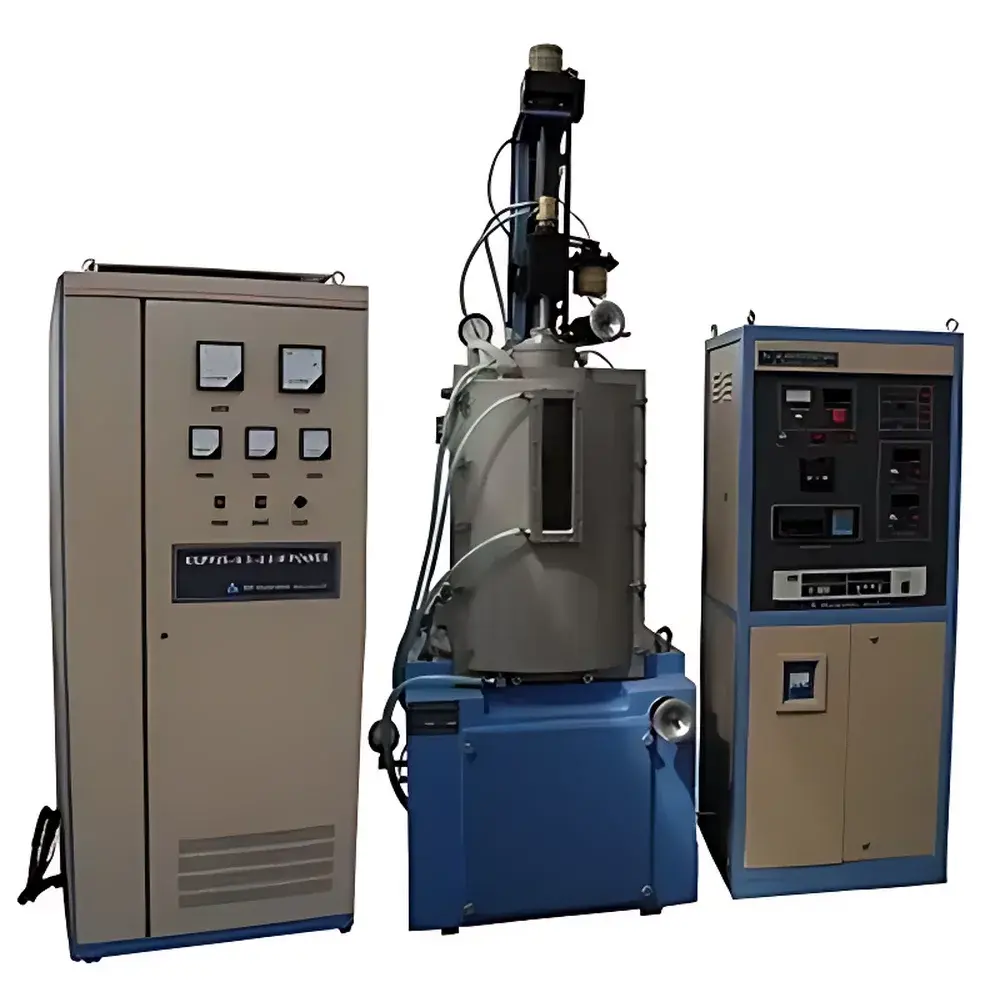
KMT SKJ-50 Mid-Frequency Induction Crystal Growth Furnace for Czochralski Oxide Single-Crystal Synthesis
| Brand | KMT (Hefei Kejing) |
|---|---|
| Model | SKJ-50 |
| Maximum Operating Temperature | 2100 °C |
| Vacuum Chamber Dimensions | 50 cm (dia.) × 70 cm (H) |
| Base Vacuum (Mechanical Pump) | ≤10⁻³ Torr |
| Ultimate Vacuum (Diffusion Pump, optional) | ≤10⁻⁶ Torr |
| Pulling Speed Range | 0.1–10 mm/h |
| Rotation Speed Range | 0–40 RPM |
| Induction Power Supply | 25 kW, 0.2–20 kHz |
| Temperature Control Accuracy | ±0.2 °C (Eurotherm Controller) |
| Crucible Cooling | Water-cooled copper coil |
| Cooling Water Requirement | 0.13–0.18 MPa pressure, 60 L/min flow rate |
| Power Input | 3-phase AC 380 V, 100 A |
| Overall Footprint (Furnace Body) | 88 L × 125 W × 285 H cm |
Overview
The KMT SKJ-50 Mid-Frequency Induction Crystal Growth Furnace is a purpose-engineered system designed for the controlled Czochralski (Cz) growth of high-melting-point oxide single crystals—including YAG (Y₃Al₅O₁₂), LSAT (La₀.₃Sr₀.₇Al₀.₆₅Ta₀.₃₅O₃), SrLaAlO₄, and LaAlO₃. Unlike conventional resistance-heated furnaces, this system employs a water-cooled, mid-frequency (0.2–20 kHz) induction power supply delivering 25 kW to generate highly localized, stable thermal gradients within refractory crucibles—enabling precise melt interface control and minimizing thermal stress during crystal solidification. The furnace operates under high-vacuum or inert-gas-purged conditions, mitigating oxidation and volatile loss during extended growth cycles. Its modular architecture integrates vacuum handling, real-time diameter monitoring via bottom-mounted electronic load cell, and closed-loop motion control—making it suitable for research-scale development of optoelectronic, laser, and quantum materials where crystal perfection, stoichiometric fidelity, and reproducible lattice orientation are critical.
Key Features
- Mid-frequency induction heating (25 kW, 0.2–20 kHz) ensures rapid thermal response, uniform axial temperature distribution, and minimal crucible wall interaction—critical for growing crack-free, low-dislocation-density oxides.
- High-stability pulling and rotation mechanisms: DC servo-driven pull rod with 0.1–10 mm/h resolution; precision gearmotor for 0–40 RPM crystal rotation—both synchronized with temperature ramp profiles.
- Vacuum processing chamber (50 cm diameter × 70 cm height) compatible with mechanical pumping (≤10⁻³ Torr) and optional diffusion pumping (≤10⁻⁶ Torr), supporting both oxide melt stabilization and post-growth annealing under ultra-low partial pressure.
- Eurotherm 3500-series temperature controller with dual thermocouple inputs (W/Re-3/25 or PtRh/Pt) delivers ±0.2 °C setpoint stability over 2000+ hours—validated per ASTM E220 calibration protocols.
- Integrated bottom-load electronic balance (0.1 g resolution) enables real-time mass feedback for adaptive diameter control algorithms—essential for maintaining constant cross-sectional area during slow-pull regimes.
- Full water-cooling circuit (60 L/min @ 0.13–0.18 MPa) protects induction coil, crucible holder, and viewport seals; all cooling interfaces conform to ISO 8502-2 leak integrity standards.
Sample Compatibility & Compliance
The SKJ-50 supports growth of single-crystal oxides with melting points up to 2100 °C using Ir, Pt, or W crucibles (Ir crucibles available as optional accessories). It complies with ISO 14001 environmental management requirements for energy-efficient operation and zero process emissions under standard operating conditions. All electrical enclosures meet IEC 61000-6-4 electromagnetic compatibility standards; safety interlocks satisfy IEC 61508 SIL2 functional safety criteria. The system design adheres to OHSAS 18001 occupational health guidelines—featuring sealed vacuum lines, redundant overtemperature cutoffs, and ergonomic control cabinet layout (EN 614-1). No hazardous substances are used in construction per RoHS Directive 2011/65/EU.
Software & Data Management
Growth parameters—including temperature, pull rate, rotation speed, vacuum level, and real-time mass—are logged at 1 Hz via an embedded industrial PC running Windows IoT Enterprise. Data export is supported in CSV and HDF5 formats, compatible with MATLAB, Python (Pandas), and LabVIEW-based analysis pipelines. The control interface provides configurable alarm thresholds, audit trails with user login authentication, and timestamped event logs—meeting GLP/GMP documentation requirements per FDA 21 CFR Part 11 when deployed with validated electronic signature modules. Remote diagnostics via Ethernet/IP are enabled without compromising firewall security.
Applications
- Growth of laser host crystals (e.g., Nd:YAG, Yb:YAG) for solid-state and ultrafast amplifier systems.
- Development of lattice-matched substrates (LSAT, LaAlO₃) for epitaxial thin-film deposition in oxide electronics.
- Production of high-purity scintillator crystals (LuAG, Gd₃Ga₅O₁₂) for radiation detection and medical imaging.
- Thermophysical property studies requiring stoichiometrically homogeneous bulk samples—e.g., thermal expansion coefficient mapping via dilatometry or Brillouin scattering.
- Process qualification for transition from lab-scale synthesis to pilot-line crystal production under ISO/IEC 17025-accredited environments.
FAQ
What crucible materials are compatible with the SKJ-50 at 2100 °C?
Iridium (Ir) crucibles are recommended for oxide melts above 1900 °C due to their high melting point (2446 °C) and chemical inertness toward Al-, La-, and Y-based oxides. Tungsten and molybdenum crucibles may be used for lower-temperature oxide systems but require strict oxygen partial pressure control.
Can the system operate under inert gas instead of vacuum?
Yes—the chamber includes dual-mode gas inlet ports and pressure regulation (0.1–1 bar absolute), enabling Ar or N₂ purging for oxide systems prone to reduction or decomposition under vacuum.
Is the Eurotherm controller compliant with FDA 21 CFR Part 11 for regulated labs?
The base controller supports audit trail logging; full Part 11 compliance requires installation of KMT’s validated software package with electronic signatures, role-based access control, and data backup verification—available upon request.
What maintenance intervals are recommended for the induction power supply?
Coolant filter replacement every 6 months; capacitor bank inspection annually; and full IGBT module thermal cycling validation every 2 years—per KMT Technical Bulletin TB-SKJ-50-MNT-2023.
Does the system support automated diameter control using the load cell signal?
Yes—closed-loop diameter control is implemented via PID tuning of pull speed in response to mass deviation from target growth profile; configuration files are programmable per crystal type and diameter specification.
Related Products



