
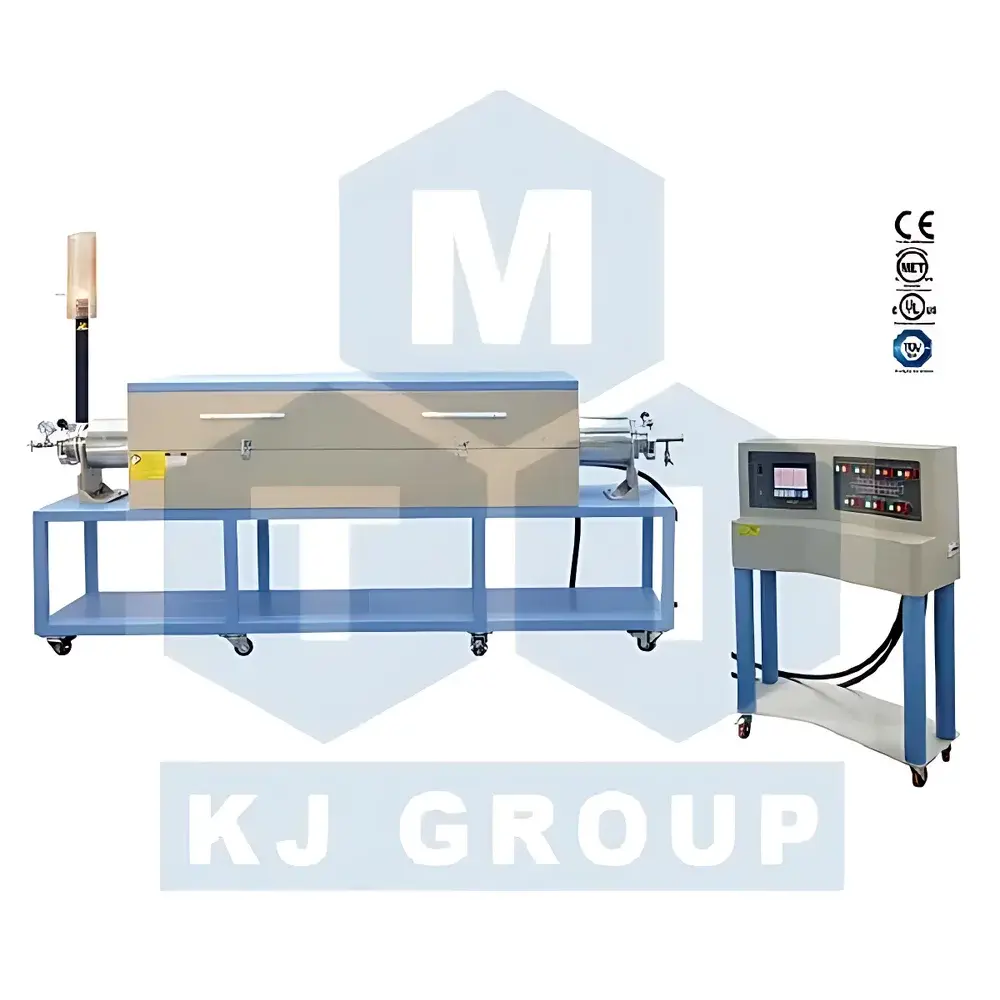
Kojin OTF-1200X-V-H4 Hydrogen-Compatible Vertical Tube Furnace
| Brand | Kojin |
|---|---|
| Origin | Anhui, China |
| Model | OTF-1200X-V-H4 |
| Instrument Type | Horizontal Tube Furnace |
| Max Temperature | 1000 °C |
| Temperature Uniformity | ±5 °C over 600 mm (isothermal zone) |
| Control Accuracy | ±1 °C |
| Heating Rate | ≤10 °C/min (to max temp) |
| Power Supply | AC 208–240 V, 1-phase, 50/60 Hz |
| Max Power | 10 kW |
| Heating Elements | Mo-doped Fe-Cr-Al alloy |
| Insulation | High-purity alumina fiber with high-temp alumina coating |
| Chamber Dimensions | Ø100 mm ID × 1500 mm L (SS310 stainless steel tube) |
| Tube Wall Thickness | 7.5 mm (OD 115 mm) |
| Pressure Rating | 4 MPa @ ≤500 °C, 2.7 MPa @ ≤700 °C, 0.6 MPa @ ≤800 °C, 0.3 MPa @ ≤900 °C, 0.1 MPa @ ≤1000 °C |
| Zone Configuration | 5 independent heating zones (200 mm each, total heated length 1000 mm) |
| Cooling | Dual-layer air-cooled shell (surface temp <60 °C) |
| Safety Systems | Integrated 3M hydrogen sensor, automatic dual-valve shutoff, UV-verified hydrogen flame ignition & extinction detection, over-temperature & thermocouple-failure protection |
| Vacuum & Gas Handling | Dual mass flow controllers (N₂ & H₂, 0–3.5 L/min), CF flanges with oxygen-free copper gaskets, optional vacuum pump and rotating tube mechanism |
| Compliance | CE-marked |
| Dimensions (W×D×H) | 500 × 2000 × 950 mm |
| Weight | 500 kg |
| Warranty | 12 months (excludes consumables: tube, seals, heating elements) |
Overview
The Kojin OTF-1200X-V-H4 is a vertically oriented, hydrogen-compatible tube furnace engineered for controlled thermal processing under reactive gas atmospheres—specifically optimized for hydrogen decrepitation (HD) of rare-earth permanent magnets and high-purity annealing of functional materials in H₂ or forming gas environments. Its design adheres to fundamental principles of conductive and radiative heat transfer within sealed metallic reaction vessels, enabling precise thermal profiling across extended axial lengths. Unlike standard muffle furnaces, this system integrates pressure-rated SS310 tubing, multi-zone resistive heating, real-time gas safety interlocks, and certified instrumentation to meet the stringent operational and regulatory requirements of advanced materials synthesis labs. The furnace operates within defined pressure–temperature envelopes validated per ASME BPVC Section VIII Division 1 guidelines for thin-walled cylindrical pressure components, ensuring mechanical integrity during hydrogen exposure up to 4 MPa at 500 °C.
Key Features
- Five independently controlled heating zones (200 mm each), delivering programmable axial thermal gradients and uniform isothermal zones of 600 mm (±5 °C) for reproducible material homogenization or step-gradient treatments.
- High-integrity SS310 furnace tube (Ø100 mm ID × 1500 mm L, 7.5 mm wall thickness) rated for sustained operation up to 900 °C continuous and 1000 °C short-term (<1 h), with documented pressure–temperature derating curves for safe H₂ service.
- Dual-stage gas safety architecture: (1) Real-time monitoring via integrated 3M hydrogen sensor (detection threshold ≤1% LEL); (2) Fail-safe solenoid valve shutdown + UV-flame verification of post-reactor H₂ combustion at exhaust, preventing accumulation in fume hoods or lab spaces.
- Industrial-grade temperature control system featuring 30-segment ramp-soak programs per zone, K-type armored thermocouples, RS485 communication for data logging, and hardware-level over-temperature and open-couple protection per IEC 61508 SIL1 requirements.
- Air-cooled double-shell enclosure maintains external surface temperature below 60 °C under full load, eliminating need for water cooling while supporting Class 1000 cleanroom-compatible installation.
Sample Compatibility & Compliance
The OTF-1200X-V-H4 accommodates cylindrical samples up to Ø95 mm × 1400 mm in length, compatible with powder metallurgy compacts, sintered NdFeB billets, Ti-based alloys, and transition metal hydride precursors. Its SS310 tube resists hydrogen embrittlement better than standard 316 stainless and exhibits low catalytic activity toward H₂ dissociation—critical for minimizing unintended surface reactions during HD processing. All electrical subsystems comply with UL 61010-1, CSA C22.2 No. 61010-1, and EN 61010-1, with CE marking affixed per EU Machinery Directive 2006/42/EC and Electromagnetic Compatibility Directive 2014/30/EU. Optional TÜV-certified validation packages support GLP-compliant documentation for ISO/IEC 17025-accredited laboratories.
Software & Data Management
The touch-enabled control panel supports local operation without PC dependency, yet provides native RS485 Modbus RTU interface for integration into centralized lab management systems (e.g., LabWare LIMS, Siemens Desigo). Temperature profiles, gas flow rates, and alarm events are timestamped and exportable as CSV files. Audit trails include operator ID (via optional RFID login), parameter change history, and safety event logs—including valve actuation timestamps and sensor fault codes—fully compliant with FDA 21 CFR Part 11 requirements when paired with validated electronic signature modules. Firmware updates are performed via USB without interrupting operational firmware partitions.
Applications
- Hydrogen decrepitation of NdFeB and SmCo magnet alloys for subsequent jet milling and re-sintering.
- Controlled hydriding/dehydriding cycling of Mg-based hydrogen storage materials (e.g., MgH₂, Mg₂NiH₄).
- Reducing anneals of oxide ceramics (e.g., YBCO, LCO) under low-oxygen partial pressures.
- Thermal stabilization of battery cathode precursors (e.g., Ni-rich NMC) in inert/H₂ mixtures to suppress Li₂CO₃ formation.
- Low-pressure carburizing and nitriding of tool steels using H₂-diluted CH₄/NH₃ feeds.
FAQ
What hydrogen concentration thresholds trigger automatic shutdown?
The integrated 3M sensor initiates valve closure at ≥1% LEL (Lower Explosive Limit), corresponding to ~400 ppm H₂ in air.
Can the furnace be operated under vacuum prior to hydrogen introduction?
Yes—equipped with dual MFCs and CF flanges, it supports base vacuum down to 10⁻² mbar when paired with an optional two-stage rotary vane pump.
Is the SS310 tube suitable for repeated thermal cycling in hydrogen?
SS310 offers superior resistance to hydrogen attack versus 304/316 grades; however, cyclic exposure above 700 °C requires periodic ultrasonic inspection per ASTM E213 for subsurface cracking.
Does the system support remote monitoring via Ethernet or Wi-Fi?
RS485 is standard; Ethernet/Wi-Fi connectivity is available via optional protocol converter (Modbus TCP gateway) with TLS 1.2 encryption.
What maintenance intervals are recommended for safety-critical components?
Hydrogen sensor calibration: every 6 months; copper gaskets: replace per seal cycle (typically 10–15 cycles); thermocouples: verify annually per ASTM E230/E230M.



