
English Product Name
| Brand | Hefei Kejing |
|---|---|
| Origin | Anhui, China |
| Manufacturer Type | Authorized Distributor |
| Country of Origin | China |
| Model | SFM-2 |
| Rated Voltage | AC 220 V |
| Rated Power | 220 W |
| Speed Control | PID Closed-Loop Speed Regulation |
| Drive Mechanism | Nylon Gear Transmission |
| Revolution Speed (Turntable) | 0–100 rpm |
| Rotation Speed (Jar) | 0–300 rpm |
| Dimensions (W×D×H) | 450 × 490 × 530 mm |
| Net Weight | 55 kg |
| Standard Jar Capacity | 4 × 500 mL |
| Jar Materials | Stainless Steel or Nylon |
| Ball Diameters | 6, 10, 12, 15, 20 mm |
| Minimum Final Particle Size | ≤ 0.1 µm (100 nm) |
| Compliance | CE-marked per EN 61000-6-2 / EN 61000-6-4 |
Overview
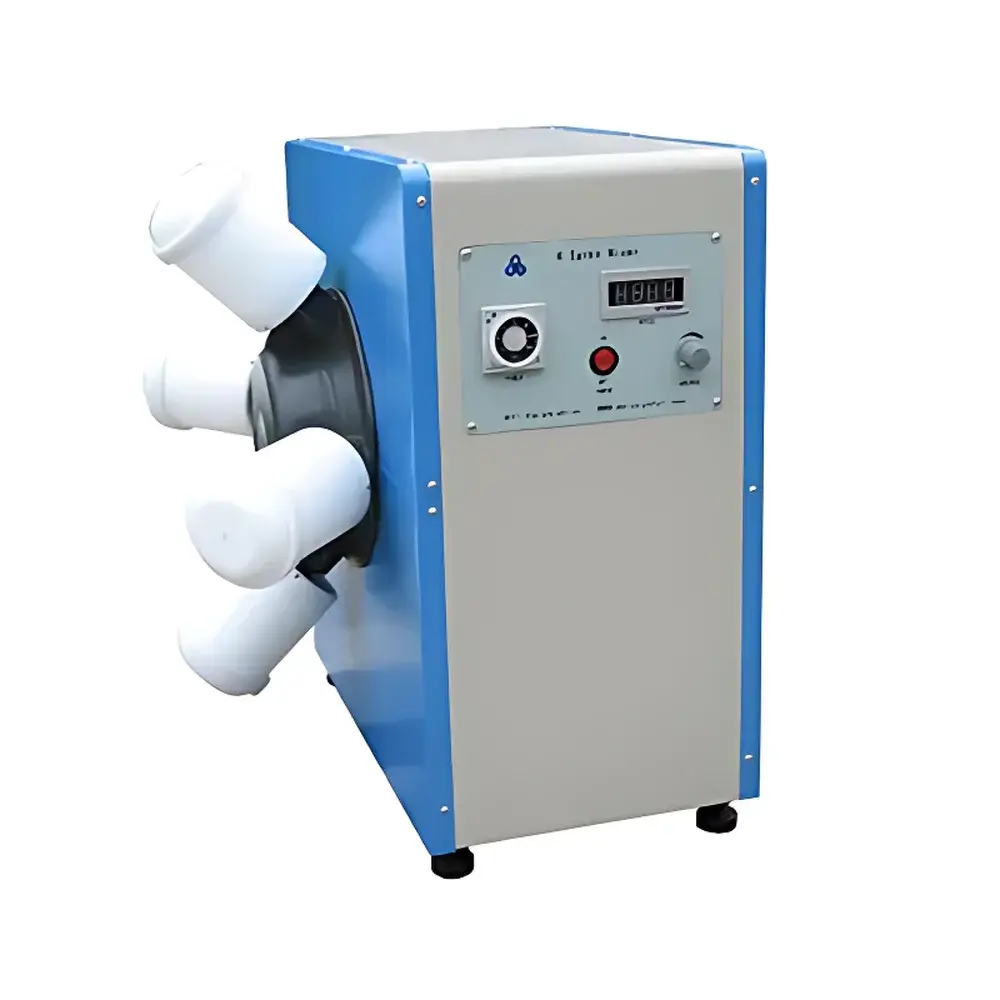
The Hefei Kejing SFM-2 Vertical Planetary Ball Mill is a precision-engineered laboratory-scale milling system based on the Couette-type planetary motion principle. It operates by rotating a central turntable (revolution) while simultaneously driving four sample jars around their own axes (rotation), generating high-energy impact and shear forces between grinding media and material. This dual-axis kinematic configuration ensures homogeneous energy distribution across all jars, enabling reproducible particle size reduction, solid-state alloying, mechanochemical synthesis, and homogenization of powders with disparate densities, hardnesses, or thermal sensitivities. Designed for controlled ambient-temperature operation, the SFM-2 is not a heating or drying device—its mechanical energy input remains decoupled from thermal management, distinguishing it from furnace-integrated or hot-stage milling systems. Its compact footprint and sealed jar architecture make it suitable for inert-atmosphere processing when used with gas-purged or vacuum-compatible jars (optional).
Key Features
- Four-jar simultaneous operation enables parallel sample processing—ideal for comparative studies, parameter screening, or replicate preparation under identical mechanical conditions.
- PID closed-loop speed regulation ensures stable rotational velocity across the full range (0–100 rpm for turntable; 0–300 rpm for jars), minimizing speed drift during extended runs (>8 h) and supporting method transfer between instruments.
- Nylon gear transmission eliminates metal-on-metal contact, reducing operational noise (<65 dB(A)) and eliminating metallic contamination risks in sensitive applications such as battery cathode precursor synthesis or pharmaceutical co-grinding.
- Modular jar mounting system accommodates standardized 500 mL and 1000 mL vessels in stainless steel (AISI 304/316L) or chemically inert nylon—enabling compatibility with corrosive, abrasive, or moisture-sensitive materials.
- Interlocked safety cover with position-sensing switch halts rotation immediately upon lid opening, meeting IEC 61000-6-2 immunity requirements for laboratory electromagnetic environments.
Sample Compatibility & Compliance
The SFM-2 supports both dry and wet milling protocols using solvents including ethanol, isopropanol, toluene, and N-methyl-2-pyrrolidone (NMP). It is routinely employed for processing ceramics (Al2O3, ZrO2), battery materials (LiCoO2, Si anodes), catalysts (Pt/C, MOFs), polymers, and geological samples (silicates, carbonates). All standard components comply with RoHS Directive 2011/65/EU. The instrument meets CE marking requirements under the EMC Directive 2014/30/EU and Low Voltage Directive 2014/35/EU. While not intrinsically rated for Class I Division 1 hazardous locations, optional explosion-proof motor kits are available for ATEX Zone 22 compliance upon request. Documentation includes traceable calibration certificates for speed verification (NIST-traceable tachometer) and mechanical stability testing reports.
Software & Data Management
The SFM-2 operates via front-panel digital interface with non-volatile memory storing up to 10 user-defined programs (time, revolution speed, rotation speed, direction reversal intervals). No proprietary software is required; however, optional RS-485 communication port enables integration into LabVantage or Thermo Fisher SampleManager LIMS environments via Modbus RTU protocol. Audit trails—including start/stop timestamps, speed setpoints, and emergency stop events—are logged internally and exportable as CSV files. For GLP/GMP-regulated workflows, optional 21 CFR Part 11-compliant firmware upgrade provides electronic signatures, role-based access control, and immutable operation logs—validated per ASTM E2500-13 guidelines for analytical instrument qualification.
Applications
- Preparation of nanoscale ceramic precursors for sintering studies (e.g., Y2O3-stabilized ZrO2 powders with D50 < 200 nm).
- Mechanochemical synthesis of metal–organic frameworks (MOFs) without solvents—demonstrated for Cu-BTC and Ni-MOF-74 formation in < 30 min.
- Homogenization of multi-component cathode blends (NMC811 + Li3PO4 + carbon black) prior to slurry casting in lithium-ion battery R&D.
- Particle size reduction of pharmaceutical APIs for dissolution rate enhancement—validated per USP for oral solid dosage form development.
- Mineralogical sample preparation for XRD and SEM-EDS analysis, maintaining phase integrity without thermal degradation.
FAQ
Can the SFM-2 operate under inert gas or vacuum?
Yes—when equipped with gas-tight or vacuum-rated jars (stainless steel with O-ring seals), the system supports argon/nitrogen purging or low-vacuum (<10 mbar) operation. Custom sealing kits are available.
What is the maximum recommended continuous run time?
For optimal bearing longevity and thermal stability, continuous operation is limited to 8 hours per cycle. Intermittent duty (e.g., 30 min on / 10 min off) extends service life and maintains ≤40 °C jar surface temperature.
Is speed synchronization between revolution and rotation programmable?
No—the gear ratio is fixed at 1:3 (turntable : jar), ensuring consistent centrifugal force profiles. This mechanical coupling guarantees reproducibility without software dependency.
How is jar loading volume optimized for efficiency?
Recommended fill level is 30–50% of jar internal volume with grinding media (ball-to-powder mass ratio typically 10:1 to 20:1). Overfilling reduces impact energy; underfilling increases wear without improving throughput.
Does Kejing provide IQ/OQ documentation for GMP labs?
Yes—factory-issued Installation Qualification (IQ) and Operational Qualification (OQ) protocols compliant with ISO/IEC 17025 and ASTM E2500-13 are available upon order confirmation, including test scripts, acceptance criteria, and raw data templates.



