
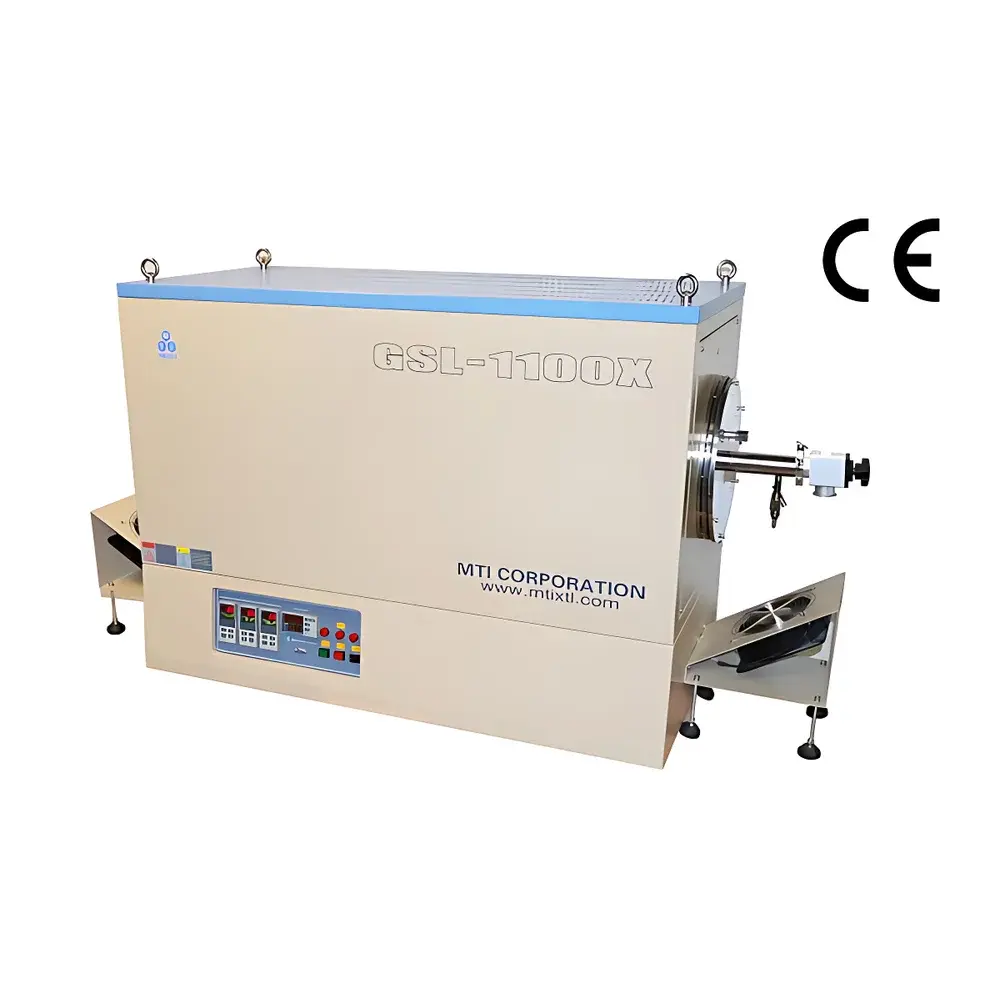
KEJING GSL-1100X-11-III Triple-Zone Tube Furnace with 11-inch Diameter Quartz Tube and CE Certification
| Brand | KEJING |
|---|---|
| Origin | Anhui, China |
| Model | GSL-1100X-11-III |
| Max Operating Temperature | 1100 °C (short-term), 1000 °C (continuous) |
| Continuous Operating Range | 200–1000 °C |
| Heating Rate | Up to 10 °C/min |
| Cooling Rate | Up to 10 °C/min |
| Tube Dimensions | 279 mm OD × 269 mm ID × 1300 mm L (11″ OD × 10.6″ ID × 51″ L) |
| Total Heating Zone Length | 900 mm (36″) |
| Each Zone | 300 mm |
| Uniform Temperature Zone | 500 mm |
| Temperature Uniformity | ±5 °C (at 1000 °C, three-zone synchronized mode) |
| Control Precision | ±1 °C |
| Thermocouples | Three K-type Omega thermocouples (one per zone) |
| Power Supply | Single-phase 220 V AC, 50/60 Hz |
| Max Power Consumption | 8 kW |
| Vacuum Capability | 10⁻² Torr (with mechanical pump) |
| Net Weight | 200 kg |
| External Dimensions | 1300 L × 680 W × 920 H mm (51″ × 24.5″ × 37″) |
| Certifications | CE, ZL-2011-2-0102249.4 (Chinese Utility Model Patent) |
Overview
The KEJING GSL-1100X-11-III is a precision-engineered triple-zone horizontal tube furnace designed for controlled thermal processing under vacuum or inert/reducing atmospheres. Built around a high-purity fused quartz tube (279 mm OD), it enables uniform, programmable heat treatment across extended sample lengths—critical for solid-state synthesis, annealing, sintering, and precursor decomposition in materials science, catalysis, and battery R&D. Its triple independent heating zones (each 300 mm long, totaling 900 mm of active heating length) allow precise axial thermal gradient control—enabling zone-specific ramp/soak protocols essential for crystal growth, zone refining, and multi-step reaction sequences. The furnace operates up to 1100 °C for short durations and maintains stable continuous operation between 200 °C and 1000 °C, with a certified temperature uniformity of ±5 °C over a 500 mm isothermal region when all zones are synchronized. Structural integrity and operator safety are ensured by a dual-layer steel shell with integrated forced-air cooling, limiting external surface temperature to <70 °C during full-power operation.
Key Features
- Triple independent PID-controlled heating zones, each equipped with a calibrated K-type Omega thermocouple for real-time feedback and closed-loop regulation
- 30-segment programmable temperature profile capability—supporting complex ramp-hold-cool sequences with user-defined rates (up to 10 °C/min) and dwell times
- High-purity α-alumina fiber insulation lining and Mo-doped FeCrAl heating elements for thermal efficiency, longevity, and minimal outgassing
- CE-certified stainless-steel vacuum flanges with silicone O-rings, achieving base pressure ≤10⁻² Torr using standard two-stage rotary vane pumps
- Dual-shell air-cooled enclosure with optimized airflow channels—reducing radiant heat loss and enabling safe benchtop integration in shared lab environments
- Included alumina tube plugs minimize axial heat loss and improve cross-sectional temperature homogeneity; optional quartz plugs available for ultra-clean applications
Sample Compatibility & Compliance
The GSL-1100X-11-III accommodates cylindrical samples up to 269 mm in diameter and 1300 mm in length, supporting bulk powders, pressed pellets, fiber arrays, and coated substrates. Its quartz tube construction ensures chemical inertness toward oxides, carbonates, and halides—making it suitable for Li-ion cathode synthesis (e.g., NMC, LFP), metal oxide thin-film annealing, and ceramic preform densification. All electrical and mechanical design complies with IEC 61000-6-3 (EMC emission limits) and IEC 61000-6-2 (immunity), while CE marking confirms conformity with the EU Machinery Directive 2006/42/EC and Low Voltage Directive 2014/35/EU. The furnace’s thermal architecture supports GLP-compliant process documentation when paired with optional PC-based control software (KEJING TC-Soft v3.x), which logs timestamped temperature data with audit-trail functionality per FDA 21 CFR Part 11 requirements.
Software & Data Management
An optional Windows-compatible control interface (KEJING TC-Soft) enables remote monitoring, real-time graphing of all three zone temperatures, and bidirectional import/export of 30-segment programs via CSV. The software records time-stamped temperature readings at user-selectable intervals (1–60 s), generating traceable .csv and .pdf reports compliant with internal QA protocols. Raw data files include metadata such as operator ID, program name, start/stop timestamps, and system error flags—facilitating root-cause analysis during process validation or regulatory audits. Firmware updates are delivered via USB, ensuring long-term compatibility with evolving laboratory IT infrastructure.
Applications
- Solid-state synthesis of layered oxide cathodes (e.g., LiCoO₂, NMC811) under Ar/H₂ mixtures
- Controlled pyrolysis of MOF-derived carbon frameworks for electrocatalyst support
- Atmosphere-dependent phase transformation studies in perovskite oxides (e.g., La₀.₇Sr₀.₃MnO₃)
- Low-pressure CVD of graphene on Cu foil using CH₄/H₂ precursors
- Thermal calibration of thermocouples and reference materials per ASTM E230/E220
- Pre-sintering of ZrO₂ dental crowns under vacuum to eliminate binder residue
FAQ
What vacuum level can be achieved with the standard configuration?
With the included stainless-steel flanges and silicone O-rings, and using a standard two-stage rotary vane pump, the system reaches ≤10⁻² Torr. For higher vacuum (≤10⁻⁵ Torr), optional turbomolecular pumping and metal-sealed CF flanges are available.
Is the quartz tube included in the base price?
Yes—the furnace ships with one high-purity fused quartz tube (279 mm OD × 269 mm ID × 1300 mm L) and two alumina end plugs. Replacement quartz tubes and quartz end plugs are offered as consumables.
Can the three zones operate at different setpoints simultaneously?
Yes—each zone has independent PID control, allowing simultaneous but distinct temperature profiles (e.g., 800 °C–900 °C–800 °C) to establish axial thermal gradients for zone melting or directional solidification.
Does the furnace support inert gas purging during operation?
Yes—dual gas inlet/outlet ports (¼″ VCR fittings) are provided on both flanges, enabling continuous flow purging with N₂, Ar, or forming gas at regulated pressures up to 0.5 bar gauge.
What maintenance is required for long-term reliability?
Annual inspection of thermocouple calibration, O-ring elasticity, and heating element resistance is recommended. Alumina insulation integrity should be verified visually before high-temperature cycles exceeding 950 °C.
Related Products



