
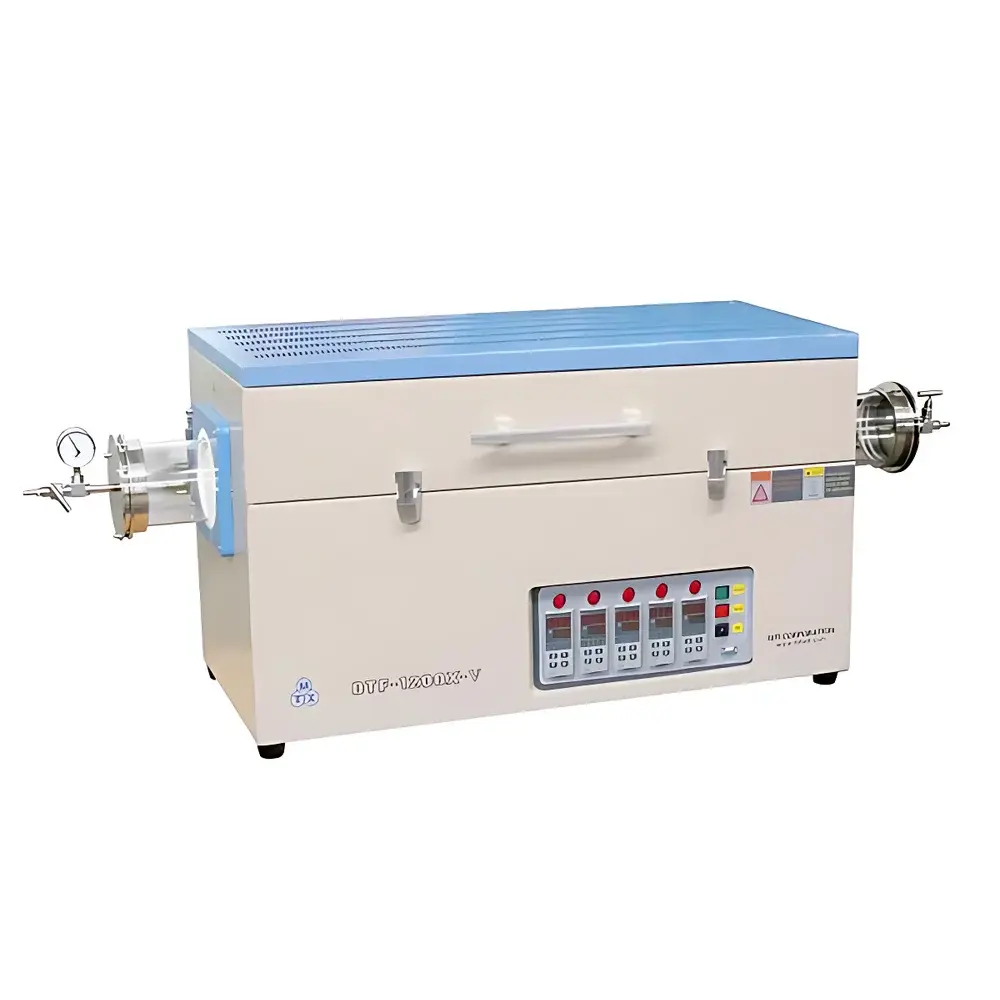
English Product Name
| Brand | KJG |
|---|---|
| Origin | Anhui, China |
| Model | OTF-1200X-V |
| Max Temperature | 1200 °C |
| Continuous Operating Temperature | 1100 °C |
| Temperature Uniformity | ±1 °C |
| Heating Rate (to max temp) | ≤20 °C/min |
| Total Power | 6 kW |
| Input Voltage | AC 208–240 V, 50/60 Hz, Single-Phase (40 A circuit breaker required) |
| Chamber Dimensions | 50 mm OD × 44 mm ID × 1400 mm L (standard) |
| optional quartz tubes | 60/54, 80/74, 100/94 mm OD/ID × 1400 mm L |
| Heating Zones | Five independent 152 mm zones |
| Effective Isothermal Zone | 635 mm (when all zones set to same temperature) |
| Thermocouple Type | K-type Omega-certified |
| Control Method | PID with 30-segment programmable ramp-soak profiles |
| Insulation | High-purity alumina fiber + US-imported high-temp alumina coating |
| Cooling | Dual-layer air-cooled housing (surface temp <60 °C) |
| Certification | CE compliant |
| Warranty | 12 months (excludes consumables: quartz tube, heating elements, silicone O-rings) |
Overview
The KJG OTF-1200X-V is a precision-engineered, CE-certified split-type horizontal tube furnace designed for advanced thermal processing in materials science, catalysis, thin-film synthesis, and solid-state reaction studies. Its defining architecture comprises five physically discrete and electrically isolated heating zones—each independently controlled via dedicated PID temperature regulators—enabling precise spatial thermal profiling across the 1400 mm furnace length. Unlike single-zone or dual-zone furnaces, this configuration supports both multi-gradient thermal environments (e.g., for zone melting, vapor transport, or thermal gradient sintering) and extended uniform-temperature zones up to 635 mm when synchronized. The furnace operates on the principle of resistive Joule heating using Mo-doped Fe-Cr-Al alloy heating elements coated with zirconia for oxidative stability and extended service life at elevated temperatures. Temperature measurement and feedback are performed by calibrated K-type Omega thermocouples embedded directly within each zone’s insulation matrix, ensuring traceable, real-time control with ±1 °C accuracy over the full operating range (room temperature to 1200 °C). The furnace is rated for continuous operation at 1100 °C and features a robust dual-shell mechanical design with forced-air interstitial cooling, limiting external surface temperature to <60 °C under full load—a critical safety and ergonomic requirement for shared laboratory environments.
Key Features
- Five independent 152 mm heating zones with individual PID controllers, supporting fully decoupled thermal programming
- 30-segment programmable temperature profiles per zone—including ramp, soak, hold, and cooling steps—with user-defined rate limits and dwell times
- High-purity fused quartz tube (standard: 50 mm OD × 44 mm ID × 1400 mm L) with optional diameters (60/54, 80/74, 100/94 mm OD/ID), rated for long-term use ≤1100 °C
- Dual-layer stainless steel housing with integrated axial airflow cooling system; surface temperature remains <60 °C during sustained 1200 °C operation
- Alumina-fiber insulated hot zone lined with US-sourced high-emissivity alumina coating—enhancing radiative efficiency and minimizing thermal lag
- Integrated safety protections: over-temperature cutoff, thermocouple break detection (open-circuit alarm), and automatic power shutdown on fault condition
- Modular gas/vacuum interface: standard flange accepts KF25 vacuum adapters, VCR compression fittings, or quartz tube end caps for inert, reducing, or reactive atmospheres
Sample Compatibility & Compliance
The OTF-1200X-V accommodates a broad spectrum of sample geometries and chemistries, including powders, pellets, fibers, thin films on substrates, and crucibles—provided they remain compatible with quartz tube constraints (max 0.02 MPa internal pressure; no vacuum operation above 1000 °C). It complies with IEC 61000-6-3 (EMC emissions) and IEC 61000-6-2 (immunity), and carries full CE marking per Directive 2014/35/EU (Low Voltage Directive) and 2014/30/EU (EMC Directive). While not GLP/GMP certified out-of-the-box, its programmable temperature logging (via optional PC software), audit-trail-capable profile storage, and hardware-based over-temperature interlocks support integration into regulated workflows aligned with ISO/IEC 17025, ASTM E1112, and USP thermal validation frameworks. All electrical components meet RoHS 2 compliance standards.
Software & Data Management
An optional RS485-to-USB interface enables bidirectional communication with Windows-based control software. This application permits remote monitoring of all five zone temperatures in real time, upload/download of 30-segment programs, graphical visualization of thermal profiles, and export of timestamped CSV data logs—including setpoints, actual readings, power output, and alarm status. Data files include metadata such as operator ID, session start/end timestamps, and firmware revision—supporting 21 CFR Part 11–aligned record retention when deployed with institutional IT policies (e.g., network-authenticated login, encrypted local storage, and periodic backup protocols). No cloud connectivity is embedded; all data resides locally unless explicitly exported by the user.
Applications
- Chemical vapor transport (CVT) and physical vapor deposition (PVD) of chalcogenides, oxides, and nitrides
- Controlled-atmosphere annealing of battery cathode precursors (e.g., NMC, LFP) and solid electrolytes
- Thermal reduction of metal oxides under H₂/N₂ mixtures for nanoparticle synthesis
- Multi-step calcination-sintering sequences requiring distinct thermal histories along a single sample length
- Diffusion couple studies and Kirkendall effect investigations using axial thermal gradients
- Calibration and qualification of thermocouples and infrared pyrometers against NIST-traceable reference standards
FAQ
What is the maximum allowable internal pressure inside the quartz tube?
The quartz tube must not exceed 0.02 MPa (2 bar absolute) internal pressure at any time.
Can the furnace operate under vacuum above 1000 °C?
No. Vacuum operation is prohibited above 1000 °C due to quartz devitrification risk and structural weakening; maintain atmospheric or positive-pressure inert gas flow instead.
Is the furnace suitable for hydrogen atmosphere processing?
Yes—when equipped with appropriate gas train components (leak-tested VCR fittings, H₂-rated mass flow controllers, and flashback arrestors) and operated within certified lab infrastructure.
What maintenance intervals are recommended for heating elements and insulation?
Heating elements require visual inspection every 200 operational hours above 1000 °C; alumina fiber insulation should be assessed for cracking or dusting annually or after thermal shock events.
Does the unit include vacuum or gas delivery hardware?
No. Vacuum pumps, gas cylinders, regulators (0.01–0.1 MPa range recommended), and mass flow controllers are sold separately and must be selected based on process chemistry and flow requirements (max 200 sccm recommended inlet flow).



