
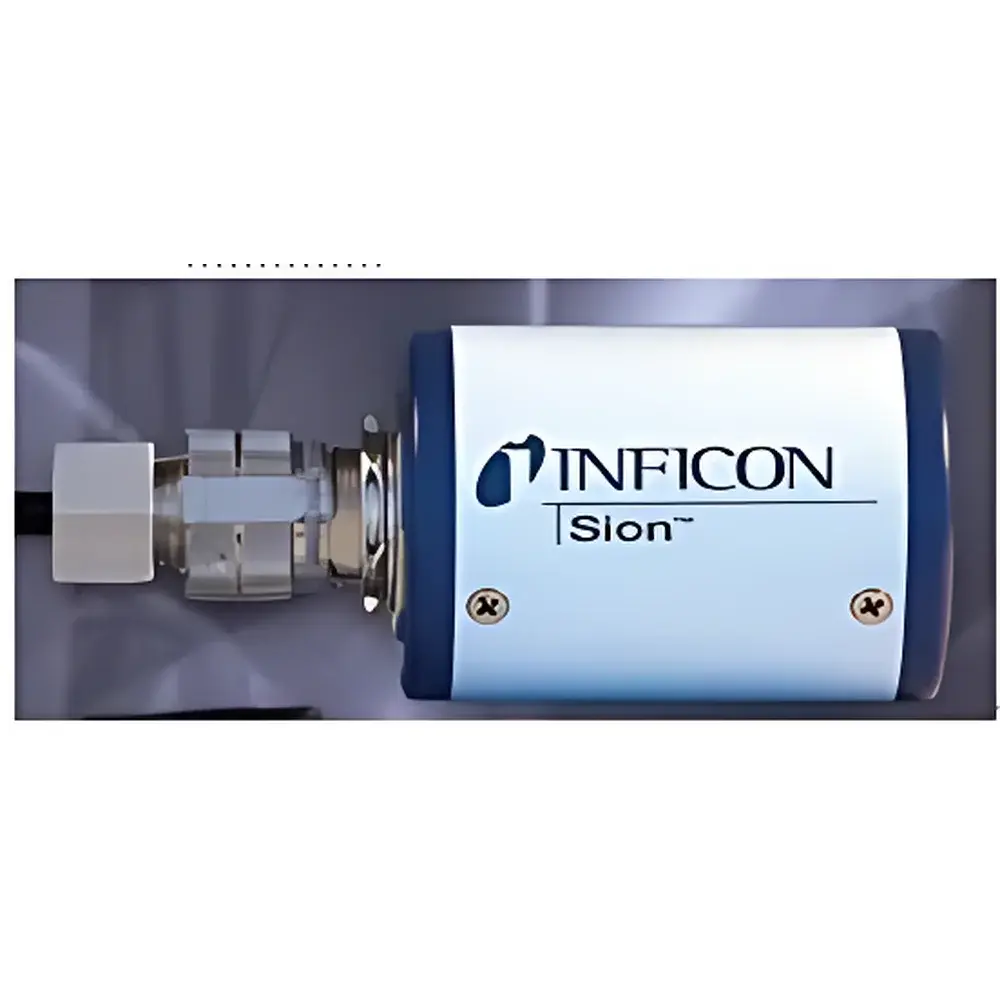
SionTM RF Arc Detector
| Origin | USA |
|---|---|
| Manufacturer Type | Distributor |
| Origin Category | Imported |
| Model | Sion TM RF Detector |
| Pricing | Upon Request |
Overview
The SionTM RF Arc Detector is a high-speed, non-contact diagnostic instrument engineered for real-time monitoring of radio frequency (RF) plasma discharges in vacuum process chambers. Operating on the principle of electromagnetic field coupling, it captures transient voltage and current harmonics induced by arc events—without physical electrode penetration or optical line-of-sight requirements. Unlike optical emission spectroscopy (OES) systems, which rely on spectral line intensity and require calibration against specific species, the SionTM detector responds directly to the electromagnetic signature of plasma instability, enabling robust endpoint detection and arc event localization across diverse PVD, CVD, and reactive ion etching (RIE) processes. Its compact form factor and RF-shielded architecture allow seamless integration into existing semiconductor fabrication tools—including cluster tools and single-wafer platforms—without chamber modification or process interruption.
Key Features
- Non-contact electromagnetic sensing: Measures RF voltage and current transients via near-field coupling, eliminating risk of contamination or arcing at feedthrough points
- Ultra-compact footprint: Designed for space-constrained tool retrofits and OEM integration; mounts externally on RF transmission lines or chamber walls
- High temporal resolution: 20 kHz sampling rate supports sub-millisecond arc event capture and precise endpoint transition identification
- Real-time arc classification: Differentiates between micro-arcs (nanosecond-scale), sustained arcs, and impedance drift—enabling adaptive power control and fault logging
- Process-agnostic signal processing: Configurable trigger thresholds and windowed analysis algorithms accommodate varying RF frequencies (13.56 MHz, 27.12 MHz, 40.68 MHz, 60 MHz) and matching network topologies
- Industrial-grade I/O interface: RS-485 and Ethernet (TCP/IP) outputs support synchronization with tool controllers and SECS/GEM host communication protocols
Sample Compatibility & Compliance
The SionTM RF Detector is compatible with standard 50 Ω RF transmission environments used in semiconductor manufacturing equipment, including capacitively coupled plasma (CCP) and inductively coupled plasma (ICP) sources. It operates reliably under high-vacuum conditions (10−6 Torr typical) and elevated ambient temperatures up to 60 °C near chamber flanges. The device conforms to CE marking requirements for electromagnetic compatibility (EN 61326-1) and industrial safety (EN 61000-6-2/6-4). Data acquisition and alarm logging are structured to support audit readiness per ISO 9001 and SEMI E10 guidelines. While not a standalone safety-critical component, its output signals may be integrated into tool-level interlock logic per SEMI S2/S8 recommendations.
Software & Data Management
The detector interfaces with the optional SionViewTM software suite, a Windows-based application supporting waveform visualization, spectral analysis (FFT), and time-aligned event tagging. All acquired data—including raw voltage/current waveforms, arc count timestamps, and user-defined process markers—are stored in HDF5 format for traceability and post-process correlation with metrology results (e.g., ellipsometry, CD-SEM). Audit trails include operator login, parameter changes, and firmware version stamps—meeting GLP/GMP documentation expectations where required. Export options include CSV, MATLAB (.mat), and XML formats compatible with factory automation systems (MES/AMHS). Firmware updates are delivered via signed packages compliant with NIST SP 800-193 principles for secure device integrity.
Applications
- Plasma etch endpoint detection in SiO2, SiNx, and low-k dielectric patterning—reducing over-etch and improving CD uniformity
- Real-time arc suppression in high-power sputtering (PVD) of Cu, Al, and barrier metals—extending target lifetime and minimizing particle generation
- Plasma stability monitoring during ALD precursor pulsing cycles to detect purge inefficiencies or chamber wall conditioning drift
- Endpoint verification in TFT-LCD and OLED display manufacturing, particularly for ITO and Mo thin-film etch steps
- Root-cause analysis of yield-limiting defects linked to transient plasma anomalies in high-aspect-ratio silicon etch (e.g., Bosch process)
FAQ
Does the SionTM RF Detector require recalibration after installation?
No—factory calibration is retained across operating temperature ranges; however, baseline impedance verification is recommended during initial tool commissioning and after major RF hardware changes.
Can it distinguish between process-related arcs and electrical noise from adjacent tools?
Yes—the detector employs adaptive digital filtering and spatial discrimination logic based on signal rise time, amplitude envelope, and phase coherence relative to the fundamental RF carrier.
Is the device compatible with 2.45 GHz microwave plasma sources?
Not natively; it is optimized for MHz-range RF generators (1–100 MHz); microwave applications require custom sensor coupling design and are evaluated on a case-by-case basis.
How is data synchronized with chamber pressure or gas flow logs?
Via external TTL triggers or timestamp alignment using IEEE 1588 Precision Time Protocol (PTP) when deployed on synchronized industrial Ethernet networks.
What cybersecurity measures are implemented in the Ethernet interface?
Role-based access control, TLS 1.2 encrypted configuration sessions, disabled default credentials, and firmware signing ensure compliance with ISA/IEC 62443-3-3 Level 1 requirements.
Related Products







