
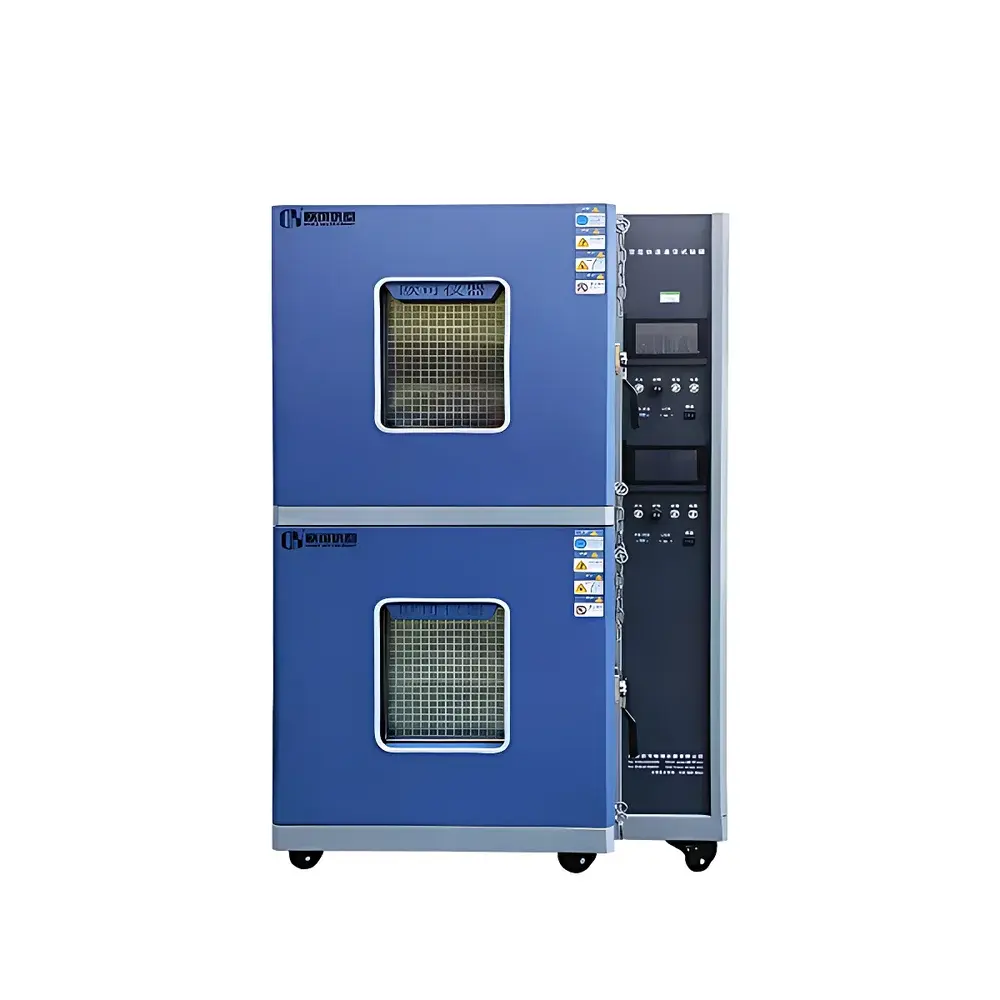
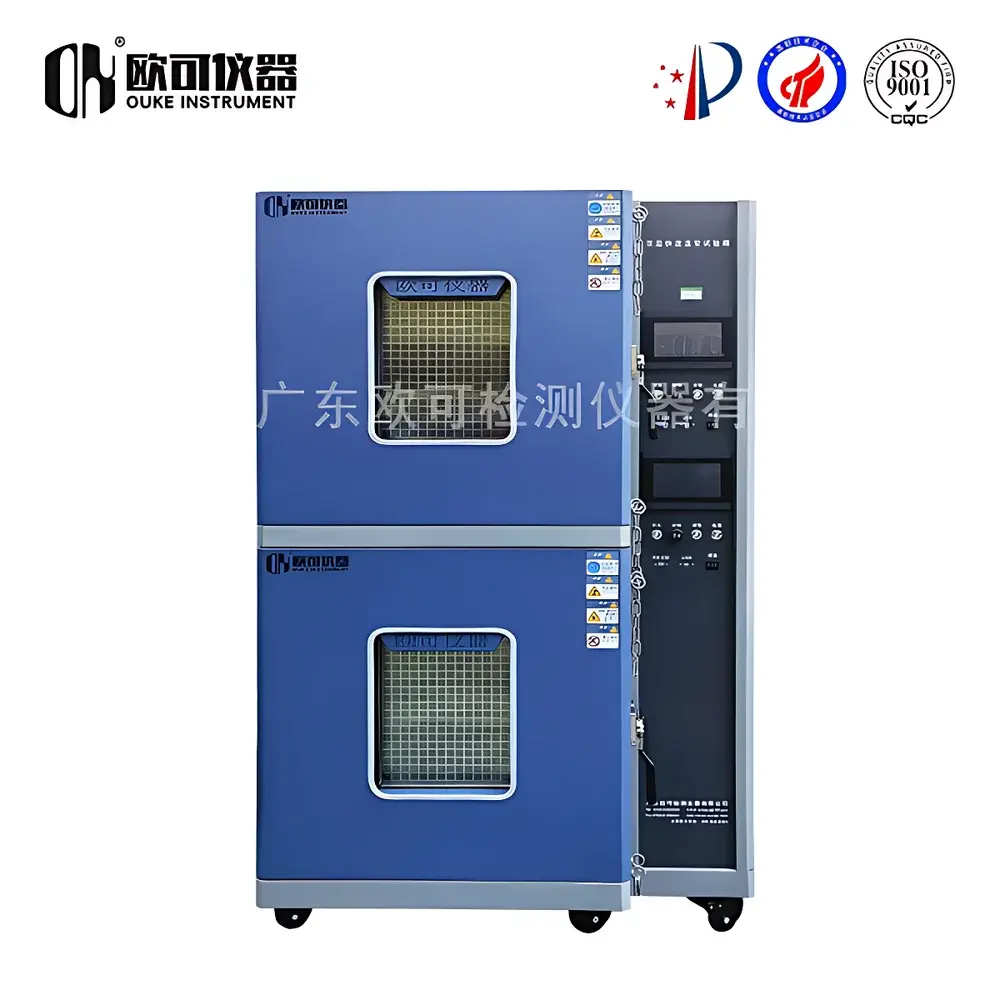
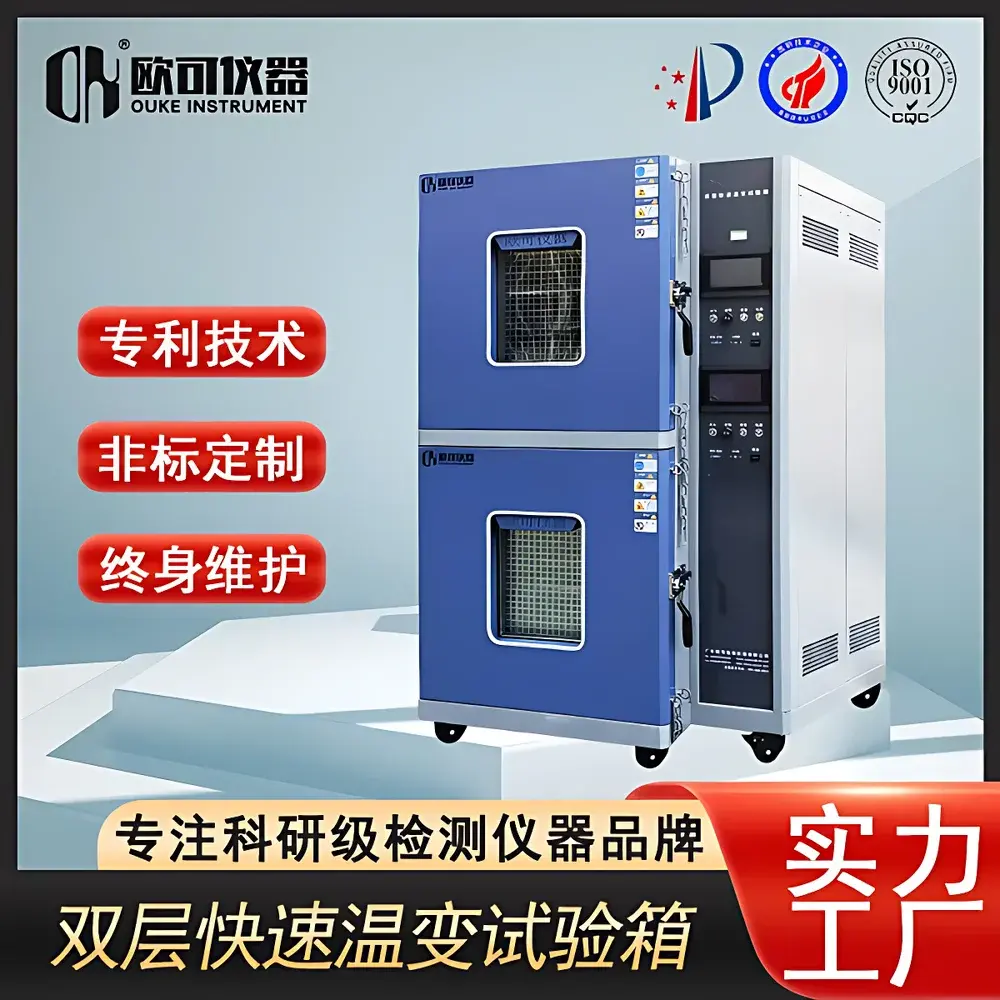
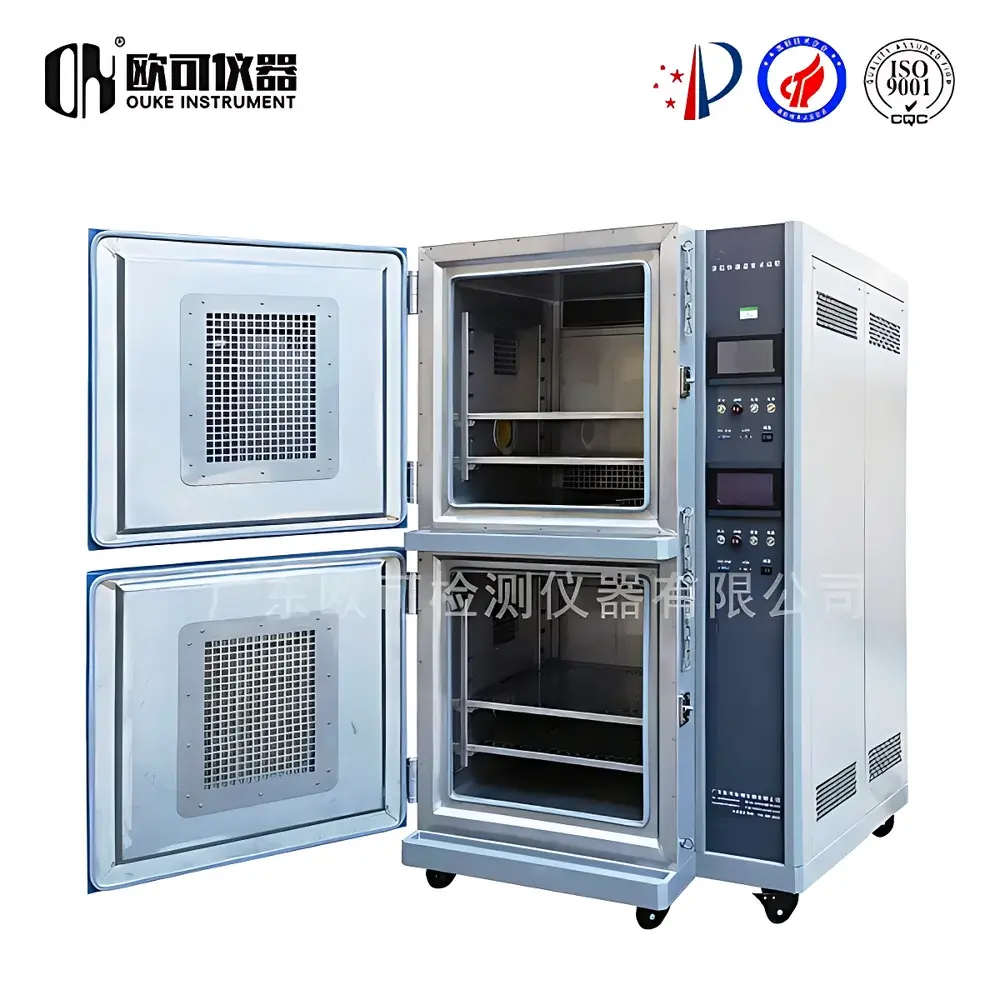
OK KS-TH-408 Mobile Rapid Temperature Change Chamber
| Brand | OK Instruments |
|---|---|
| Origin | Guangdong, China |
| Manufacturer Type | OEM/ODM Manufacturer |
| Country of Origin | China |
| Model | KS-TH-408 |
| Price | USD 2,650 (FOB Guangdong) |
| Temperature Range | −60 °C to +150 °C |
| Heating Rate (empty) | ≤50 min (−60 °C → +150 °C) |
| Cooling Rate (empty) | ≤55 min (+30 °C → −60 °C) |
| Temp. Uniformity | ±1 °C |
| Temp. Stability | ±0.5 °C |
| Temp. Deviation | ±1 °C |
| Stabilization Time | ≤10 min |
| Humidity Range | 20–98% RH |
| Humidity Uniformity | ±2% RH |
| Humidity Stability | ±2% RH |
| Humidity Deviation | ±2.5% RH |
| Load Capacity | ≤30 kg |
| Refrigerant | R404A / R23 |
| Compressor | Imported Tecumseh (France) |
| Insulation | 100 mm PU foam + high-density glass fiber |
| Viewing Window | Heated double-layer tempered glass with interior LED lighting |
| Test Ports | Two × Φ50 mm (left side & top) |
| Construction | Interior – SUS304 stainless steel |
| Water Supply | Front-mounted pull-out reservoir with optional auto-refill + inline water filtration |
Overview
The OK KS-TH-408 Mobile Rapid Temperature Change Chamber is an engineered environmental test system designed for accelerated thermal stress evaluation under dynamically varying temperature and humidity conditions. It operates on the principle of forced-air convection combined with precision-controlled refrigeration and steam-based humidification, enabling rapid transitions between extreme thermal states while maintaining strict compliance with IEC 60068-2-1 (cold), IEC 60068-2-2 (dry heat), IEC 60068-2-30 (damp heat cyclic), and MIL-STD-810H Method 503.5. Its mobile configuration—integrated casters, reinforced chassis, and compact footprint—supports flexible deployment across QC labs, pilot production lines, and field validation sites without permanent installation. The chamber is not intended for continuous operation at extremes but for controlled, repeatable thermal shock profiling per defined test protocols.
Key Features
- Structural integrity ensured by CNC-machined frame with seamless arc-corner design and flat, non-reactive door handles for ergonomic access.
- Interior chamber fabricated from 1.2 mm thick SUS304 stainless steel; exterior housing options include SECC cold-rolled steel with electrostatic powder coating or full SUS304 cladding for enhanced corrosion resistance and cleanroom compatibility.
- 100 mm-thick composite insulation comprising rigid polyurethane (PU) foam and high-density glass fiber minimizes thermal bridging and reduces energy consumption during transient cycles.
- Heated, double-pane tempered observation window with embedded heating element and integrated LED illumination ensures unobstructed visual monitoring without condensation or frost formation.
- Front-access, slide-out water reservoir with quick-release mechanism simplifies maintenance; optional automatic refill system includes inline sediment and particulate filtration to protect humidifier components.
- Two standardized Φ50 mm test ports (one on left wall, one on ceiling) accommodate power feeds, sensor cables, or pneumatic lines while preserving chamber integrity via silicone grommets and threaded flange interfaces.
- Refrigeration circuit utilizes dual-stage cascade architecture with imported Tecumseh compressors (France), R404A/R23 mixed refrigerants, and nitrogen-pressurized leak-tested tubing (24-hour hold test per ASME B31.5).
Sample Compatibility & Compliance
The KS-TH-408 accommodates test specimens up to 30 kg total mass, with internal dimensions optimized for standard automotive ECUs, PCB assemblies, photovoltaic modules, and packaged consumer electronics. Its thermal performance meets ASTM D4332 (conditioning containers), ISO 16750-4 (road vehicles — environmental conditions), and JIS C 0025 (humidity testing). Humidity control adheres to ISO 17025 calibration traceability requirements when operated with NIST-traceable hygrometers. All electrical components comply with CE marking directives (2014/30/EU EMC, 2014/35/EU LVD), and the unit supports GLP/GMP audit readiness through configurable logging intervals and user-accessible event history.
Software & Data Management
Control is managed via a 7-inch capacitive touchscreen HMI running OK’s proprietary TC-OS firmware, supporting programmable multi-step profiles (up to 99 segments), real-time graphing, and USB data export in CSV format. Optional Ethernet connectivity enables integration into LabVIEW™ or MATLAB® environments via Modbus TCP. Data logs include timestamped temperature/humidity values, alarm events (e.g., compressor fault, door open, sensor timeout), and system status flags—all compliant with FDA 21 CFR Part 11 when paired with optional electronic signature module and audit trail activation. Calibration certificates are provided with each shipment, covering sensor linearity, uniformity mapping, and rate verification per ISO/IEC 17025-accredited third-party lab reports.
Applications
- Qualification testing of aerospace avionics per RTCA DO-160G Section 4 (temperature), Section 10 (humidity), and Section 25 (thermal shock).
- Reliability screening of lithium-ion battery packs under combined thermal-humidity stress to assess electrolyte stability and SEI layer integrity.
- Accelerated aging of optical coatings and encapsulants used in outdoor LED lighting and solar concentrators.
- Validation of hermetic seal integrity in medical device housings via moisture ingress analysis using gravimetric post-test weighing.
- Process window definition for reflow soldering equipment by simulating preheat, soak, and cooling phase transitions.
FAQ
What is the maximum thermal transition rate achievable with this chamber?
The system achieves ≤50 minutes for −60 °C to +150 °C (heating, empty load) and ≤55 minutes for +30 °C to −60 °C (cooling, empty load), as verified per IEC 60068-3-5 Annex A.
Does the chamber support automated test sequencing across multiple environmental profiles?
Yes—up to 99 programmable steps per profile, including dwell, ramp, and cycle repeat functions, with trigger-based conditional branching (e.g., initiate humidity ramp upon reaching target temperature).
Is remote monitoring possible without additional hardware?
Basic remote status viewing (current setpoints, actual readings, alarm status) is supported via built-in web server; full SCADA integration requires optional Ethernet I/O expansion module.
How is humidity generated and controlled?
Steam humidification using stainless-steel immersion heaters with PID-controlled water level management; dehumidification via direct-expansion refrigeration coil condensation, not desiccant or membrane systems.
Can the chamber be calibrated in-house using standard reference equipment?
Yes—the controller accepts external PT100 inputs for field verification; however, full chamber mapping (uniformity, stability, rate) requires accredited third-party service per ISO/IEC 17025 due to spatial sensor array requirements.



