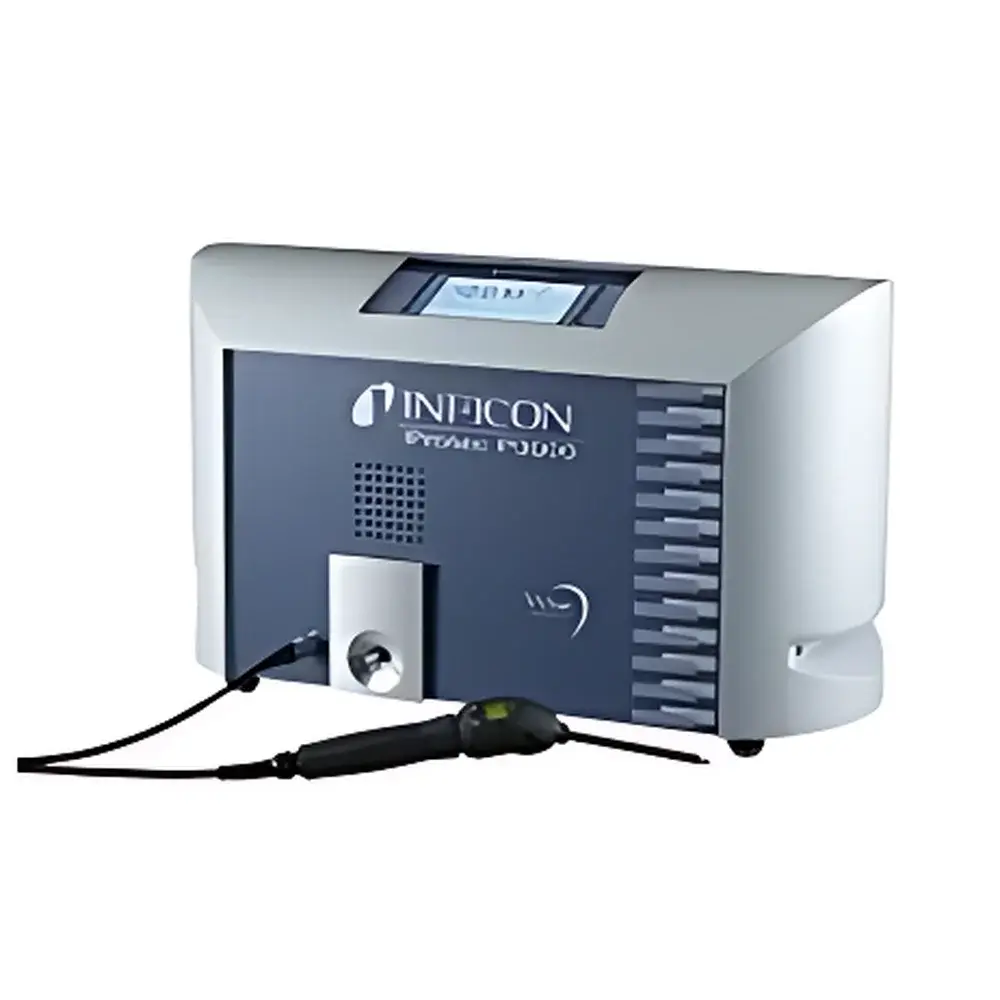
Protec® P3000 Helium Sniffer Leak Detector
| Origin | Germany |
|---|---|
| Manufacturer Type | Authorized Distributor |
| Origin Category | Imported |
| Model | Protec® P3000 |
| Pricing | Upon Request |
Overview
The Protec® P3000 Helium Sniffer Leak Detector is an industrial-grade, handheld helium mass spectrometer-based leak detection system engineered for high-reliability sniffer-mode operation in demanding manufacturing and quality assurance environments. Utilizing a quadrupole mass spectrometer (QMS) tuned specifically to the 4-amu helium ion peak, the P3000 delivers quantitative leak rate measurement in real time via thermal conductivity-compensated ion current detection. Its architecture is optimized for continuous-duty production line integration—supporting ISO 10648-2 Class 2 sensitivity (down to 5 × 10⁻¹² mbar·L/s with optimized probe configuration) while maintaining robust immunity to background helium fluctuations and mechanical vibration. Designed for compliance with IEC 61000-6-2 (immunity) and IEC 61000-6-4 (emissions), the instrument meets electromagnetic compatibility requirements for factory-floor deployment without signal degradation.
Key Features
- Integrated PRO-CHECK reference leak port enabling on-site, traceable calibration verification without external standards—fully compliant with ISO/IEC 17025 metrological traceability workflows.
- I°Guide operator guidance system: context-aware visual prompts on the integrated OLED display direct users to correct probe positioning, dwell time, and scanning velocity—reducing human error and improving test repeatability per ASTM E1884 and ISO 9712 Level 2 procedural requirements.
- Helium-equivalent leak rate display with optional refrigerant gas library (R-134a, R-410A, R-32), allowing direct conversion of measured helium response to industry-standard refrigerant-equivalent values per SAE J2722 and EN 378-2 Annex D.
- Integrated LED probe illumination system with adjustable intensity—enabling precise localization of leak sources in low-light or confined-access assemblies (e.g., HVAC heat exchangers, EV battery coolant manifolds).
- Self-regulating maintenance cycle: automatic sensor protection protocol activates when probe flow exceeds threshold, triggering internal valve sequencing to isolate the QMS from particulate and oil vapor ingress—extending sensor service life by up to 40% versus non-protected configurations.
- Multi-language firmware (English, German, French, Spanish, Chinese, Japanese) with configurable UI scaling for glove-compatible touchscreen interaction in cleanroom or protective-gear environments.
Sample Compatibility & Compliance
The P3000 is validated for use with pressurized components containing helium or helium-trace gas mixtures at operating pressures from 0.5 to 10 bar(g). It supports leak detection on metallic, polymer, and composite substrates—including aluminum evaporators, stainless steel medical gas manifolds, and laminated pouch cells. The system conforms to ISO 13849-1 PLd safety integrity level for its internal pressure interlock logic and meets UL 61010-1 and CE marking requirements for electrical safety. All firmware revisions maintain full audit trail capability for GLP/GMP environments, with timestamped calibration events, user logins, and parameter change history stored in non-volatile memory per FDA 21 CFR Part 11 electronic record requirements.
Software & Data Management
The embedded firmware includes USB-C host interface for direct export of CSV-formatted test logs (timestamp, location ID, leak rate, operator ID, pass/fail status). Optional PC software—Protec DataLink v3.2—supports automated report generation compliant with ISO/IEC 17025 clause 7.8.2, including uncertainty budgeting per GUM (JCGM 100:2008). Data encryption (AES-256) and role-based access control ensure secure integration into enterprise MES platforms such as Siemens Opcenter or Rockwell FactoryTalk.
Applications
- Aerospace: Hermeticity validation of avionics enclosures, fuel system fittings, and oxygen delivery manifolds per MIL-STD-883 Method 1014.
- Automotive: EV battery module cooling circuit testing, hydrogen fuel cell stack sealing verification, and ADAS radar housing integrity checks.
- Medical Devices: Sterile barrier packaging validation (ISO 11607-2), implantable device housing leak screening, and anesthesia machine gas pathway certification.
- Energy: Vacuum-integrated solar thermal receiver tubes, LNG cryogenic valve seat integrity, and nuclear-grade instrumentation tubing inspection.
FAQ
What is the minimum detectable leak rate in sniffer mode?
The P3000 achieves a typical minimum detectable leak rate of 5 × 10⁻¹² mbar·L/s under controlled conditions with optimal probe proximity and zero-background helium environment.
Does the instrument support external trigger inputs for automated test stations?
Yes—via opto-isolated digital I/O (24 V DC), supporting TTL-level start/stop commands and pass/fail output signals synchronized with PLC-controlled conveyors or robotic arms.
How often does the PRO-CHECK reference leak require recalibration?
The integrated stainless-steel reference leak is factory-calibrated to NIST-traceable standards and certified for 24 months; annual verification using a certified transfer standard is recommended per ISO/IEC 17025 Clause 6.6.
Can the P3000 be used in cleanroom ISO Class 5 environments?
Yes—the unit is rated IP54 and features a static-dissipative enclosure; optional HEPA-filtered purge air kit enables operation in ISO Class 5 without compromising internal vacuum integrity.