
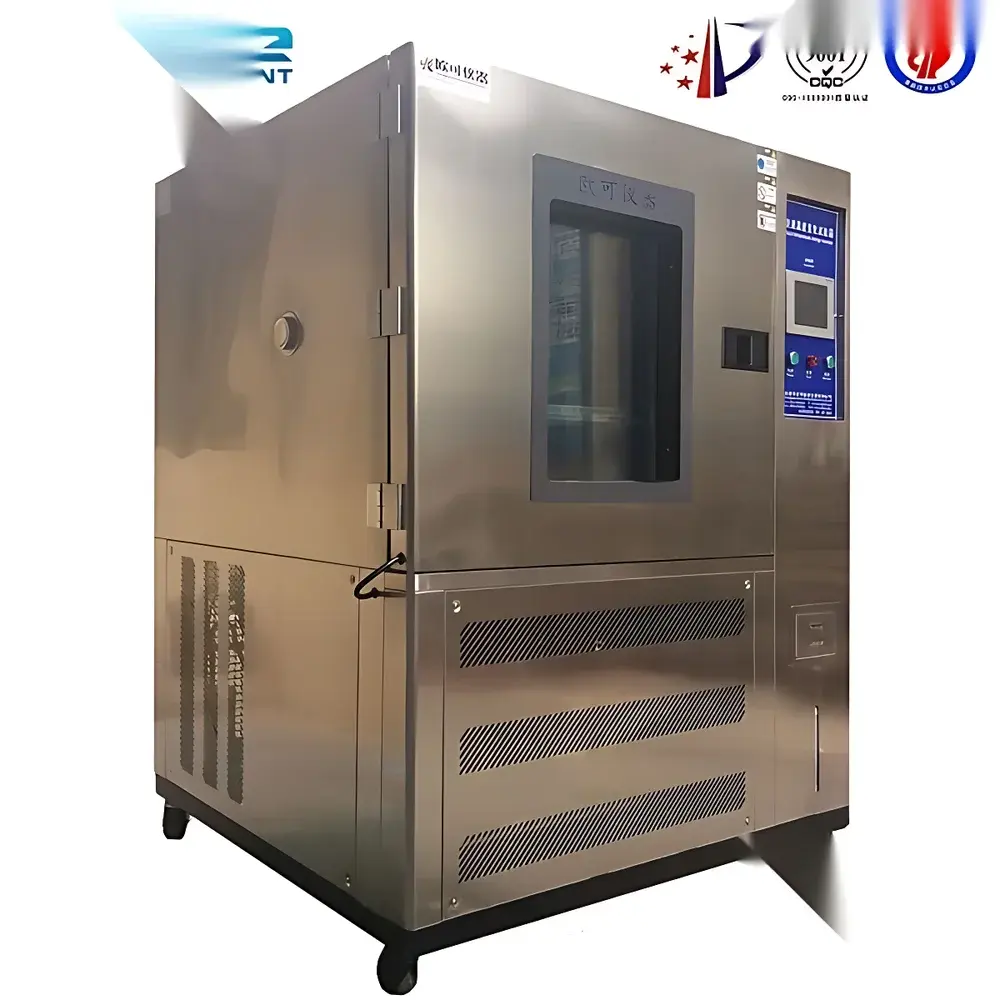
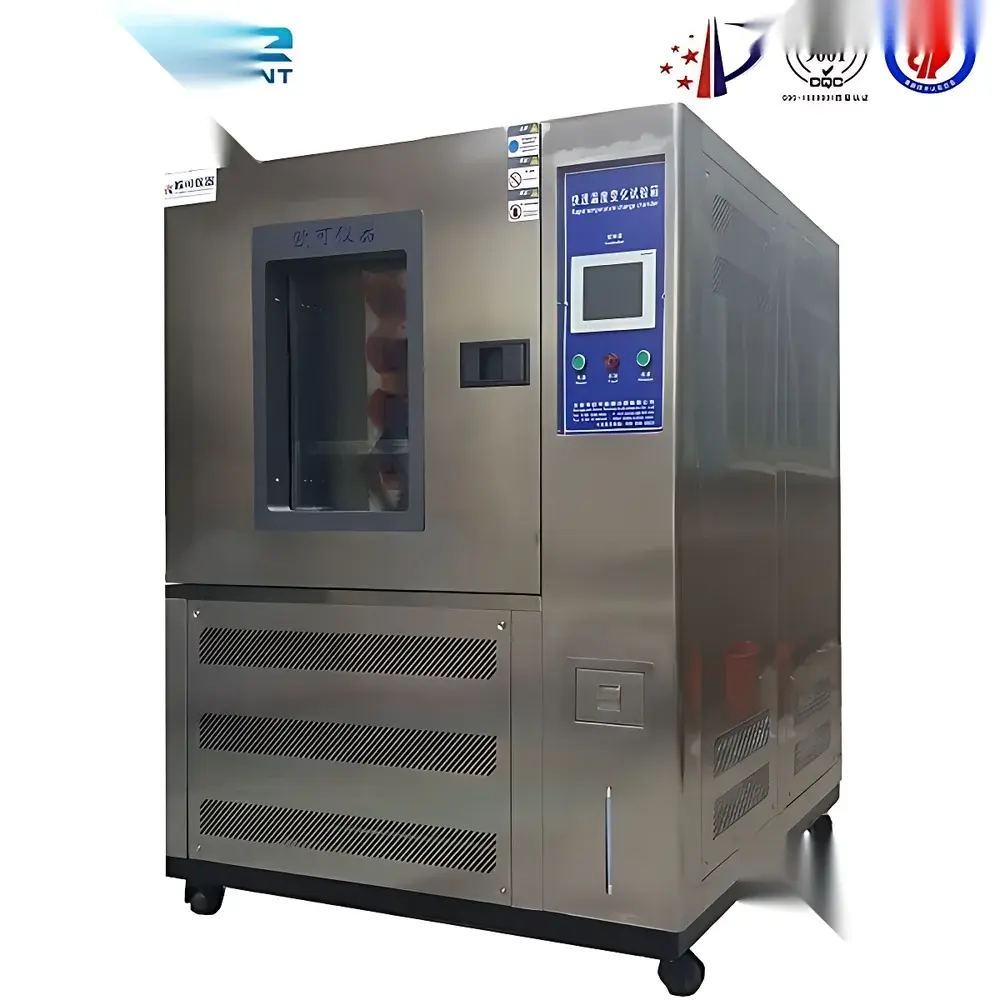
Quick-Cycling Thermal and Humidity Environmental Test Chamber
| Brand | Other Brands |
|---|---|
| Origin | Imported |
| Manufacturer Type | Authorized Distributor |
| Price | USD 2,650 (FOB) |
Overview
The Quick-Cycling Thermal and Humidity Environmental Test Chamber is an engineered environmental simulation system designed for accelerated reliability assessment of electronic components, electrical equipment, automotive parts, aerospace materials, and industrial assemblies under dynamically varying temperature and humidity conditions. It operates on a dual-chamber or forced-air thermal mass exchange principle—enabling rapid transitions between extreme thermal states (e.g., −70 °C to +150 °C) while maintaining precise humidity control (10–98% RH, non-condensing). Unlike static climatic chambers, this system supports programmable thermal ramp rates up to 15 °C/min and humidity transition times under 10 minutes (typical), making it suitable for IEC 60068-2-14 (change of temperature), IEC 60068-2-30 (damp heat, cyclic), and MIL-STD-810H Method 507.5 compliance testing. Its core function is to replicate real-world environmental stress sequences—including diurnal cycling, condensation-prone storage, and transport-induced thermal shock—thereby accelerating failure mode identification during design validation and production lot sampling.
Key Features
- High-speed thermal cycling capability with independent refrigeration and heating circuits, minimizing cross-interference between temperature and humidity control loops
- Microprocessor-based programmable controller with dual-language interface (English/Chinese) and real-time graphical display of temperature/humidity profiles
- Storage capacity for up to 100 test programs, each supporting 100 segments with 999-step looping capability per segment
- Maximum segment duration: 99 hours 59 minutes; total program runtime support exceeds 30 days without interruption
- Screen lock function prevents unauthorized parameter modification during active test execution
- Auto-tuning algorithm continuously adjusts PID parameters in response to load variation and chamber occupancy, ensuring long-term stability (< ±0.3 °C temp deviation, < ±2.5% RH deviation)
- Robust stainless-steel inner chamber construction with insulated double-wall design and anti-condensation heating on observation window and door seal
Sample Compatibility & Compliance
The chamber accommodates standard test specimens up to 500 mm × 500 mm × 500 mm (W×D×H), with optional internal fixtures for PCB racks, cable harnesses, and sealed enclosures. It meets fundamental requirements for ISO/IEC 17025-accredited laboratories conducting environmental qualification per IPC-9701, JEDEC JESD22-A104 (Temperature Cycling), JESD22-A108 (Bias Humidity Life), and AEC-Q200 stress screening protocols. While not certified to UL or CE as a standalone safety appliance, its electrical architecture complies with IEC 61000-6-2 (immunity) and IEC 61000-6-4 (emission) standards. Optional data logging modules support audit-ready traceability aligned with GLP and GMP documentation workflows.
Software & Data Management
The embedded controller records timestamped temperature and humidity values at user-configurable intervals (1–60 seconds). Raw data export is supported via USB flash drive in CSV format, compatible with MATLAB, JMP, and Minitab for statistical process analysis. An optional Ethernet-enabled remote monitoring module allows integration into centralized lab management systems (LIMS) and supports SNMP traps for alarm notification. All configuration changes, runtime events, and manual interventions are logged with user ID and timestamp—providing full 21 CFR Part 11–compliant audit trail when paired with validated PC-based supervision software.
Applications
- Qualification testing of printed circuit boards (PCBs) and solder joints under thermomechanical fatigue stress
- Validation of conformal coating integrity and moisture barrier performance in MEMS sensors and optoelectronic packages
- Accelerated aging of polymer housings, gaskets, and adhesive bonds used in outdoor-rated enclosures
- Pre-compliance screening for automotive ECUs prior to formal ISO 16750-4 environmental certification
- Reliability growth testing of battery management systems (BMS) under combined thermal-humidity stress
- Material compatibility assessment for medical device packaging per ISO 11607-1 Annex B
FAQ
What is the typical ramp rate achievable between −40 °C and +85 °C?
Standard configuration achieves 10–12 °C/min under no-load conditions; actual rate depends on specimen thermal mass and chamber loading.
Does the system support dew point control or only relative humidity setpoints?
It maintains RH setpoints via chilled mirror or capacitive sensor feedback; dew point is calculated and displayed but not directly controlled.
Can test programs be uploaded from external PCs?
Yes—via USB port using standardized .csv or proprietary .prg file formats; firmware version 3.2+ supports drag-and-drop import.
Is third-party calibration certificate included with shipment?
A factory calibration report (traceable to NIST or equivalent national metrology institute) is provided; ISO/IEC 17025-certified calibration is available as optional service.
What maintenance intervals are recommended for long-term operational reliability?
Refrigerant circuit inspection and humidity sensor recalibration every 12 months; condensate drain line cleaning every 90 days in high-RH operation.



