
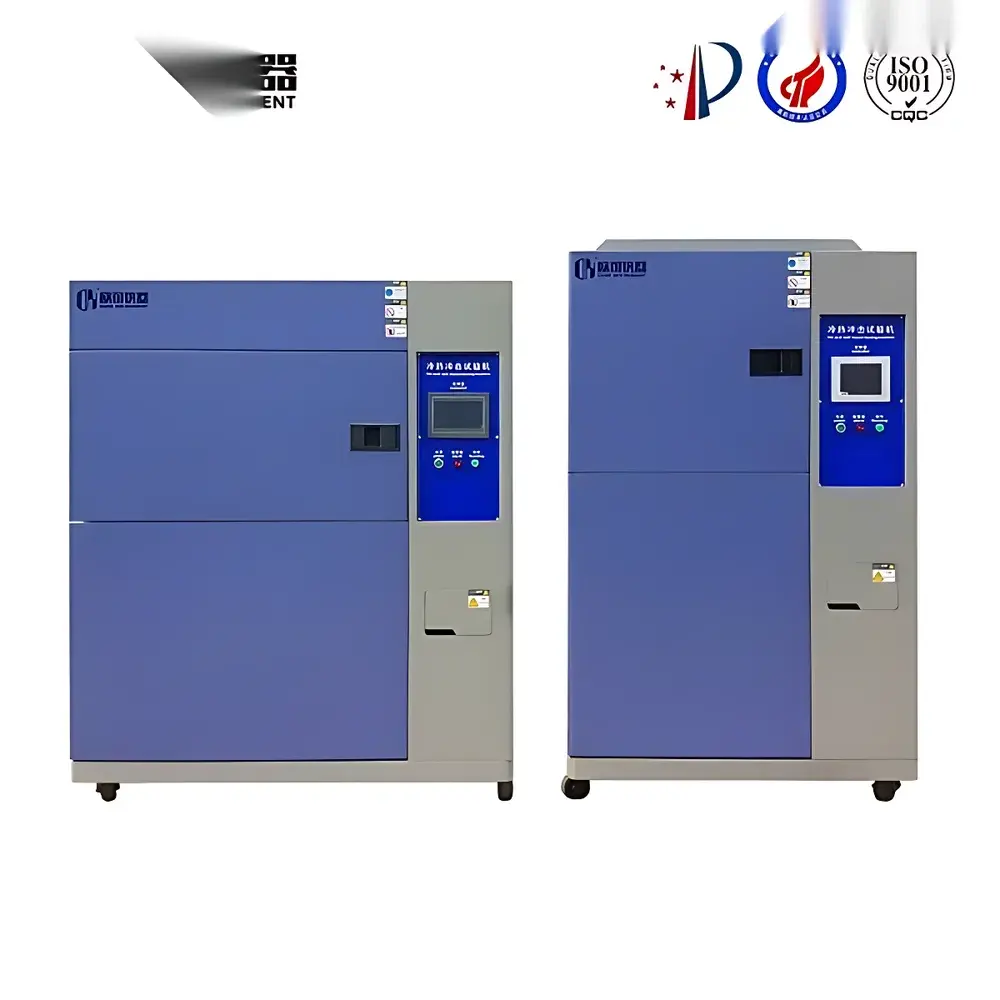
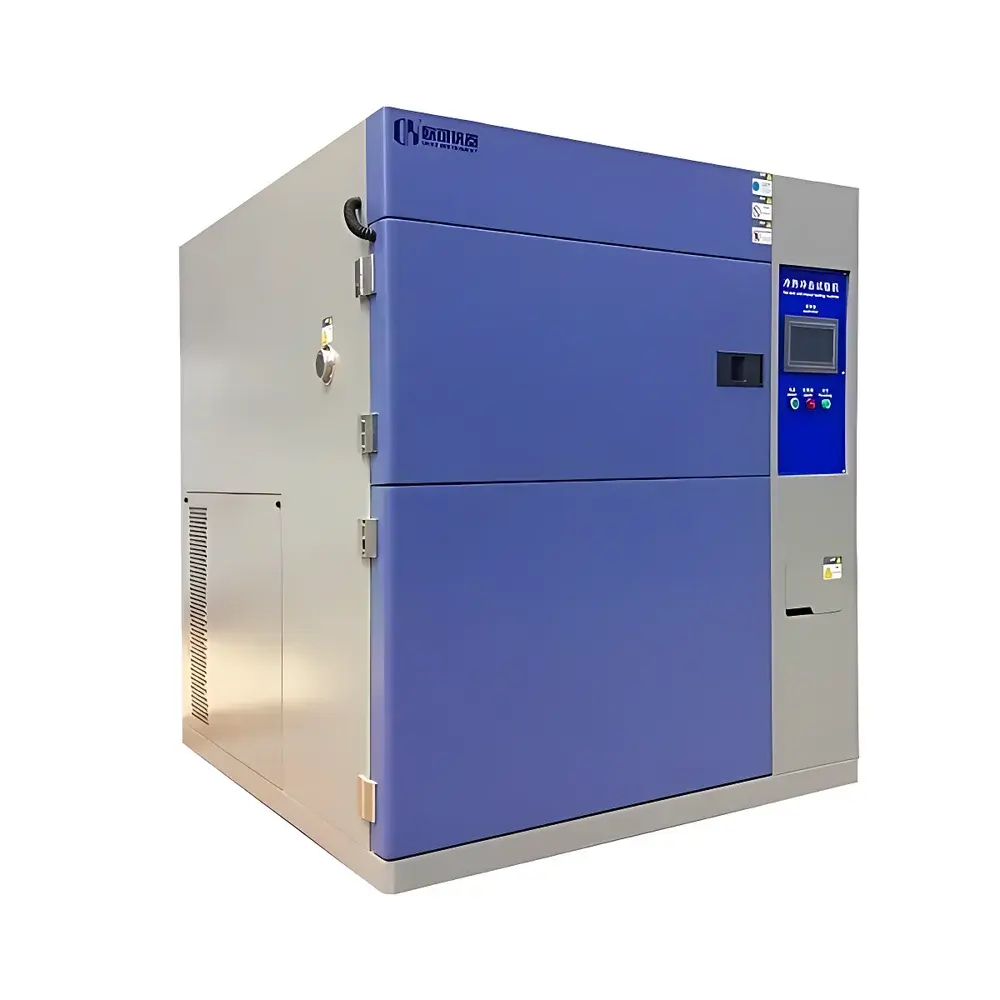
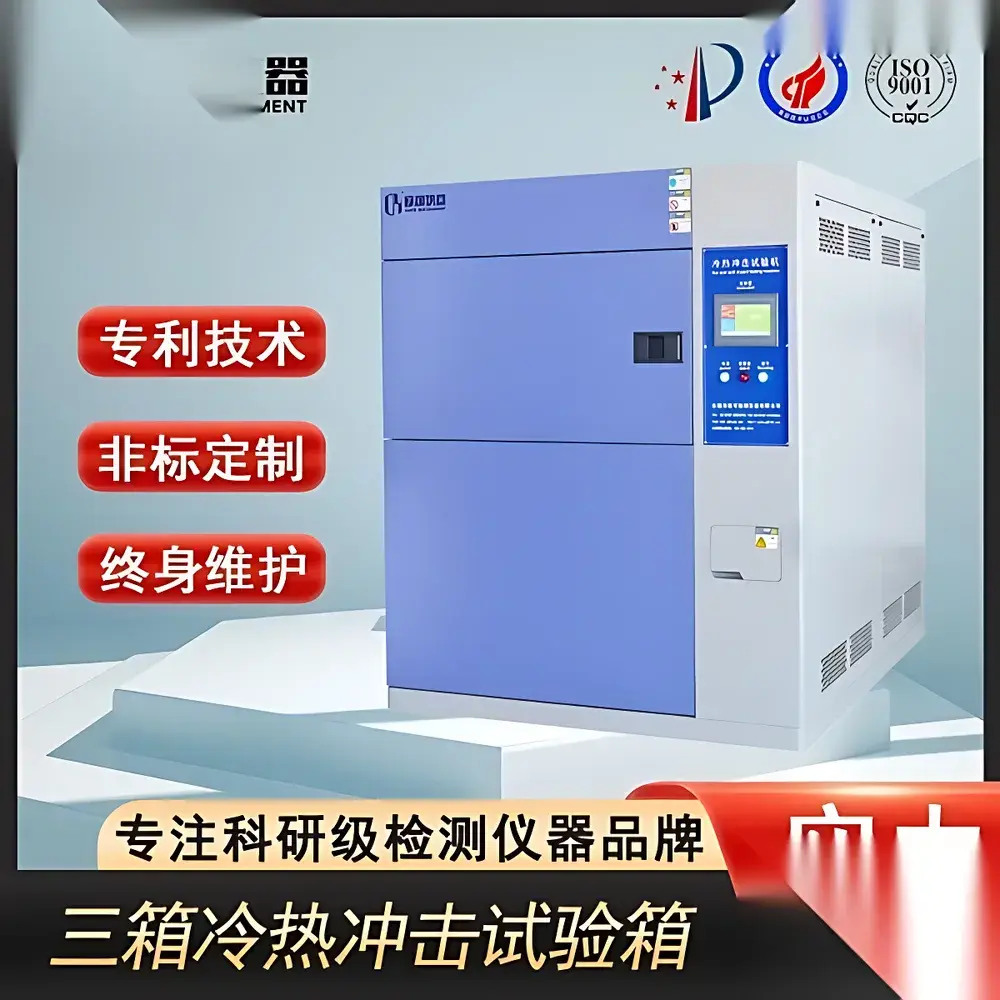
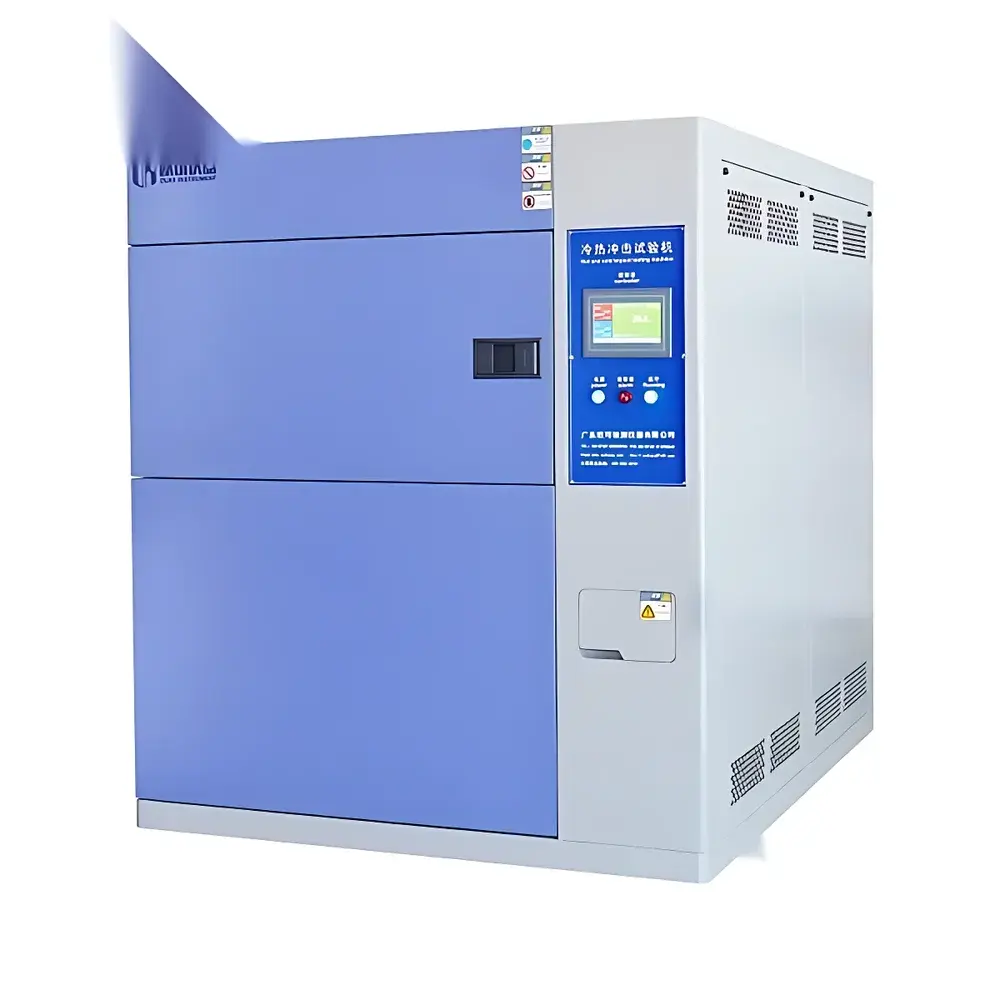
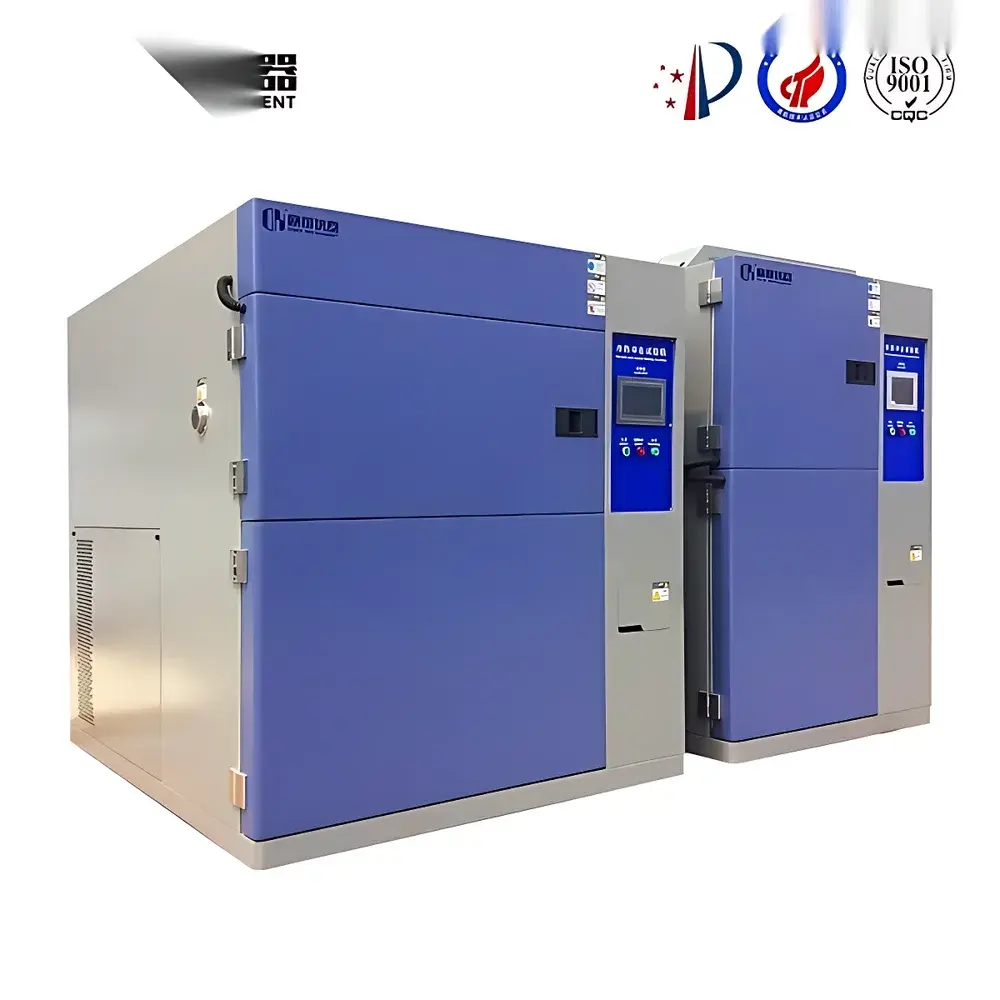
Thermal Shock Test Chamber – Dual-Chamber Rapid Temperature Transition System
| Brand | OEM |
|---|---|
| Origin | Imported |
| Manufacturer Type | Authorized Distributor |
| Price | USD 11,200 (FOB) |
| Temperature Range | -65°C to +180°C |
| Transfer Time (Basket) | ≤10 s |
| Dwell Time per Zone | 1–999 h |
| Cycle Count | Up to 9,999 cycles |
| Cooling Method | Water-Cooled Dual-Stage Refrigeration |
| Refrigerant | R502 |
| Controller | TEMI300 PID-based Touchscreen Interface (English UI) |
| Compliance | GB/T 10586, GB/T 10592, GB/T 2423.1/2/3/4, GB/T 5170.2/5 |
Overview
The Thermal Shock Test Chamber – Dual-Chamber Rapid Temperature Transition System is an engineered environmental test solution designed for accelerated reliability assessment of electronic components, aerospace materials, automotive modules, and precision assemblies subjected to extreme thermal transients. Unlike single-chamber or air-to-air thermal shock systems, this dual-zone configuration physically isolates high-temperature (+180°C) and low-temperature (–65°C) environments—minimizing thermal cross-contamination and enabling precise, repeatable step-change transitions. Test specimens are mounted on a motorized stainless-steel basket that rapidly transfers between chambers via linear actuation, achieving transfer times of ≤10 seconds. This mechanical transfer method ensures true dynamic thermal shock exposure, conforming to the physical basis of IEC 60068-2-14 (Test N: Change of temperature) and supporting qualification per MIL-STD-810H Method 503.5. The system operates on thermal equilibrium control logic—maintaining setpoint stability within ±0.5°C during dwell phases—critical for valid failure mode identification in HALT/HASS protocols.
Key Features
- Dual independent chamber architecture: High-temp zone (up to +180°C) and low-temp zone (down to –65°C), each with dedicated heating and refrigeration circuits
- Mechanically actuated stainless-steel test basket (SUS304 mirror finish) with programmable positioning and position feedback sensors
- Water-cooled dual-stage refrigeration system using hermetic Tecumseh (France) compressors and Danfoss thermostatic expansion valves for rapid cooling ramp rates (≥10°C/min from 25°C to –65°C)
- TEMI300 color touchscreen controller with English-language interface, real-time curve plotting (PROG), multi-segment program storage (up to 99 programs), and audit-trail-capable event logging
- Robust thermal insulation: 120 mm thick ultra-fine glass fiber blanket with vapor barrier; internal chamber walls constructed from electropolished SUS304 stainless steel (Ra ≤ 0.4 µm)
- Comprehensive safety architecture: Independent over-temperature cutouts (mechanical & electronic), high-pressure refrigerant shutdown, phase-loss detection, water-flow interlock for chiller interface, and automatic condensate management
Sample Compatibility & Compliance
This chamber accommodates standard test specimens up to 400 mm × 400 mm × 400 mm (W×D×H) with optional custom basket configurations available. It supports non-powered and powered-in-situ testing via one Φ50 mm cable port with silicone gasket seal. The viewing window features double-layer heated conductive glass (low-emissivity ITO coating) to prevent fogging and icing during extreme transitions. All structural and control subsystems comply with GB/T 10586–2018 (General technical conditions for damp heat test chambers), GB/T 10592–2008 (Technical conditions for temperature test chambers), and GB/T 2423.1–2021 (Cold test), GB/T 2423.2–2021 (Dry heat test), GB/T 2423.3–2016 (Damp heat, steady state), and GB/T 2423.4–2017 (Damp heat, cyclic). Calibration traceability follows GB/T 5170.2 (Temperature testing equipment) and GB/T 5170.5 (Humidity testing equipment).
Software & Data Management
The TEMI300 controller provides native English-language operation with password-protected access levels (Operator, Engineer, Administrator). All test parameters—including setpoints, dwell durations, cycle counts, alarm history, and real-time sensor traces—are stored internally with timestamping. USB export enables CSV-formatted data retrieval for post-test statistical analysis (e.g., Cpk, Weibull). While not natively 21 CFR Part 11 compliant, the system supports integration with third-party LIMS or MES platforms via RS485 Modbus RTU or optional Ethernet/IP interface. Audit trail records include user ID, action type, timestamp, and parameter values before/after change—meeting GLP documentation requirements for QC laboratories under ISO/IEC 17025 accreditation.
Applications
- Qualification testing of PCBAs, solder joints, and encapsulated IC packages per JEDEC JESD22-A104 (Temperature Cycling) and A106 (Thermal Shock)
- Validation of adhesive bond integrity in battery module housings and EV power electronics under repeated thermal stress
- Reliability screening of optical sensors, MEMS devices, and ceramic substrates used in avionics
- Material compatibility studies for conformal coatings, potting compounds, and thermal interface materials (TIMs)
- Accelerated aging of medical device housings per ISO 10993-12 biocompatibility evaluation protocols
FAQ
Can this chamber perform tests at ambient temperature (25°C)?
No. This dual-chamber thermal shock system is specifically engineered for rapid transitions between two extreme setpoints. Ambient dwell is not supported by design—neither as a defined zone nor as an intermediate stop. For combined environmental profiles including ambient segments, a triple-zone chamber or integrated walk-in chamber with auxiliary conditioning is required.
Is R502 refrigerant still serviceable under current environmental regulations?
R502 is a Class II ozone-depleting substance phased out under the Montreal Protocol. Units shipped post-2020 are supplied with R507A or R404A retrofit kits and updated pressure relief certification. Field conversion must be performed by certified refrigeration technicians with EPA Section 608 certification.
What is the maximum allowable specimen weight for the transfer basket?
The standard basket supports loads up to 25 kg uniformly distributed. Exceeding this limit may affect transfer repeatability and actuator lifetime. Load distribution must avoid cantilevered mass beyond the basket’s lateral centerline.
Does the system include validation documentation (IQ/OQ/PQ)?
Factory-assembled units ship with a Factory Acceptance Test (FAT) report including temperature uniformity mapping (per GB/T 5170.2), alarm verification, and controller calibration certificate. Site-specific IQ/OQ protocols and PQ execution require engagement of qualified metrology partners.
Is remote monitoring possible without additional hardware?
Basic status monitoring (run/stop, active alarm, chamber temperature) is accessible via built-in web server (HTTP) using the controller’s static IP. Full SCADA integration, historical trend export, or email/SMS alerts require optional communication gateway modules and network configuration support.



