
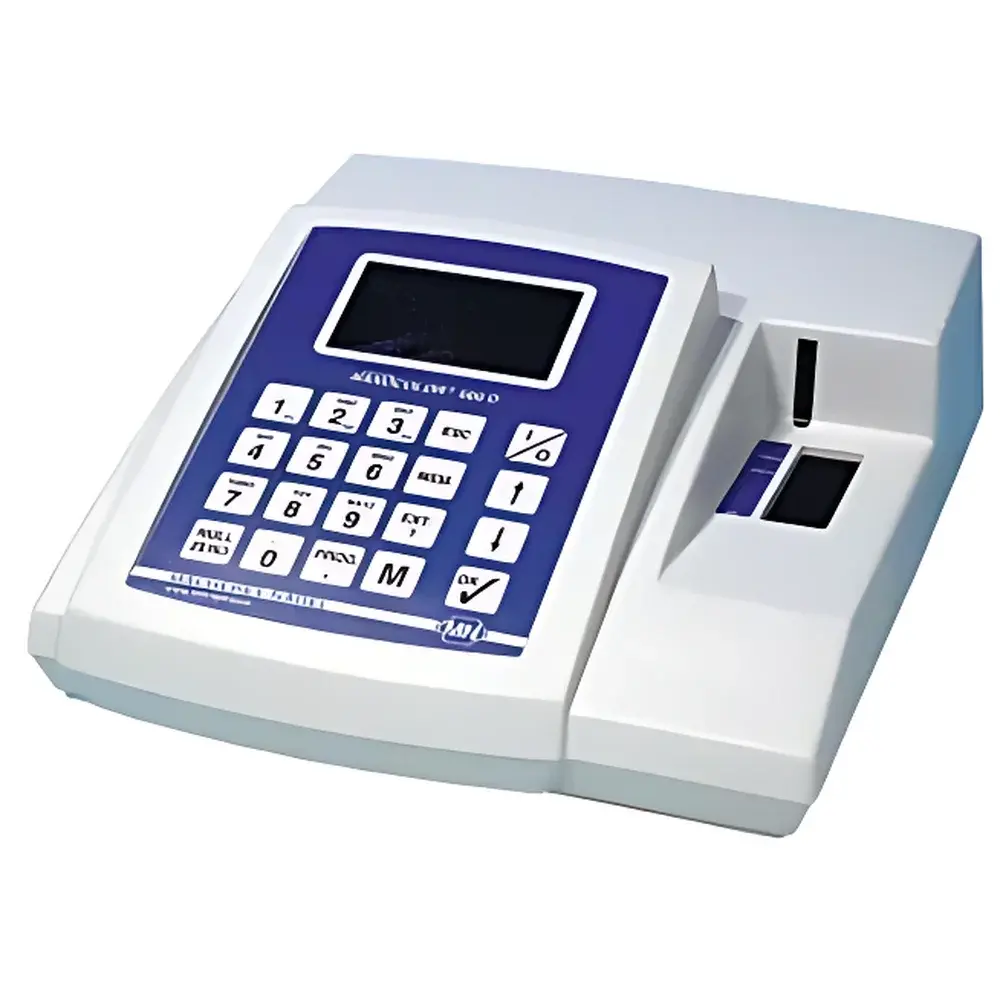
Macherey-Nagel NANOCOLOR 500D Portable Spectrophotometer
| Brand | Macherey-Nagel |
|---|---|
| Origin | Germany |
| Model | NANOCOLOR 500D |
| Wavelength Range | 340–860 nm |
| Wavelength Selection | 10 fixed-band interference filters (345, 365, 436, 470, 520, 540, 585, 620, 690, 800 nm) |
| Wavelength Accuracy | ±2 nm |
| Bandwidth | 10–12 nm |
| Light Source | Tungsten halogen lamp |
| Detector | Silicon photodiode |
| Photometric Accuracy | ±1% of reading |
| Stability | <0.002 Abs/h |
| Sample Holders | 16-mm round cuvettes (NANOCOLOR tubes), plus 10 mm, 20 mm, and 50 mm rectangular cuvettes |
| Data Storage | 500 measurements with GLP-compliant metadata |
| Display | Graphic LCD (64 × 128 pixels), backlit, 10-language interface |
| Interfaces | RS-232 (bidirectional), USB 1.1 |
| Power | Internal rechargeable 6 V / 3.2 Ah battery or AC adapter (100–240 V~, 50/60 Hz) |
| Operating Environment | 0–50 °C, ≤90% RH (non-condensing) |
| Dimensions | 227 × 282 × 105 mm |
| Weight | 2.4 kg |
Overview
The Macherey-Nagel NANOCOLOR 500D Portable Spectrophotometer is a microprocessor-controlled, single-beam filter-based photometer engineered for routine quantitative analysis in water and wastewater applications. It operates on the principle of absorbance spectroscopy—measuring light attenuation at discrete wavelengths selected via a motorized 10-position interference filter wheel. Unlike scanning spectrophotometers, the NANOCOLOR 500D delivers rapid, high-reproducibility measurements optimized for standardized colorimetric and enzymatic assays compliant with ISO 7027, ISO 8466, DIN 38405, and EPA-approved methods. Its rugged, field-ready design supports deployment across laboratory, industrial process control, municipal water treatment plants, and remote environmental monitoring sites—without compromising analytical traceability or measurement integrity.
Key Features
- Barcode-driven assay execution: Automatically identifies and loads method parameters from pre-calibrated NANOCOLOR test tubes using integrated linear barcode reader.
- Multi-format sample compatibility: Accepts standard 16-mm round disposable tubes plus 10-mm, 20-mm, and 50-mm rectangular cuvettes—enabling flexibility across legacy protocols and custom dilution workflows.
- Embedded method library: Includes over 100 pre-programmed test routines for common parameters (e.g., COD, nitrate, phosphate, ammonia, chlorine, iron, hardness), plus 99 user-definable methods supporting extinction coefficient input, transmittance conversion, factor-based calculation, kinetic profiling, and two-point calibration.
- GLP-compliant data handling: Stores up to 500 measurement records with timestamp, operator ID, wavelength, cuvette type, blank reference, and calibration status—fully auditable per ISO/IEC 17025 and USP requirements.
- Dual communication architecture: Equipped with both RS-232 (for direct printer output or legacy lab systems) and USB 1.1 (for secure data export and firmware updates) interfaces.
- Field-sustained operation: Powered by an internal 6 V / 3.2 Ah rechargeable battery (typical runtime >12 h at ambient temperature) or universal AC adapter—enabling uninterrupted use during extended site surveys or emergency response deployments.
Sample Compatibility & Compliance
The NANOCOLOR 500D accommodates standard aqueous samples without pretreatment for most regulatory tests—including turbidity (ISO 7027), total phosphorus (ISO 6878), nitrate (ISO 7890-3), and residual chlorine (ISO 7393-2). Its optical path geometry and detector linearity are validated for absorbance values up to 3.0 E (A = –log10T), ensuring reliable quantification across typical environmental concentration ranges. All factory-loaded methods undergo metrological verification against NIST-traceable standards, and instrument performance is documented in accordance with ISO 9001 and ISO/IEC 17025 quality management frameworks. The device meets CE marking requirements under the EU Electromagnetic Compatibility Directive 2014/30/EU and Low Voltage Directive 2014/35/EU.
Software & Data Management
Data acquisition and reporting are supported via the included NANOCOLOR Software Suite (Windows-compatible), which enables batch export to CSV or PDF, trend visualization, report generation with digital signature fields, and audit trail review. Firmware upgrades—delivered via encrypted PC download or internet update—are version-controlled and preserve all user-defined methods and calibration history. The software enforces role-based access control and supports electronic signatures compliant with FDA 21 CFR Part 11 when deployed in regulated environments. All stored measurements include mandatory GLP metadata: date/time stamp, operator code, method ID, wavelength, zero-reference mode (automatic or manual), and battery voltage at time of measurement.
Applications
The NANOCOLOR 500D serves as a primary analytical tool in municipal drinking water QA/QC laboratories verifying compliance with WHO Guidelines and EU Drinking Water Directive (98/83/EC); in industrial effluent monitoring for textile, food processing, and pharmaceutical facilities subject to local discharge permits; and in field-based environmental assessments conducted by governmental agencies and third-party consultants. Typical use cases include rapid screening of nutrient loading in surface waters, verification of disinfection efficacy in distribution networks, validation of membrane filtration performance, and real-time verification of coagulant dosing in clarification processes.
FAQ
Does the NANOCOLOR 500D support wavelength scanning or spectral acquisition?
No. It is a fixed-wavelength filter photometer—not a scanning spectrophotometer—and performs measurements only at its ten factory-installed wavelengths.
Can I import custom calibration curves or modify existing test methods?
Yes. Up to 99 user-defined methods can be created and stored locally, including custom extinction coefficients, dilution factors, and calculation algorithms.
Is the instrument suitable for use in humid outdoor environments?
Yes. It is rated for operation at up to 90% relative humidity (non-condensing) and features sealed keypad overlays and corrosion-resistant housing for field durability.
How is instrument calibration verified and maintained?
Automatic zeroing is performed before each measurement cycle using air or solvent blank; optional certified optical density filters (e.g., NIST-traceable neutral density standards) may be used for periodic verification of photometric accuracy.
What documentation is provided for regulatory audits?
Each unit ships with a Factory Calibration Certificate, Declaration of Conformity, and full traceable metrology documentation aligned with ISO/IEC 17025 Annex A.3 requirements for portable analytical instrumentation.




