
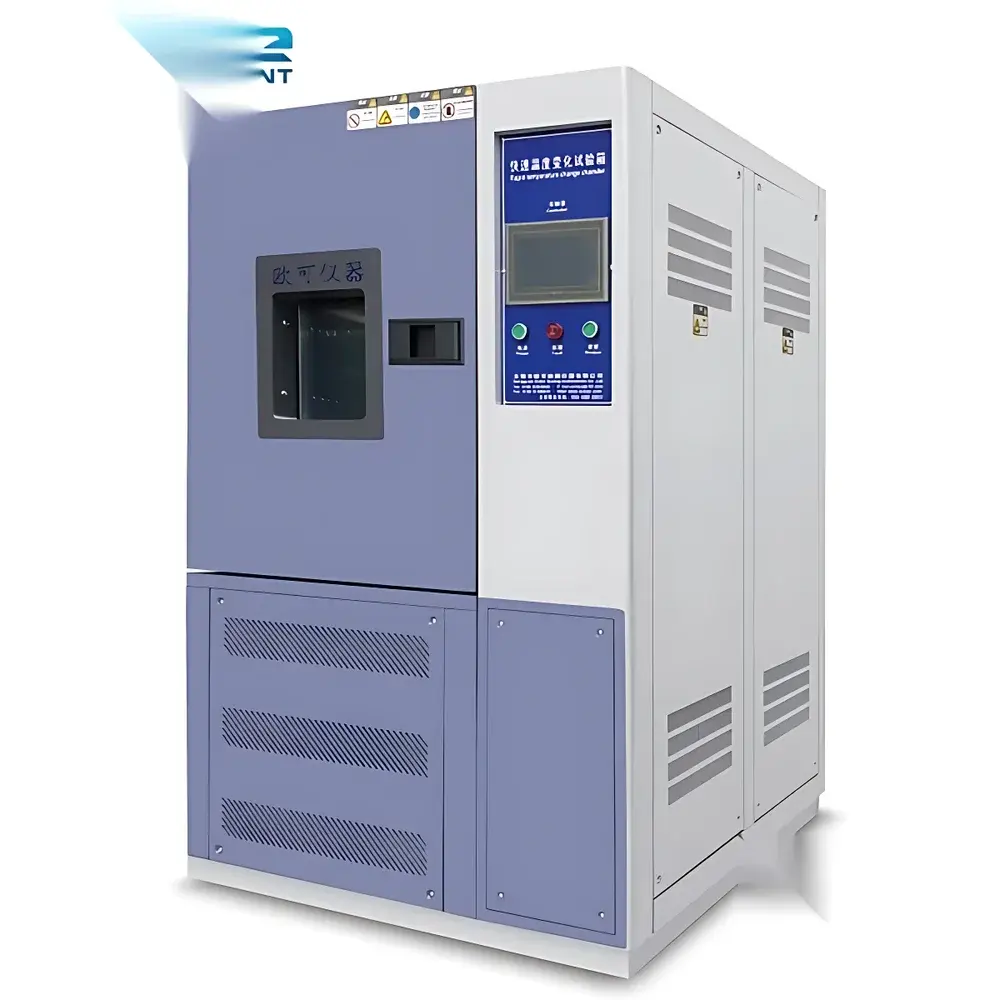
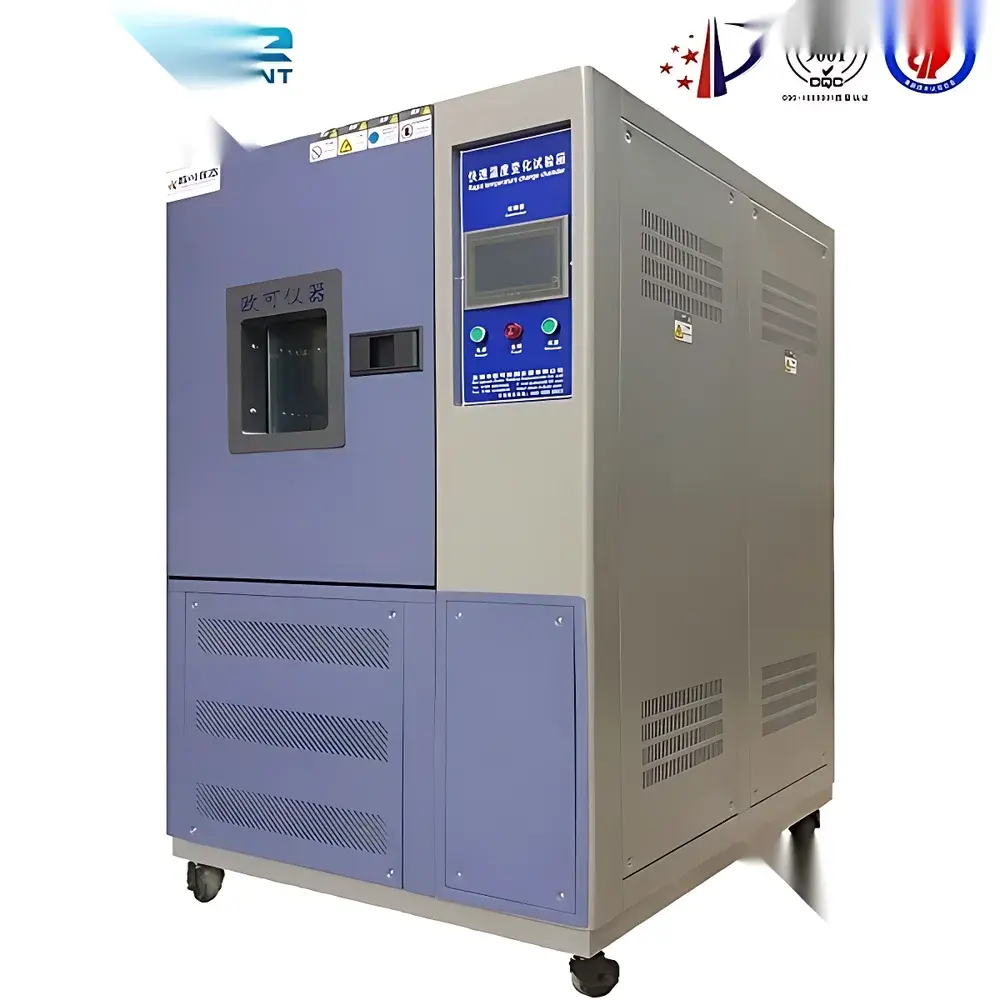
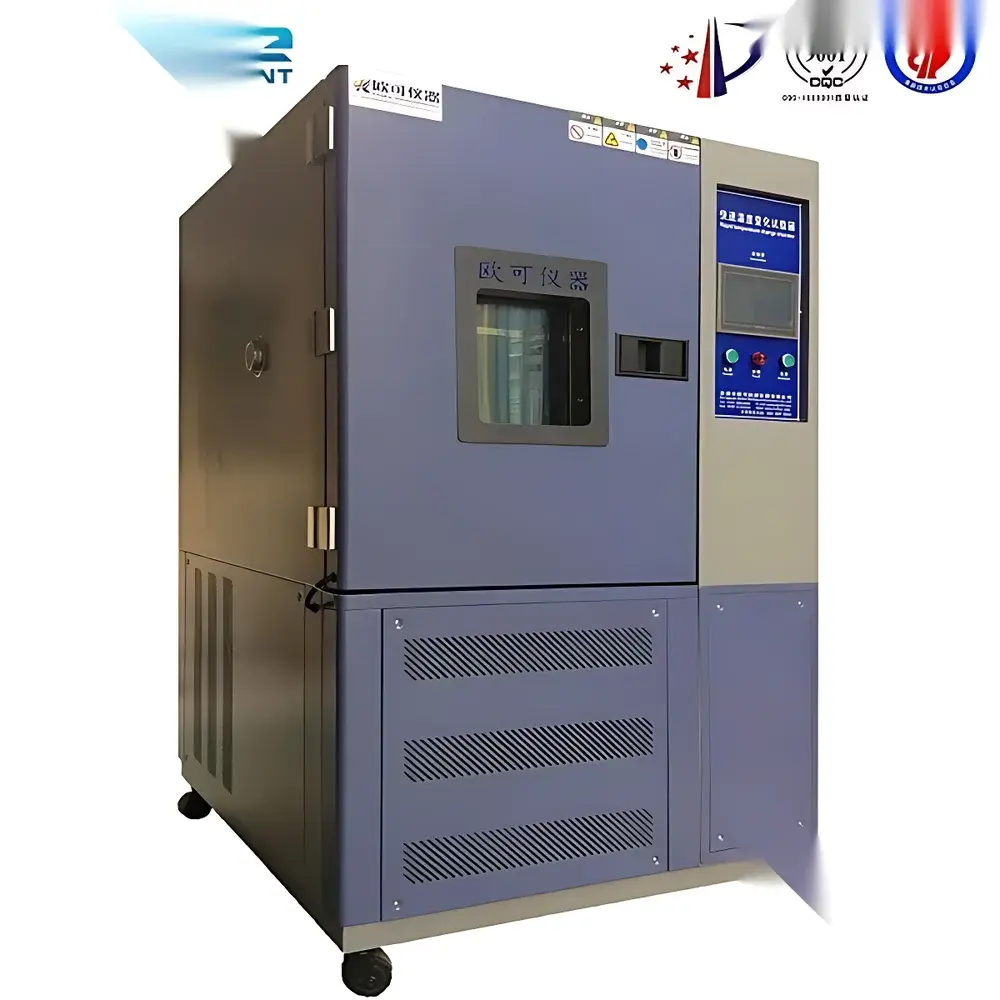
Ouke KS-TH Series Rapid Temperature Change Chamber (RTCC) – Industrial Environmental Test Chamber
| Brand | Ouke |
|---|---|
| Origin | China |
| Manufacturer Type | Authorized Distributor |
| Country of Origin | Imported Components |
| Price | USD 2,650 (FOB Guangdong) |
| Internal Dimensions (W×H×D, mm) | 500×600×500 to 1000×1000×1000 |
| External Dimensions (W×H×D, mm) | 1750×2250×2350 to 2350×2800×3000 |
| Temperature Range | −70 °C to +150 °C |
| Humidity Range (Optional) | 20–98% RH |
| Rapid Thermal Transition Range | −45 °C to +85 °C |
| Rapid Thermal Transition Accuracy | ±3.0 °C |
| Ramp Rates | 5–30 °C/min (Linear or Nonlinear Mode, Selectable) |
| Temperature Resolution | 0.1 °C |
| Humidity Resolution | 0.1% RH |
| Temperature Uniformity | ±2.0 °C |
| Humidity Uniformity | ±3.0% RH |
| Temperature Control Stability | ±0.5 °C |
| Humidity Control Stability | ±2.5% RH |
| Inner Chamber Material | SUS304 Stainless Steel |
| Outer Chamber Material | Cold-Rolled Steel with Powder Coating or Stainless Steel |
| Insulation | High-Density Polyurethane Foam (CFC-Free) |
| Refrigeration System | Water-Cooled |
| Compressor | Tecumseh (France) or Bitzer (Germany) |
| Power Supply | AC 380 V, 3-Phase 5-Wire, 50/60 Hz |
| Weight | 950–2300 kg |
Overview
The Ouke KS-TH Series Rapid Temperature Change Chamber (RTCC) is an industrial-grade environmental test system engineered for high-fidelity thermal stress evaluation under dynamically controlled conditions. It operates on a dual-loop PID-controlled refrigeration and heating architecture, enabling precise, repeatable transitions between extreme temperature setpoints without compromising chamber integrity or test specimen stability. Unlike standard thermal chambers, the KS-TH series is specifically designed for accelerated thermal cycling applications—such as HALT (Highly Accelerated Life Testing), qualification per MIL-STD-810H Method 503.6, and IEC 60068-2-14 change-of-temperature testing—where rapid ramp rates, tight uniformity, and traceable control performance are critical. The system supports both linear and non-linear ramp profiles, allowing users to emulate real-world thermal transients encountered in automotive electronics, aerospace avionics, battery modules, and semiconductor packaging. Humidity control (optional) extends capability to combined temperature-humidity stress tests aligned with JEDEC JESD22-A104E and IPC-9701 standards.
Key Features
- Programmable ramp rates from 5 °C/min to 30 °C/min across six standardized configurations (A–F), each calibrated and verified per IEC 60068-3-5
- Dual independent control loops for temperature and optional humidity, minimizing cross-coupling effects during dynamic transitions
- SUS304 stainless steel inner chamber with seamless welding and electropolished finish—resistant to corrosion, condensation buildup, and outgassing
- Water-cooled condensing unit with dual-stage compressors (Tecumseh or Bitzer), optimized for continuous operation at maximum ramp load
- Integrated safety architecture including high/low refrigerant pressure monitoring, over-temperature cutoff, phase-loss protection, and leak-detection interlocks
- Front-access observation window with double-glazed, low-E tempered glass (optional), rated for full operational temperature range
- Modular insulation using CFC-free polyurethane foam (≥150 mm thickness), achieving thermal conductivity ≤0.022 W/m·K at −40 °C
Sample Compatibility & Compliance
The KS-TH chamber accommodates test specimens up to 1000 L volume (KS-TH-1000 model), with configurable internal fixtures and load-bearing shelves rated for 50 kg uniformly distributed load. All models comply with electromagnetic compatibility (EMC) per EN 61326-1 and safety requirements per IEC 61010-1. The control system supports audit-ready operation under GLP/GMP environments, with optional 21 CFR Part 11-compliant software packages available for electronic signature, user access control, and immutable data logging. Calibration documentation follows ISO/IEC 17025 guidelines, and factory verification reports include temperature mapping (per ASTM E2297), ramp rate validation, and uniformity assessment across nine defined chamber zones.
Software & Data Management
Standard controller firmware includes a 7-inch capacitive touchscreen HMI with multilingual UI (English, German, Japanese, Simplified Chinese), real-time graphing, and onboard data storage (≥16 GB). Optional PC-based software enables remote monitoring via Ethernet/IP or Modbus TCP, automated report generation (PDF/CSV), and integration into enterprise LIMS or MES platforms. All logged parameters—including chamber setpoint, actual temperature/humidity, compressor status, alarm history, and ramp deviation—are timestamped with microsecond resolution and support CSV export for statistical process analysis (SPC). Audit trails record operator ID, parameter changes, and session start/stop events—fully compliant with FDA 21 CFR Part 11 when configured with digital signature modules.
Applications
- Thermal shock screening of PCBAs, MEMS sensors, and power electronics per JEDEC J-STD-020 and AEC-Q200
- Material characterization of polymer composites, adhesives, and conformal coatings under cyclic thermal stress
- Reliability validation of lithium-ion battery cells and packs under fast-ramp conditions (−30 °C ↔ +65 °C in <90 s)
- Environmental qualification of medical device enclosures and sterilizable components per ISO 13485 Annex C
- Pre-compliance testing for automotive ECUs per ISO 16750-4 and GMW3172 Section 5.4.2
FAQ
What is the difference between linear and non-linear ramp modes?
Linear mode maintains constant temperature change per minute throughout the entire transition; non-linear mode allows user-defined breakpoints and variable ramp rates within a single profile—essential for simulating non-uniform thermal gradients in complex assemblies.
Is humidity control available on all models?
Humidity capability is optional and requires additional steam generator, dehumidification module, and enhanced chamber sealing—only recommended for KS-TH-408 and larger models due to volumetric constraints.
Can the chamber be integrated into an automated test cell?
Yes—standard RS-485, Ethernet, and dry-contact I/O ports support PLC-level integration; optional EtherCAT or PROFINET gateways are available for Industry 4.0 deployment.
What maintenance intervals are recommended?
Compressor oil and refrigerant checks every 12 months; condenser coil cleaning every 3 months in dusty environments; full calibration verification annually or after 2000 thermal cycles.
Does the system support third-party calibration services?
All KS-TH units ship with NIST-traceable calibration certificates; accredited field service partners in EU, US, and APAC provide ISO/IEC 17025-compliant recalibration with uncertainty budgets.



