
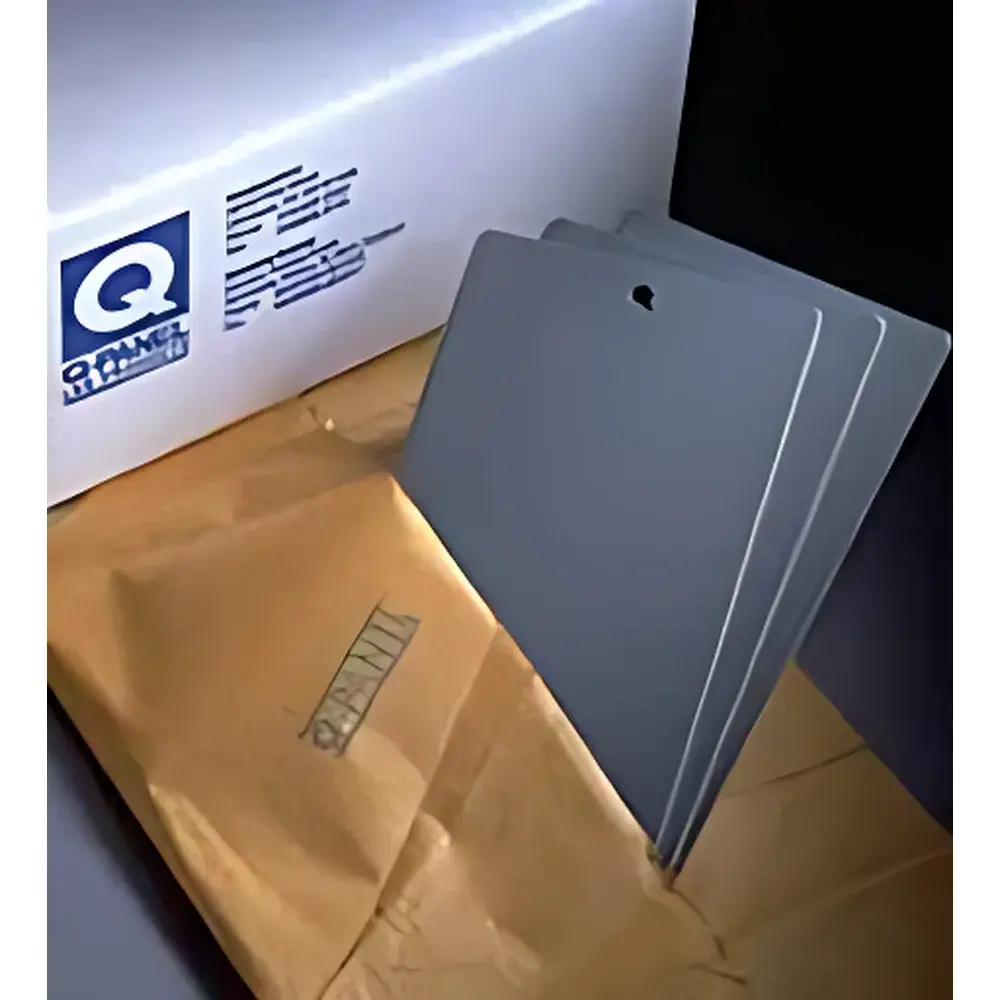
Q-Lab Q-Panel Standard Test Panels
| Brand | Q-Lab |
|---|---|
| Origin | USA |
| Manufacturer Type | Original Equipment Manufacturer (OEM) |
| Import Status | Imported |
| Model | Q-Panel |
| Pricing | Available Upon Request |
Overview
Q-Lab Q-Panel Standard Test Panels are precision-engineered reference substrates designed for reproducible, standardized evaluation of coating performance under accelerated weathering, corrosion, adhesion, and mechanical stress testing. As globally recognized benchmark substrates, Q-Panel test panels serve as the foundational interface between coating formulations and standardized test protocols—including ASTM D609, ISO 1514, ISO 2808, ASTM D3359, and ISO 2409. Manufactured in Q-Lab’s ISO 9001-certified facility in Westlake, Ohio, USA, each panel undergoes rigorous dimensional control, surface cleanliness validation, and batch traceability to ensure metrological consistency across laboratories, QC labs, and R&D facilities worldwide.
Key Features
- Material Consistency: Steel panels are fabricated from low-carbon, cold-rolled steel (ASTM A1008 CS Type B), with tightly controlled thickness tolerances (±0.02 mm), surface roughness (Ra ≤ 0.8 µm), and minimal residual oil content (< 0.5 mg/m²) to eliminate substrate-induced variability in salt spray, humidity, and UV exposure tests.
- Aluminum Panel Specification: Aluminum variants utilize 5052-H32 alloy per ASTM B209, offering balanced formability, corrosion resistance, and electrochemical stability—critical for cyclic corrosion testing (CCT), electrochemical impedance spectroscopy (EIS), and automotive OEM qualification protocols.
- Surface Readiness: All panels are cleaned via vapor degreasing and packaged in low-particulate, static-dissipative polyethylene bags. No pre-cleaning is required prior to coating application in most standard test methods, reducing procedural variability and operator dependency.
- Dimensional Flexibility: Available in standardized dimensions—including 75 × 150 mm, 100 × 200 mm, and 150 × 300 mm—and custom-cut options up to 610 × 1220 mm—with edge deburring and squareness tolerance maintained within ±0.1°.
- Traceability & Documentation: Each production lot includes a Certificate of Conformance (CoC) listing material certification, surface profile data, and cleaning verification records. Batch numbers are laser-etched on packaging for full GLP-compliant audit trail linkage.
Sample Compatibility & Compliance
Q-Panel substrates are validated for compatibility with solvent-based, waterborne, powder, and high-solids coatings across architectural, automotive, aerospace, and industrial maintenance sectors. Their surface chemistry and topography meet the substrate requirements of major international standards including ASTM G151/G154 (accelerated exposure), ISO 11341 (artificial weathering), and SAE J2334 (cyclic corrosion). Panels are routinely specified in OEM material specifications (e.g., Ford WSS-M2P177-A2, GMW14872, BMW GS 90010) and accepted by third-party accreditation bodies such as A2LA and UKAS for ISO/IEC 17025-compliant testing.
Software & Data Management
While Q-Panel test panels are passive physical substrates, their use is fully integrated into digital quality workflows. Q-Lab’s Q-Support platform provides downloadable substrate specification sheets, test method cross-references, and batch-specific CoC templates compatible with LIMS (Laboratory Information Management Systems) and electronic lab notebooks (ELNs). All documentation conforms to FDA 21 CFR Part 11 requirements for electronic records and signatures when deployed in regulated environments. Traceability metadata—including lot number, manufacturing date, and surface verification logs—can be imported directly into Q-Lab’s Q-Lab Dashboard for longitudinal test correlation analysis.
Applications
- Accelerated weathering and lightfastness evaluation in Q-SUN xenon-arc and Q-UV fluorescent UV chambers
- Corrosion resistance assessment per ASTM B117 (salt spray), ASTM D5894 (cyclic corrosion), and ISO 9227
- Adhesion testing using cross-hatch (ASTM D3359) or pull-off (ASTM D4541) methodologies
- Film thickness measurement calibration for magnetic induction (ISO 2808) and eddy current gauges
- Colorimetric stability studies requiring spectrophotometric baseline consistency
- Qualification of pretreatment chemistries (phosphating, chromating, zirconium-based conversion coatings)
FAQ
Are Q-Panel test panels certified to ISO/IEC 17025?
No—Q-Panel panels are reference materials, not calibrated measurement devices; however, their production process and incoming material certifications comply with ISO 9001, and they are widely accepted as compliant substrates within ISO/IEC 17025-accredited testing laboratories.
Can I request surface roughness or coating weight data for a specific lot?
Yes—Q-Lab provides optional surface profilometry reports (per ISO 4287) and mill certificate data upon request at time of order.
Do aluminum Q-Panel substrates require anodizing before coating application?
Not unless specified by the test method; standard Q-Panel aluminum panels are supplied in the as-rolled, chemically cleaned condition per ASTM D2651 and are suitable for direct coating application in most industry-standard protocols.
What is the shelf life of unopened Q-Panel packages?
When stored in original packaging at ambient conditions (15–25°C, <60% RH), shelf life exceeds 24 months with no degradation in surface integrity or cleanliness.
Are custom panel geometries available with NIST-traceable dimensional certification?
Yes—Q-Lab offers custom cutting services with optional CMM (coordinate measuring machine) dimensional validation reports traceable to NIST standards for critical applications requiring metrological assurance.



