
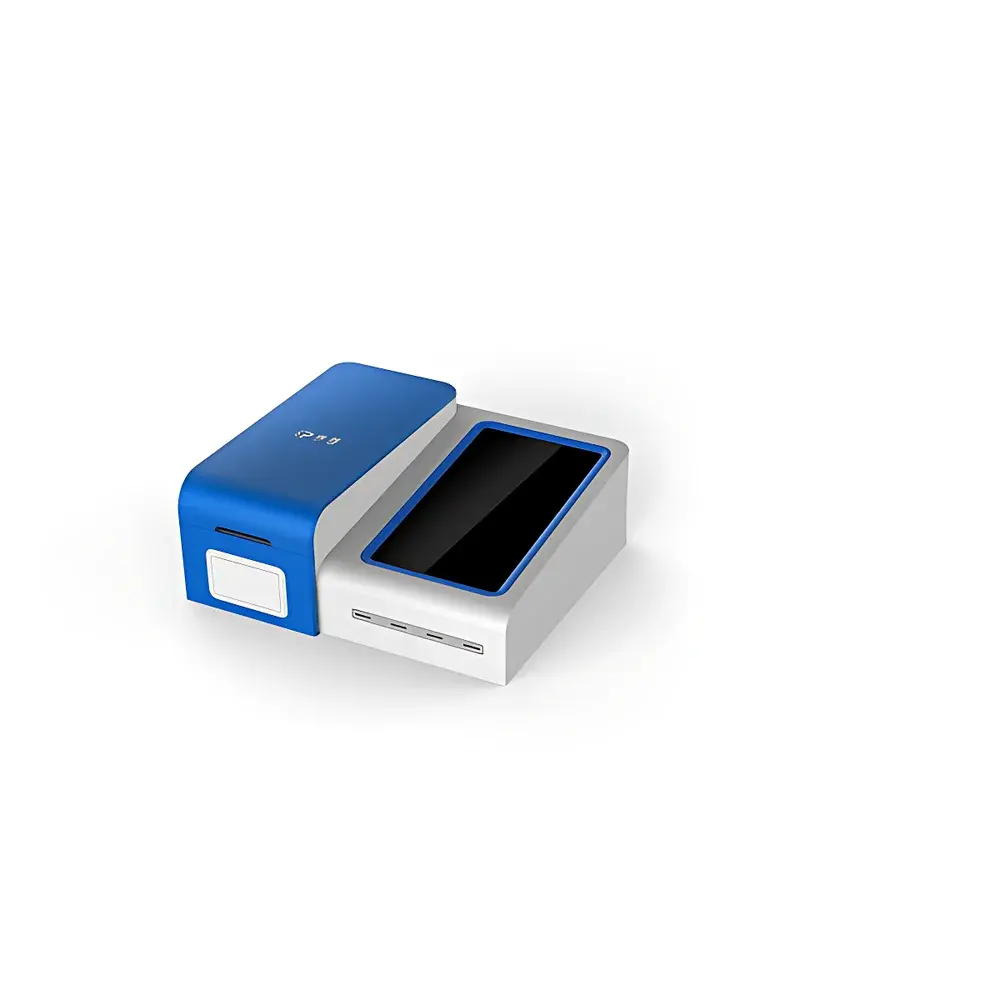
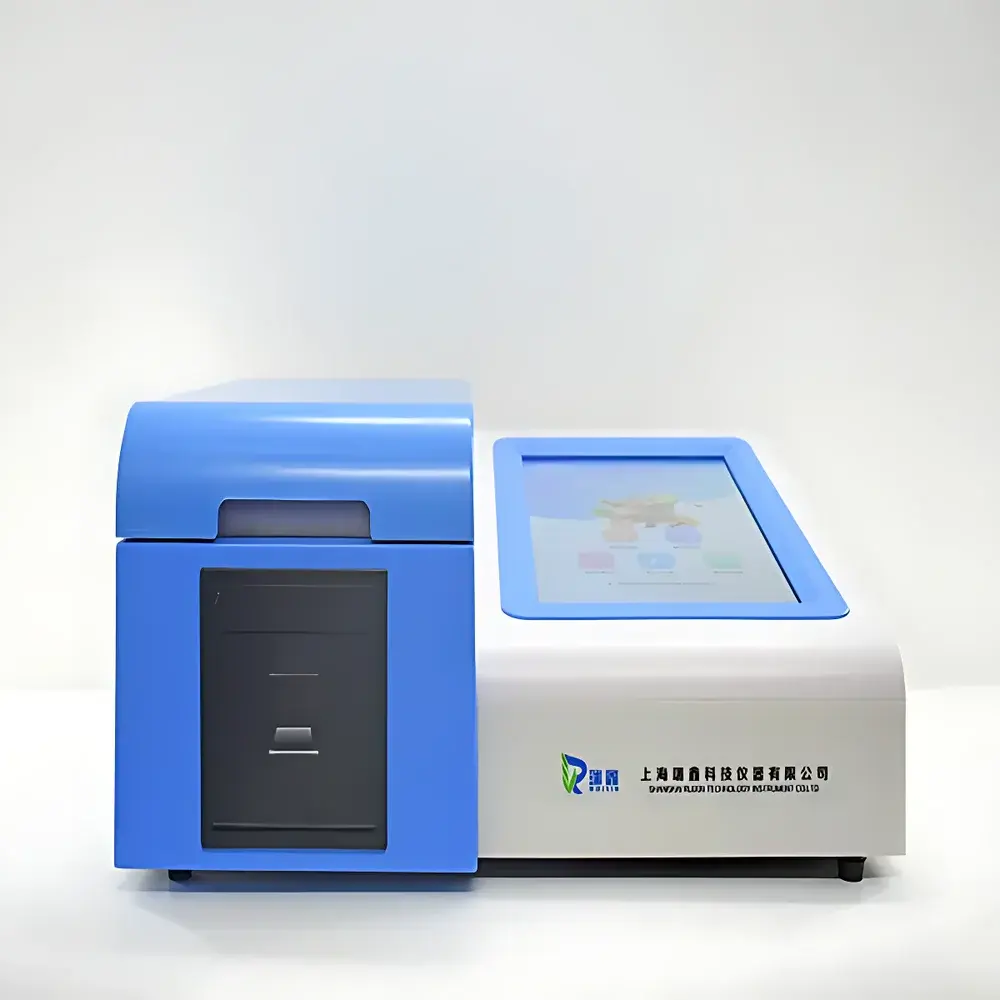
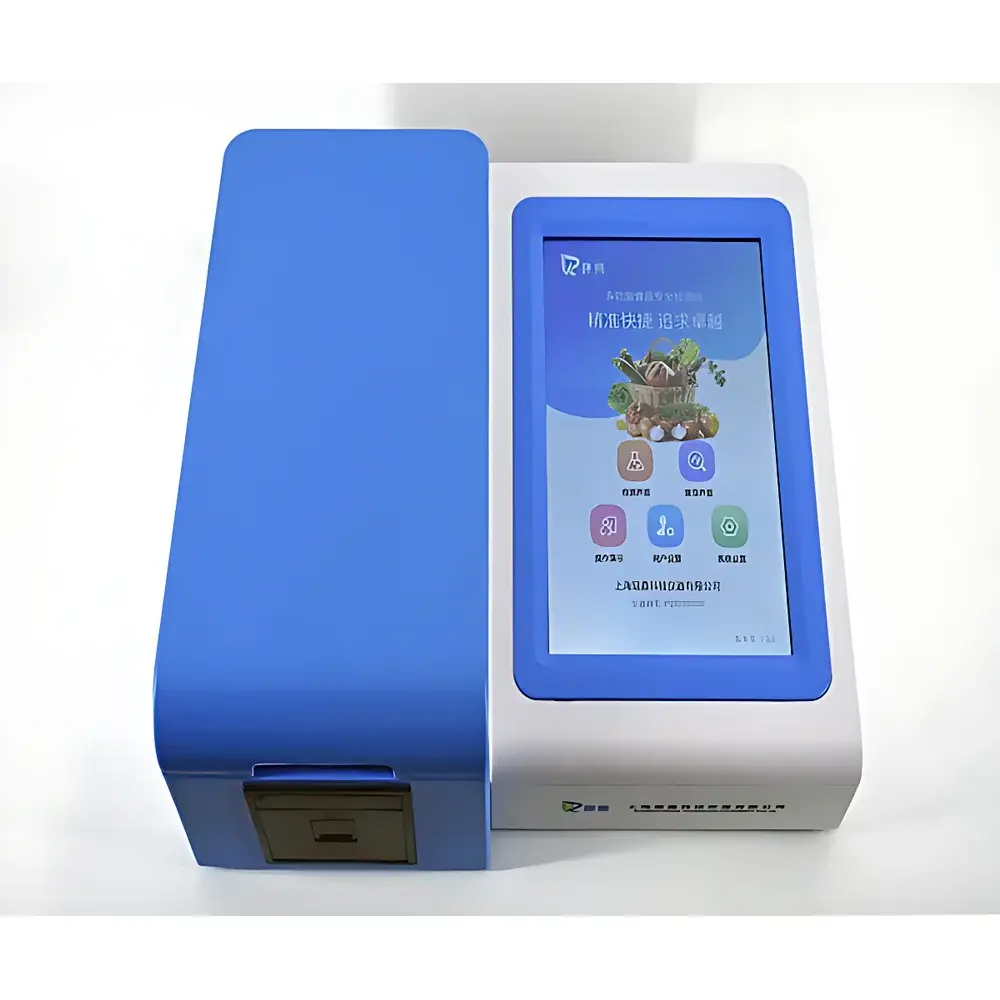
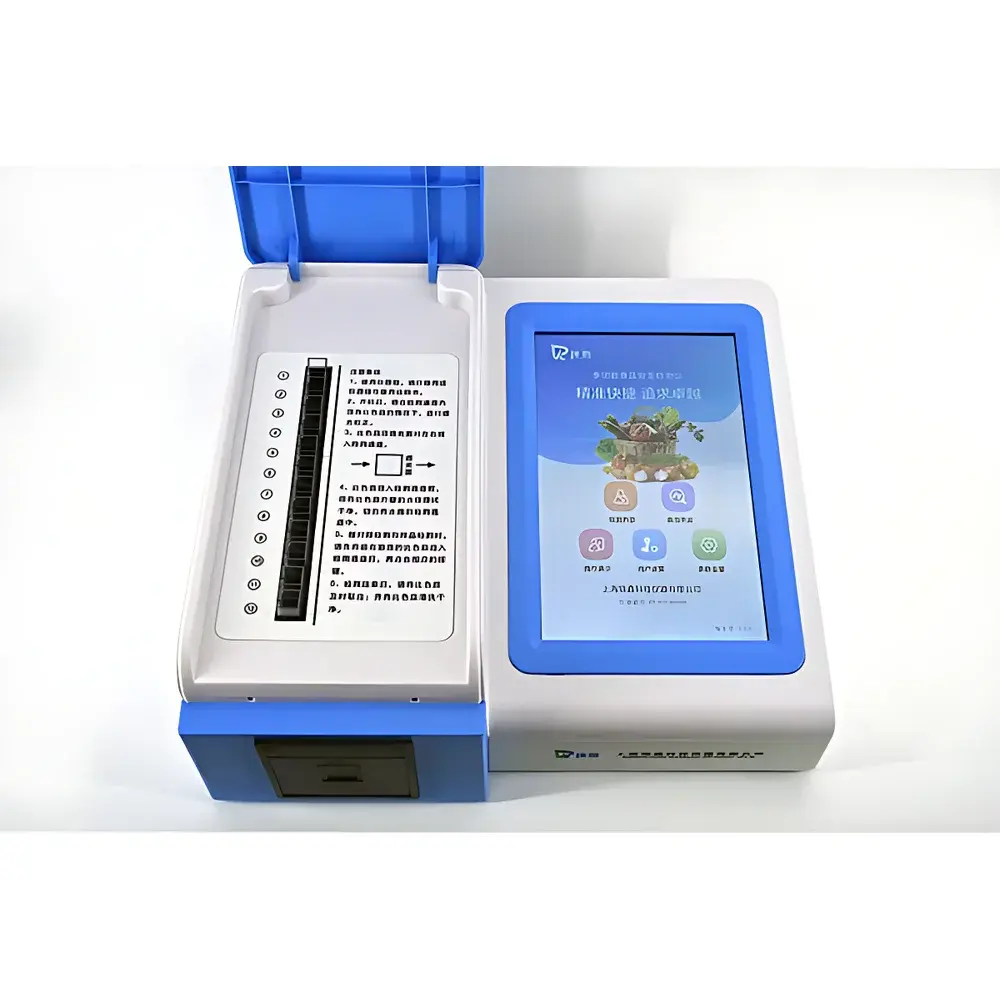
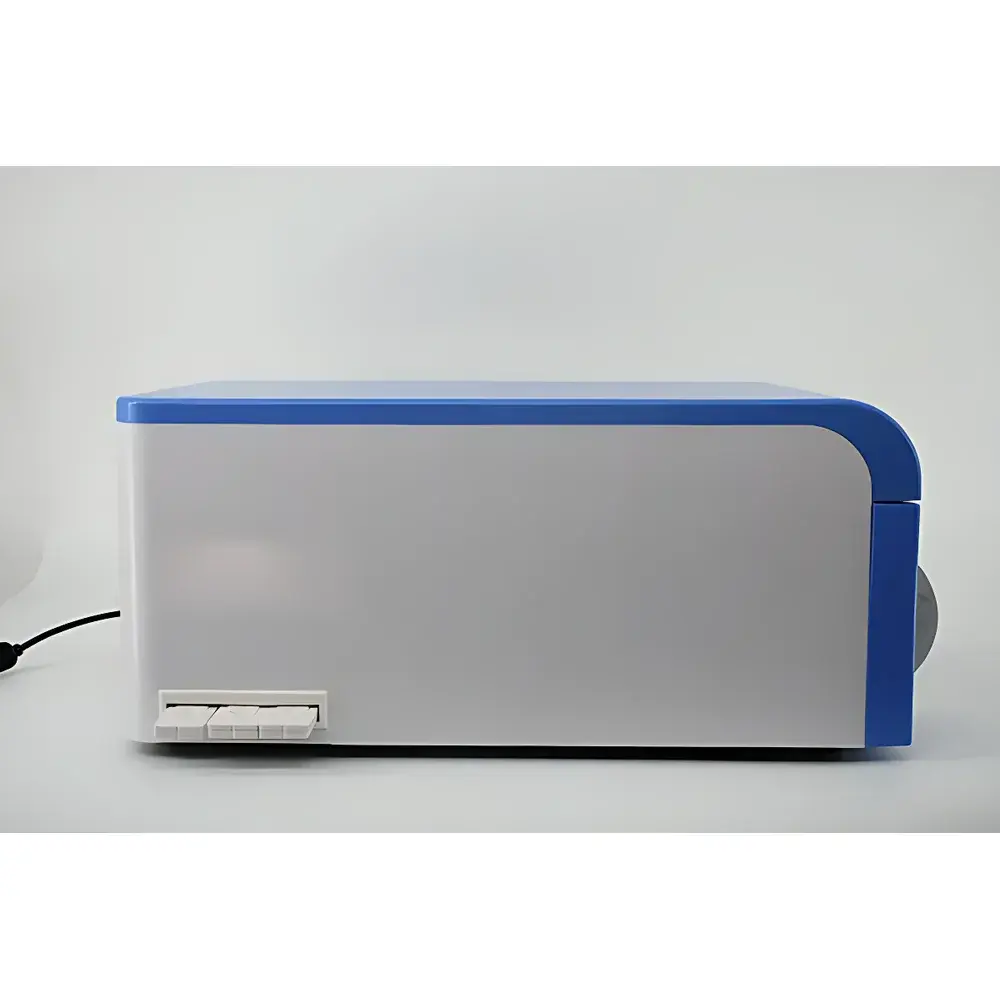
Ruixin CNY-1618C Pesticide Residue Rapid Tester
| Brand | Ruixin |
|---|---|
| Origin | Shanghai, China |
| Manufacturer Type | Authorized Distributor |
| Country of Origin | China |
| Model | CNY-1618C |
| Detection Method | Enzyme Inhibition (Spectrophotometric) |
| Measurement Range | 0–100% Inhibition |
| Number of Channels | 16 |
| Measurement Error | <10% |
| Limit of Detection (LOD) | 0.2 ppm |
| Display | 10.1-inch TFT LCD Touchscreen (1024×600), IP65-rated front panel |
| Operating System | Android 7.0 (Quad-core, 1.8 GHz, 2 GB RAM, 16 GB internal storage + microSD expansion) |
| Optical Performance | Absorbance range 0.000–4.000 A |
| Throughput | Up to 180 samples/hour |
| Connectivity | Dual USB 2.0 ports, Wi-Fi (802.11 b/g/n), RJ45 Ethernet, optional 3G/4G/5G module, GPS/AGPS |
| Power Supply | AC 220 V ±10%, 50/60 Hz |
| Compliance | Designed per GB 5009.199–2003 and NY/T 448–2001 |
Overview
The Ruixin CNY-1618C Pesticide Residue Rapid Tester is a dedicated benchtop spectrophotometric analyzer engineered for high-throughput, on-site screening of organophosphorus and carbamate pesticide residues in fresh agricultural commodities. It operates on the well-established enzyme inhibition principle: acetylcholinesterase (AChE) activity is inhibited proportionally by residual organophosphate or carbamate pesticides present in extracted samples. The degree of inhibition is quantified via colorimetric measurement of substrate hydrolysis (typically using 5,5′-dithiobis-(2-nitrobenzoic acid), DTNB), expressed as percentage inhibition relative to a reagent blank. This method is standardized under Chinese national food safety regulation GB 5009.199–2003 and agricultural industry standard NY/T 448–2001, and aligns with internationally recognized rapid screening protocols for pre-screening prior to confirmatory analysis (e.g., GC-MS or LC-MS/MS). The instrument is designed for deployment in regulatory laboratories, municipal market supervision offices, smart farmers’ markets, and agri-food quality control centers where operational simplicity, data traceability, and integration into digital food safety infrastructures are critical requirements.
Key Features
- 16-channel parallel detection architecture enables simultaneous analysis of up to 16 samples per run, supporting throughput of up to 180 samples per hour under routine operation.
- 10.1-inch industrial-grade capacitive touchscreen (1024 × 600 resolution) with IP65-rated front panel, 400 cd/m² brightness, and integrated stylus support—including secure handwritten signature capture for audit-compliant reporting.
- Embedded Android 7.0 operating system (quad-core 1.8 GHz processor, 2 GB RAM, 16 GB eMMC storage + microSD expansion slot) ensures responsive UI navigation and local data persistence without external computing hardware.
- Automated workflow logic: intelligent sample presence detection per channel, real-time pass/fail classification against configurable inhibition thresholds, and auto-generation of printable compliance reports.
- Integrated dual-network connectivity: built-in Wi-Fi (802.11 b/g/n) and Gigabit Ethernet (RJ45), with optional field-upgradable 3G/4G/5G modem and GPS/AGPS modules for geotagged sampling and offline-to-cloud synchronization.
- Self-diagnostic firmware and embedded instructional video library support rapid troubleshooting and operator training—reducing dependency on technical service visits.
Sample Compatibility & Compliance
The CNY-1618C is validated for qualitative and semi-quantitative analysis of organophosphate and carbamate residues in homogenized extracts from leafy vegetables, fruits, cereals, grains, and fresh tea leaves. Sample preparation follows standardized aqueous extraction protocols defined in GB 5009.199–2003. While not intended for regulatory confirmation, its performance characteristics—including photometric accuracy (±1.5% T), repeatability (≤0.2% T), and LOD of 0.2 ppm—meet the sensitivity and reproducibility expectations for Tier-1 rapid screening in food safety surveillance programs. Data integrity is maintained through timestamped, user-authenticated records stored locally and synchronized to cloud platforms compliant with GLP-aligned metadata requirements (e.g., operator ID, location stamp, instrument ID, calibration log reference).
Software & Data Management
Data acquisition, processing, and export are fully managed within the onboard Android environment. All results—including absorbance (0.000–4.000 A), transmittance (0.00–100.00% T), inhibition %, sample ID, testing date/time, operator credentials, and GPS coordinates—are stored in a structured SQLite database. Export options include direct USB transfer of Excel-compatible .csv files and encrypted cloud upload via HTTPS REST API to Ruixin’s certified SaaS platform or customer-hosted LIMS. Audit trails record all critical events (e.g., calibration actions, threshold modifications, report generation), satisfying foundational requirements for ISO/IEC 17025 Annex A.2 traceability and FDA 21 CFR Part 11 electronic record principles (though formal Part 11 validation requires site-specific configuration and procedural documentation).
Applications
- Routine surveillance testing at wholesale markets, supermarket QC labs, and county-level agricultural product quality supervision stations.
- On-farm gate verification prior to harvest dispatch or cooperative aggregation.
- Real-time monitoring in “smart vegetable markets” equipped with public-facing dashboards and blockchain-enabled traceability systems.
- Training and capacity-building for rural extension technicians and cooperative QA staff due to intuitive interface and embedded procedural guidance.
- Pre-screening triage in regional food safety laboratories to prioritize samples for confirmatory GC-MS analysis.
FAQ
What pesticide classes does the CNY-1618C detect?
It detects organophosphorus and carbamate insecticides—including chlorpyrifos, dimethoate, omethoate, methomyl, and carbofuran—via enzymatic inhibition of acetylcholinesterase.
Is calibration required before each use?
A single-point reagent blank calibration is performed automatically at startup; no manual wavelength or zero-adjustment is needed. Periodic verification using control standards is recommended per GB 5009.199–2003 Section 7.3.
Can test results be integrated with national food safety information systems?
Yes—through Ruixin’s open API or configurable HTTP POST endpoints, enabling interoperability with provincial food safety big-data platforms and national traceability networks (e.g., China’s National Agricultural Product Quality and Safety Traceability Platform).
Does the instrument support multi-language UI?
The default interface is English and Simplified Chinese; additional language packs (e.g., Vietnamese, Thai, Arabic) are available upon request for export markets.
What is the expected lifetime of the enzymatic reagents?
Lyophilized AChE and DTNB substrates retain full activity for ≥12 months when stored at –20 °C; working solutions remain stable for 4 hours at ambient temperature (25 °C) post-reconstitution.






