
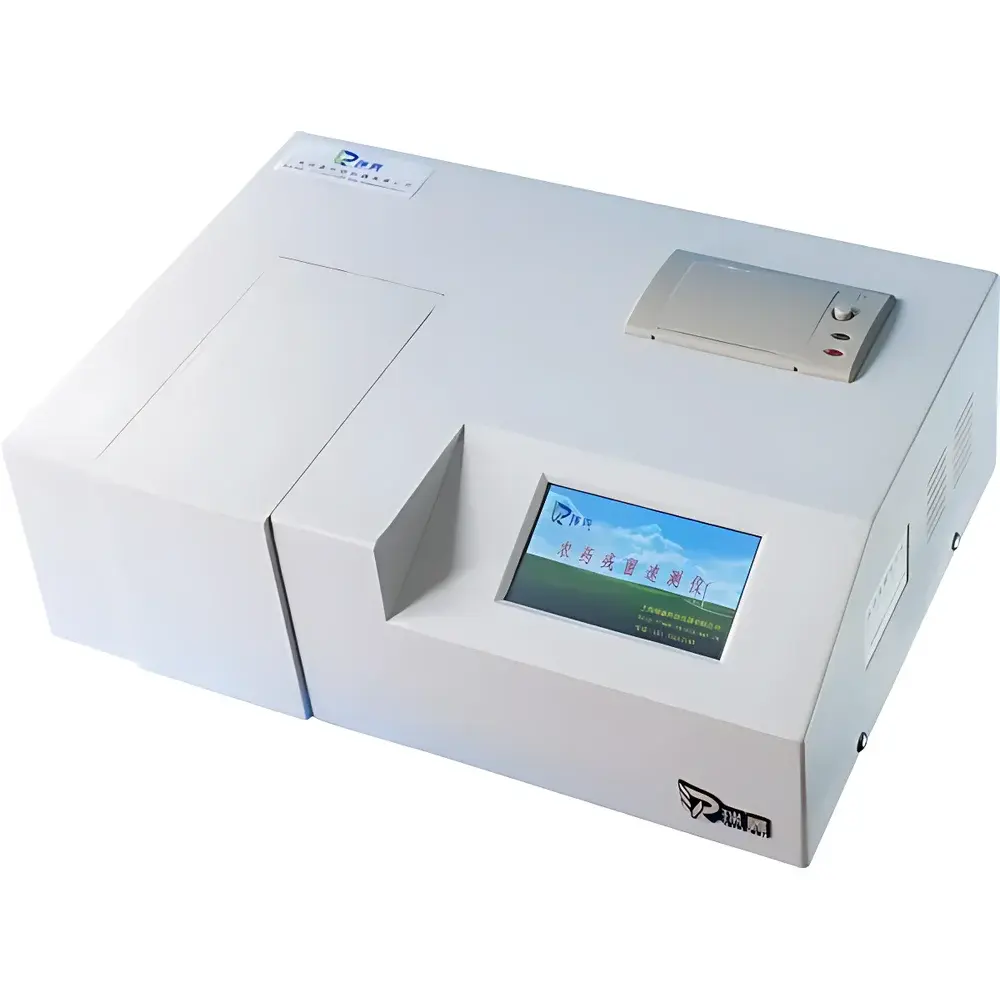
Ruixin CNY-815C Pesticide Residue Rapid Tester
| Brand | Ruixin |
|---|---|
| Origin | Shanghai, China |
| Manufacturer Type | Authorized Distributor |
| Country of Origin | China |
| Model | CNY-815C |
| Detection Method | Enzyme Inhibition Assay |
| Measurement Range | 0–100% inhibition rate |
| Number of Channels | 8 |
| Measurement Error | ≤10% |
| Limit of Detection (LOD) | 0.3 ppm |
| Display | 4.5-inch high-resolution color LCD touchscreen |
| Absorbance Range | 0.000–4.000 |
| Transmittance Range | 0.00–100.00% |
| Transmittance Resolution | 0.01% |
| Absorbance Resolution | 0.001 |
| Photometric Accuracy (Transmittance) | ≤2.0% |
| Photometric Repeatability (Transmittance) | ≤0.2% |
| Photocurrent Drift | ≤0.2% (within 3 min) |
| Wavelength | 410 nm |
| Data Storage Capacity | 10,000 test records |
| Communication Interfaces | RS232 and USB |
| Power Supply | 220 V ±10% |
Overview
The Ruixin CNY-815C Pesticide Residue Rapid Tester is a dedicated benchtop photometric analyzer engineered for the quantitative determination of organophosphorus and carbamate pesticide residues in fresh fruits and vegetables. It operates on the principle of acetylcholinesterase (AChE) or butyrylcholinesterase (BChE) inhibition assay—a well-established biochemical method standardized under GB 5009.199–2003 (National Food Safety Standard – Determination of Organophosphorus and Carbamate Pesticides in Foods) and NY/T 448–2001 (Agricultural Industry Standard – Rapid Detection Method for Pesticide Residues in Vegetables). The instrument measures the degree of enzyme activity suppression caused by residual anticholinesterase pesticides, converting optical density changes at 410 nm into inhibition rate values (0–100%). Its design emphasizes field-deployable reliability, regulatory alignment, and operational simplicity for non-specialist users in food safety screening environments.
Key Features
- 8-channel simultaneous detection architecture enables parallel analysis of up to eight samples per run, improving throughput for high-volume screening operations.
- 4.5-inch high-resolution color LCD touchscreen with full Chinese GUI supports intuitive navigation, real-time data visualization, and direct中文 input via on-screen keyboard or stylus—eliminating transcription errors in sample annotation.
- Built-in sample library containing 72 preloaded fruit and vegetable names; editable via touchscreen interface or bulk import through companion software.
- Integrated thermal mini-printer delivers immediate hard-copy reports compliant with internal QA documentation requirements.
- Self-calibrating optical path system performs automatic zero and 100% transmittance calibration at power-on—no manual adjustment required prior to analysis.
- User-configurable reaction time (1–15 min) and inhibition threshold criteria (e.g., ≥50% inhibition = positive result), supporting method flexibility across diverse matrix types and regulatory thresholds.
- Onboard storage capacity for 10,000 test records with timestamp, sample ID, operator ID, inhibition rate, and raw absorbance values—enabling traceability without external devices.
- Supports both AChE and BChE reagents, ensuring compatibility with national standard protocols and facilitating method validation under dual-enzyme verification schemes.
- Low reagent consumption (~¥0.3–0.5 per test) reduces cost-per-analysis while maintaining analytical validity for routine surveillance programs.
Sample Compatibility & Compliance
The CNY-815C is validated for homogenized extracts from common agricultural commodities including leafy greens (e.g., spinach, lettuce), solanaceous crops (tomato, pepper), cucurbits (cucumber, zucchini), and pome/stone fruits (apple, peach). Sample preparation follows standardized homogenization, centrifugation, and supernatant dilution procedures outlined in GB 5009.199–2003. While not intended for quantitative LC-MS/MS confirmation, the instrument meets performance criteria for rapid prescreening in accordance with China’s Ministry of Agriculture and Rural Affairs (MARA) guidance for market-level monitoring. Its photometric specifications—including transmittance accuracy (≤2.0%), repeatability (≤0.2%), and 410 nm fixed-wavelength optics—are aligned with ISO 7027 principles for turbidimetric/enzymatic assays. Data integrity safeguards include sequential record numbering, immutable timestamps, and audit-ready export logs compatible with GLP-aligned laboratory information management systems (LIMS).
Software & Data Management
A dedicated Windows-based data management software package enables secure bidirectional communication via RS232 or USB. Functions include remote firmware updates, batch editing of sample metadata, statistical summary generation (mean inhibition rate, pass/fail rates by location or commodity), and CSV/Excel-compatible export for integration into enterprise reporting platforms. Audit trails capture user login events, parameter modifications, and report generation actions—supporting basic compliance with FDA 21 CFR Part 11 expectations for electronic records when deployed in regulated environments. All exported datasets retain original measurement IDs, instrument serial number, and calibration history references to ensure forensic traceability.
Applications
- Government-run vegetable quality supervision centers performing statutory surveillance of wholesale markets and distribution hubs.
- Supermarket and hypermarket QA laboratories conducting daily inbound inspections of produce suppliers.
- Agricultural cooperatives and certified organic farms implementing internal residue monitoring programs prior to harvest or shipment.
- Hotel and institutional catering procurement departments verifying vendor compliance before accepting deliveries.
- Environmental protection agencies assessing pesticide drift impact near cultivation zones using roadside sampling protocols.
- Educational institutions utilizing the platform for hands-on training in food toxicology and analytical biochemistry curricula.
FAQ
What pesticides does the CNY-815C detect?
It detects organophosphorus (e.g., chlorpyrifos, diazinon) and carbamate (e.g., carbaryl, methomyl) pesticides based on their reversible inhibition of cholinesterase enzymes.
Is the instrument suitable for regulatory reporting?
Yes—it complies with GB 5009.199–2003 and NY/T 448–2001, and its performance metrics satisfy requirements for official rapid screening programs in China’s food safety governance framework.
Can inhibition rate results be converted to concentration units (ppm)?
No—the CNY-815C provides semi-quantitative inhibition percentages only; quantitative calibration curves require external reference standards and are outside its design scope.
How often does the optical system require maintenance?
The self-calibrating photometric path eliminates routine zero/100 adjustments; however, periodic cleaning of cuvette holders and LED source windows every 3 months is recommended to maintain long-term photometric stability.
Does the device support network connectivity for centralized data aggregation?
While it lacks built-in Ethernet or Wi-Fi, the RS232/USB interfaces allow connection to local servers or cloud gateways via intermediary PCs running the official data management software.




