
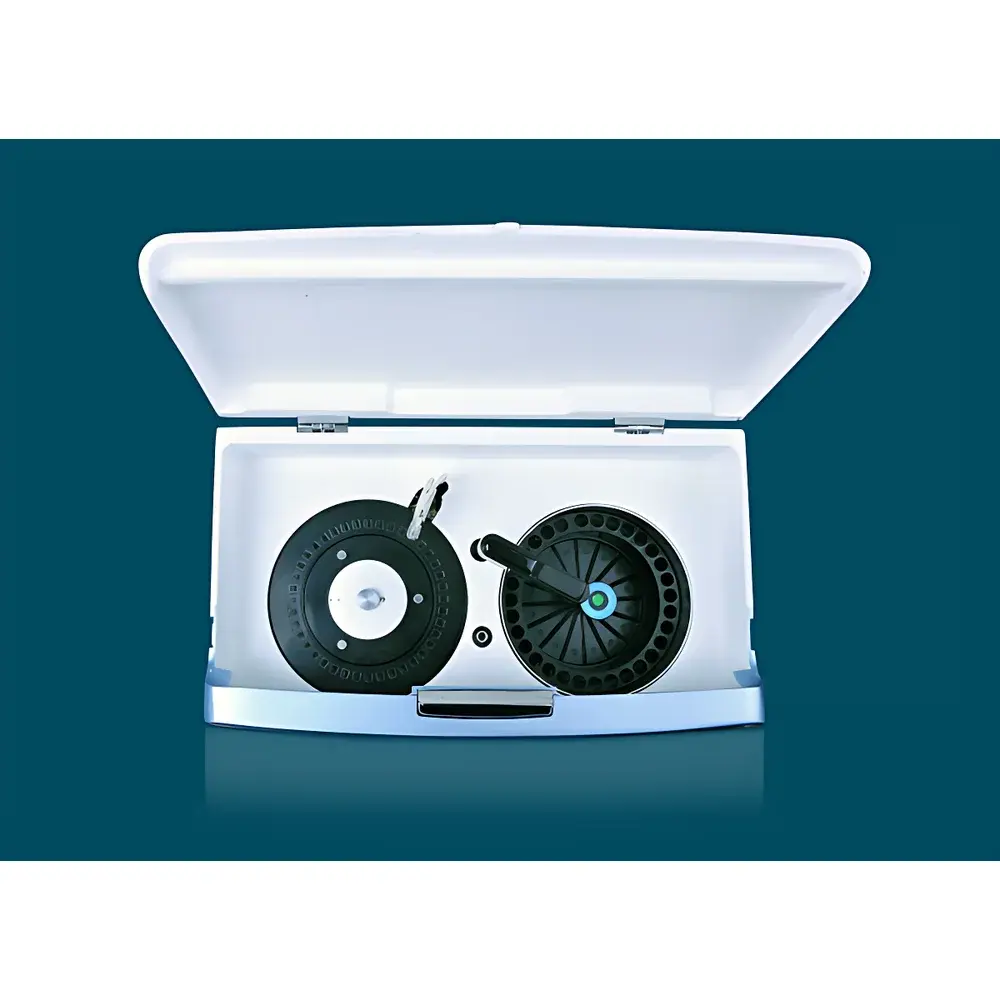
Ruixin NC-32ZD Fully Automated Pesticide Residue Analyzer
| Brand | Ruixin |
|---|---|
| Origin | Shanghai, China |
| Model | NC-32ZD |
| Detection Method | Enzyme Inhibition Assay |
| Measurement Range | 0–100% inhibition |
| Number of Channels | 32 |
| Measurement Error | ≤10% |
| Limit of Detection (LOD) | 0.3 ppm (for methamidophos) |
| Wavelength Options | 340, 410, 450, 510, 546, 630 nm |
| Reaction Temperature | 37 ± 1 °C (software-adjustable) |
| Transmittance Accuracy | ±1.5% |
| Transmittance Repeatability | ≤0.5% |
| Absorbance Drift | ≤0.005 Abs/3 min |
| Inhibition Rate Repeatability | ≤5% |
| Power Supply | AC 100–240 V, 50/60 Hz, 102 W |
| Dimensions | 468 × 270 × 290 mm |
| Weight | ~13 kg |
Overview
The Ruixin NC-32ZD Fully Automated Pesticide Residue Analyzer is a dedicated benchtop spectrophotometric system engineered for high-throughput screening of organophosphorus and carbamate pesticide residues in food and agricultural commodities. It operates on the principle of enzyme inhibition assay—measuring the degree of acetylcholinesterase (AChE) activity suppression caused by residual pesticides in extracted samples. The instrument quantifies inhibition rates (%) by monitoring absorbance changes at user-selectable wavelengths (340–630 nm) following colorimetric reaction kinetics. Designed for compliance with Chinese national standards GB 5009.199–2016 (replacing 2003) and NY/T 448–2001, the NC-32ZD delivers reproducible, field-deployable results without requiring certified laboratory infrastructure. Its integrated thermal control (37 ± 1 °C), precision liquid handling, and optical stability make it suitable for routine quality control in food safety laboratories, agro-processing facilities, and regulatory inspection units.
Key Features
- Fully automated workflow: independent control of sample aspiration, reagent dispensing, mixing, incubation, photometric measurement, and post-assay channel cleaning—eliminating manual intervention and inter-operator variability.
- 32 parallel detection channels with individual addressability: each channel supports customizable sample metadata, independent start/stop control, and flexible assignment as reference or test position.
- Intelligent liquid handling system: equipped with liquid-level sensing and collision avoidance for pipetting needles—ensuring robust operation across varying sample viscosities and container geometries.
- Dual-mode optical system: high-stability LED light source paired with precision glass cuvettes (long service life, low scatter, minimal batch-to-batch deviation).
- Multi-wavelength capability: six fixed wavelengths (340, 410, 450, 510, 546, 630 nm) configurable singly or in combination—enabling method adaptation for alternative analytes beyond standard AChE inhibition assays.
- Thermostatically regulated reaction chamber: maintains precise 37 ± 1 °C incubation temperature; software-adjustable to accommodate protocol-specific kinetic requirements.
- Comprehensive photometric performance: transmittance accuracy ±1.5%, repeatability ≤0.5%, and baseline drift ≤0.005 Abs/3 min—meeting ISO 8466-1 requirements for quantitative spectrophotometric validation.
Sample Compatibility & Compliance
The NC-32ZD accepts homogenized extracts from fresh produce (leafy vegetables, fruits), cereals, drinking water, and green tea—following standardized sample preparation protocols outlined in GB 5009.199–2016. It is validated for detection of common organophosphates (e.g., methamidophos, chlorpyrifos, dimethoate) and carbamates (e.g., carbaryl, methomyl) with a stated LOD of 0.3 ppm for methamidophos. All hardware and firmware components comply with IEC 61010-1 (safety of laboratory equipment) and electromagnetic compatibility (EMC) directives per CISPR 11. While not FDA 21 CFR Part 11–certified out-of-the-box, the system supports audit-trail-enabling software upgrades and GLP/GMP-aligned data export formats (CSV, PDF, XML) compatible with LIMS integration.
Software & Data Management
Bundled Ruixin Analytical Control Software (RACS v3.2+) provides full instrument orchestration via Windows-based GUI. Functions include method library management, calibration curve generation (linear/logistic), real-time inhibition rate calculation, pass/fail thresholding per sample, and automatic report generation compliant with GB/NY format templates. Data export supports encrypted USB transfer, wired Ethernet (RJ45), Wi-Fi (802.11n), and Bluetooth 5.0 connectivity. The software architecture permits RESTful API integration with third-party regulatory platforms—including provincial food safety surveillance systems and national traceability networks—enabling scheduled or event-triggered data push with timestamped digital signatures.
Applications
- Routine surveillance testing in municipal food safety inspection centers and agricultural commodity markets.
- Pre-harvest and post-harvest residue screening in cooperative farms and organic certification bodies.
- In-process quality assurance in juice, dried fruit, and tea processing lines.
- Field-deployable verification at border checkpoints and cold-chain distribution hubs (with optional portable power adapter).
- Training and capacity building in vocational agricultural colleges and regional extension offices.
FAQ
What types of pesticides does the NC-32ZD detect?
It detects organophosphate and carbamate pesticides via acetylcholinesterase inhibition—common targets include methamidophos, omethoate, parathion-methyl, carbaryl, and propoxur.
Can the instrument be used with non-standard sample matrices?
Yes—provided extraction efficiency and matrix interference are validated per GB 5009.199–2016 Annex B; users must perform spike-recovery studies for novel matrices (e.g., spices, fermented products).
Is remote monitoring supported?
Yes—via embedded web server accessible over LAN/Wi-Fi; real-time status dashboard, alarm notifications, and historical run logs are available through browser interface.
How often does the system require maintenance?
Optical path cleaning every 200 runs; needle wash station fluid replacement weekly; annual verification of temperature uniformity and photometric linearity recommended per ISO/IEC 17025 guidelines.
Does the software support multi-user role-based access control?
RACS v3.2+ includes configurable user profiles with permission tiers (operator, supervisor, administrator), supporting audit-ready workflows under GLP conditions.







