
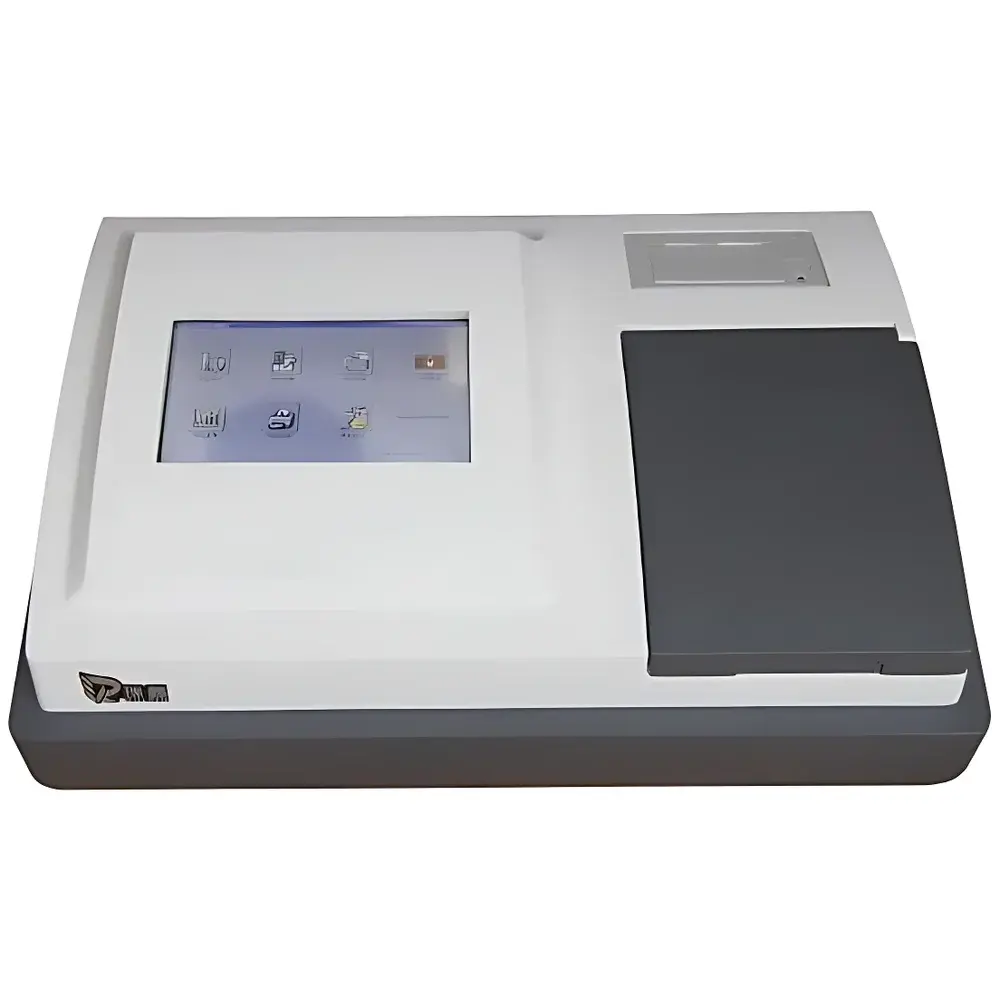
Ruixin CNY-96 High-Capacity Pesticide Residue Rapid Tester
| Brand | Ruixin |
|---|---|
| Origin | Shanghai, China |
| Manufacturer Type | Authorized Distributor |
| Origin Category | Domestic (China) |
| Model | CNY-96 |
| Price | USD 7,800 (FOB Shanghai) |
| Detection Method | Enzyme Inhibition Assay |
| Measurement Range | 0–100% inhibition |
| Number of Channels | 96-well microplate format |
| Measurement Error | ≤10% |
| Limit of Detection (LOD) | 0.3 ppm (for organophosphates & carbamates) |
| Optical Wavelengths | 410 nm, 450 nm, 540 nm, 630 nm |
| Bandwidth | 8 nm ±1 nm |
| Absorbance Read Range | 0.000–3.500 Abs |
| Max Absorbance Range | 0.000–4.500 Abs |
| Resolution | 0.001 Abs (display), 0.0001 Abs (internal ADC) |
| Linearity (r) | ≥0.995 |
| Repeatability | ±1.0% or ±0.007 Abs |
| Accuracy | ±0.5% or ±0.005 Abs |
| Calibration Modes | Two-point, Linear Regression, Logarithmic, Exponential, Power, and Multi-point % Inhibition |
| Measurement System | 8-channel optical fiber array with simultaneous 96-well scanning |
| Detection Time | 5 sec/wavelength (single), 7 sec/wavelength (dual) |
| Plate Shaking | Adjustable speed and duration |
| Display | 7-inch color TFT capacitive touchscreen (with stylus support |
| Input Language | Chinese & English (full IME support for Chinese sample/unit names) |
| Data Storage | Internal 16 GB SD card — supports ≥1,000 assay protocols and ≥1,000,000 test records |
| Print Output | Integrated thermal printer (Chinese-language report templates) |
| Connectivity | RS-232, RJ-45 Ethernet, dual USB-A, SD card slot |
| Optional Modem Module | PSTN-based remote diagnostics, firmware update, and encrypted data transmission |
| Operating Environment | 10–40 °C, 20–85% RH (non-condensing) |
| Power Supply | 90–260 VAC, 50/60 Hz |
Overview
The Ruixin CNY-96 High-Capacity Pesticide Residue Rapid Tester is a dedicated benchtop absorbance microplate reader engineered for quantitative and semi-quantitative screening of organophosphate and carbamate pesticide residues in fresh produce. It operates on the principle of acetylcholinesterase (AChE) enzyme inhibition assay—a well-established biochemical method standardized under GB/T 5009.199–2003 and NY/T 448–2001. In this assay, residual pesticides inhibit AChE activity in a concentration-dependent manner; the degree of inhibition—measured photometrically at defined wavelengths (410 nm, 450 nm, 540 nm, and 630 nm)—is inversely proportional to analyte concentration. The CNY-96 integrates a high-stability LED-optical path with an 8-channel fiber-coupled detection system, enabling rapid, parallel readout across all 96 wells of a standard microtiter plate. Its architecture complies with metrological requirements outlined in JJG 861–2007 (Verification Regulation for Microplate Readers), ensuring traceable performance for routine food safety laboratories.
Key Features
- 96-well high-throughput capacity optimized for batch analysis of vegetables, fruits, and other agricultural commodities
- Multi-wavelength photometric engine with narrow-band interference filters (±1 nm tolerance) and calibrated photodiode detection
- Adjustable orbital shaking mechanism for uniform reagent mixing—critical for reproducible enzyme-substrate kinetics
- 7-inch capacitive touchscreen interface with full Chinese input method editor (IME), enabling direct entry of sample IDs, unit names, and inspection agency details
- Onboard storage of >100 preloaded vegetable names and customizable assay protocols—facilitating rapid method selection and field deployment
- Dual-mode reporting: real-time screen display and thermal-printed Chinese-language compliance reports, including inhibition rate, pass/fail status, and reference thresholds
- Robust power design supporting universal AC input (90–260 VAC, 50/60 Hz), suitable for mobile labs and rural testing stations with unstable grid conditions
- Modular connectivity suite—including RS-232, Ethernet, dual USB ports, and optional PSTN modem—for secure data export, remote calibration validation, and over-the-air firmware updates
Sample Compatibility & Compliance
The CNY-96 is validated for use with homogenized extracts from leafy greens, tomatoes, cucumbers, apples, citrus, and other high-water-content produce. Sample preparation follows standardized QuEChERS-free extraction protocols compatible with rapid field kits. While primarily intended for organophosphate and carbamate screening per Chinese national standards, its flexible calibration modes allow method adaptation for veterinary drug residue screening in honey, milk, and aquaculture samples—subject to internal method validation per ISO/IEC 17025 requirements. Instrument performance meets JJG 861–2007 specifications for photometric accuracy, linearity, and repeatability. All stored test records include timestamp, operator ID, assay parameters, and raw absorbance values—supporting GLP-compliant audit trails when paired with user-defined access controls and electronic signature workflows.
Software & Data Management
Firmware v3.2+ provides embedded database management with role-based access control (admin/operator modes). Up to 500 assay protocols—including custom curve-fitting algorithms (linear, log-log, four-parameter logistic)—can be saved locally. The 16 GB SD card retains ≥1,000,000 result entries with metadata (date/time, well position, wavelength, inhibition %, LOD flag). Data export is supported via CSV over USB or Ethernet using SFTP or HTTP POST to LIMS endpoints. Optional remote maintenance mode enables authorized service engineers to perform diagnostic checks and recalibration verification without physical site visits—reducing instrument downtime. Audit logs record all configuration changes, user logins, and report generation events—aligning with FDA 21 CFR Part 11 expectations for electronic records when deployed in regulated environments.
Applications
- Routine surveillance testing at agricultural cooperatives, wholesale markets, and border inspection points
- Pre-harvest residue monitoring for Good Agricultural Practice (GAP) certification programs
- Quality assurance screening in food processing facilities prior to ingredient release
- Regulatory enforcement by municipal market supervision bureaus and provincial CDC laboratories
- Field-deployable triage tool for rapid response during foodborne outbreak investigations
- Method development platform for validating alternative substrates or enzyme variants in academic research settings
FAQ
What regulatory standards does the CNY-96 comply with?
It conforms to GB/T 5009.199–2003, NY/T 448–2001, and JJG 861–2007 for measurement performance and operational validation.
Can the instrument be used for non-vegetable matrices such as meat or grain?
Yes—provided matrix-specific extraction and cleanup protocols are validated internally; the optical platform supports any colorimetric endpoint assay within its absorbance range.
Is data encryption available for network-transmitted results?
All Ethernet and modem-based transmissions support TLS 1.2 encryption; local SD card storage is unencrypted but may be supplemented with third-party FIPS 140-2 compliant software solutions.
How frequently must the optical system be recalibrated?
Annual verification against NIST-traceable neutral density filters is recommended; daily blank calibration is performed automatically during startup.
Does the device support integration with enterprise LIMS systems?
Yes—via configurable CSV export, RESTful API (optional firmware module), or HL7-compatible middleware adapters.






