
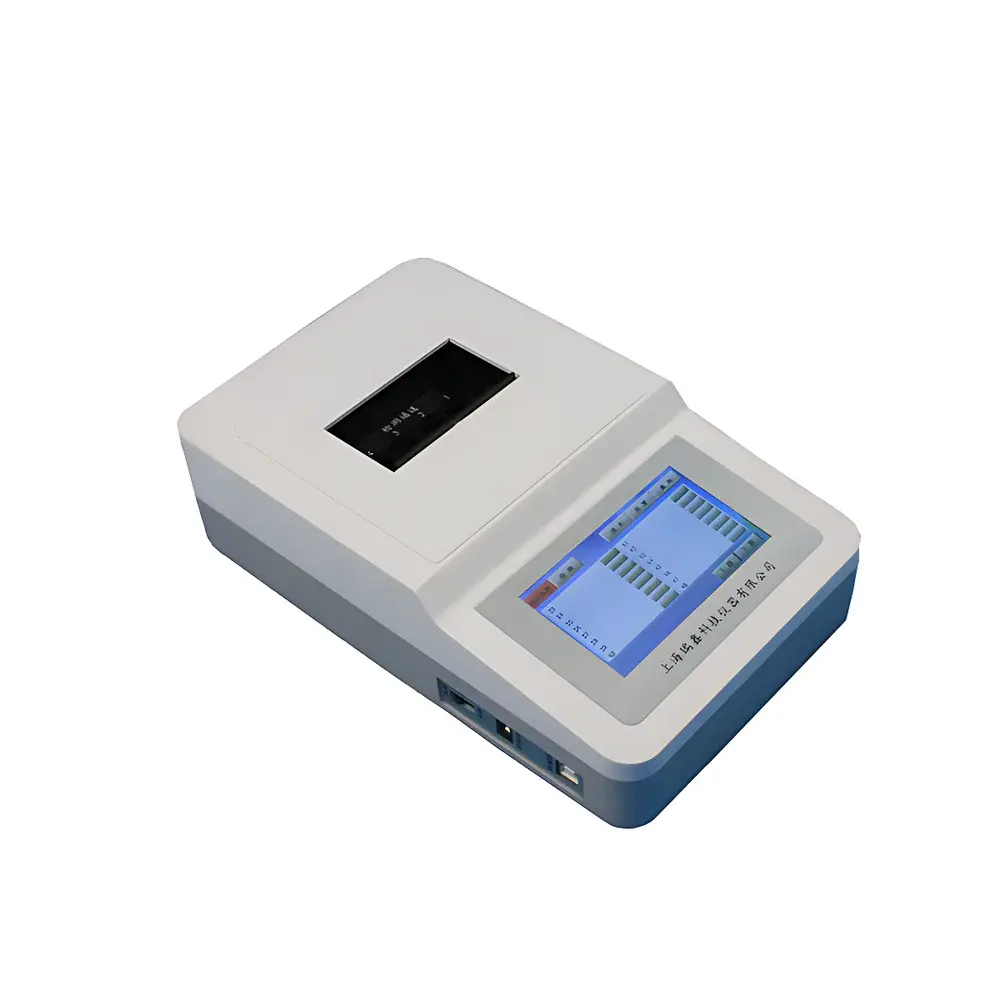
Ruixin CNY-4S Portable Pesticide Residue Rapid Tester
| Brand | Ruixin |
|---|---|
| Origin | Shanghai, China |
| Manufacturer Type | Authorized Distributor |
| Country of Origin | China |
| Model | CNY-4S |
| Detection Method | Enzyme Inhibition Assay |
| Measurement Range | 0–100% Inhibition Rate |
| Number of Channels | 8 |
| Measurement Error | ≤10% |
| Limit of Detection (LOD) | 0.3 ppm |
| Display | 4.3-inch Color TFT Touchscreen |
| Wavelength | 410 nm (±2 nm) |
| Absorbance Range | 0.000–4.000 A |
| Transmittance Range | 0.00–100.00% T |
| Transmittance Resolution | 0.01% T |
| Absorbance Resolution | 0.001 A |
| Photometric Accuracy | ±2.0% T |
| Photometric Repeatability | ≤0.2% T |
| Photocurrent Drift | ≤0.2% (within 3 min) |
| Inhibition Rate Accuracy | ±10% |
| Inhibition Rate Repeatability | ≤5% |
| Power Supply | AC 220 V ±10% and Rechargeable Li-ion Battery |
| Communication Interfaces | RS-232 and USB |
Overview
The Ruixin CNY-4S Portable Pesticide Residue Rapid Tester is a field-deployable photometric analyzer engineered for on-site quantitative screening of organophosphorus and carbamate pesticide residues in fresh fruits and vegetables. It operates on the principle of acetylcholinesterase (AChE) or butyrylcholinesterase (BChE) inhibition assay—a standardized biochemical method recognized by GB 5009.199–2003 (National Food Safety Standard for Determination of Organophosphorus and Carbamate Pesticides in Foods) and NY/T 448–2001 (Agricultural Industry Standard for Rapid Detection of Pesticide Residues in Vegetables). The instrument measures the degree of enzymatic activity suppression—expressed as inhibition rate (%)—caused by residual anticholinesterase compounds in extracted samples. With its integrated 410 nm optical path, self-calibrating photometric system, and dual-mode display (absorbance and transmittance), the CNY-4S delivers reproducible, traceable results under variable ambient conditions without requiring laboratory infrastructure.
Key Features
- 8-channel simultaneous detection architecture with automatic sample presence recognition—channels without samples remain idle, reducing reagent consumption and eliminating false triggers.
- 4.3-inch high-resolution color TFT touchscreen with full Chinese GUI; supports direct selection from a built-in database of 72 common produce names (e.g., spinach, cucumber, apple) and real-time Chinese character editing.
- Embedded thermal printer enabling immediate hardcopy output per channel: includes channel ID, inhibition rate (%), pass/fail interpretation, Chinese sample name, operator ID, testing unit, and timestamp.
- Self-diagnostic optical calibration system performs automatic zero-point and blank correction at startup; provides real-time fault alerts for channel-specific photometric anomalies.
- Dual photometric readout modes: absorbance (0.000–4.000 A, resolution 0.001 A) and transmittance (0.00–100.00% T, resolution 0.01% T), supporting method flexibility beyond pesticide screening.
- Programmable reaction time (1–15 min) and customizable inhibition threshold (e.g., 50% cutoff per GB/NY standards), enabling compliance with site-specific regulatory protocols.
- Rechargeable lithium-ion battery enables >6 hours of continuous operation in field settings; AC adapter included for benchtop use.
- Supports both AChE and BChE enzyme reagents—fully compatible with national standard requirements and validated reference methods.
Sample Compatibility & Compliance
The CNY-4S is validated for homogenized aqueous extracts from leafy greens, solanaceous crops, pome/stone fruits, and root vegetables. Sample preparation follows standardized homogenization, centrifugation, and filtration steps outlined in GB 5009.199–2003. Its measurement uncertainty (±10% inhibition rate) and LOD (0.3 ppm for common organophosphates such as methamidophos and omethoate) meet the performance criteria for rapid screening tools defined under China’s Ministry of Agriculture and Rural Affairs (MARA) field inspection guidelines. While not intended for confirmatory analysis, the instrument satisfies preliminary triage requirements for food safety surveillance programs operating under GLP-aligned workflows. Data integrity is maintained via timestamped, non-editable result logs stored internally (≥10,000 records) and exportable via USB/RS-232 to external LIMS or regulatory reporting platforms.
Software & Data Management
Bundled PC software enables centralized data management: import/export of sample lists (including batch editing of 72 produce names), statistical analysis (mean inhibition rate, CV%, pass/fail distribution), report generation (PDF/CSV), and audit-trail-enabled user access control. The software supports integration with third-party laboratory information systems (LIS) via configurable ASCII/CSV data exchange protocols. All instrument-generated reports include metadata required for internal quality assurance—operator ID, instrument serial number, calibration date, and environmental temperature/humidity (if logged externally). While not certified for FDA 21 CFR Part 11 compliance out-of-the-box, the architecture permits configuration for electronic signature and audit logging upon customer-requested validation support.
Applications
- On-farm pre-harvest screening at vegetable production bases to verify pre-harvest intervals (PHIs).
- Routine surveillance at wholesale markets, supermarkets, and farmers’ cooperatives to enforce vendor accountability.
- Mobile food safety inspections by municipal market supervision bureaus during routine patrols.
- Internal QC checks in catering establishments and institutional kitchens sourcing raw produce.
- Training and capacity building in agricultural extension centers for cooperative-level residue monitoring.
FAQ
What pesticides does the CNY-4S detect?
It quantitatively screens for organophosphorus (e.g., chlorpyrifos, dimethoate) and carbamate (e.g., carbaryl, methomyl) pesticides based on their shared mechanism of cholinesterase inhibition.
Can the instrument be used without a power outlet?
Yes—the integrated rechargeable Li-ion battery supports uninterrupted operation for up to 6 hours, making it suitable for roadside, market, or greenhouse deployments.
Is calibration required before each test?
No—automatic optical self-calibration occurs at power-on; users only need to perform a blank measurement using enzyme-substrate buffer prior to sample testing.
How are results interpreted against regulatory limits?
The instrument reports inhibition rate (%); pass/fail determination follows national thresholds (e.g., ≥50% inhibition indicates noncompliance per NY/T 448–2001), which can be customized in software settings.
Does the device store historical data locally?
Yes—it retains ≥10,000 test records with full metadata (time, channel, sample name, inhibition %, operator), searchable by date range or sample ID.




