
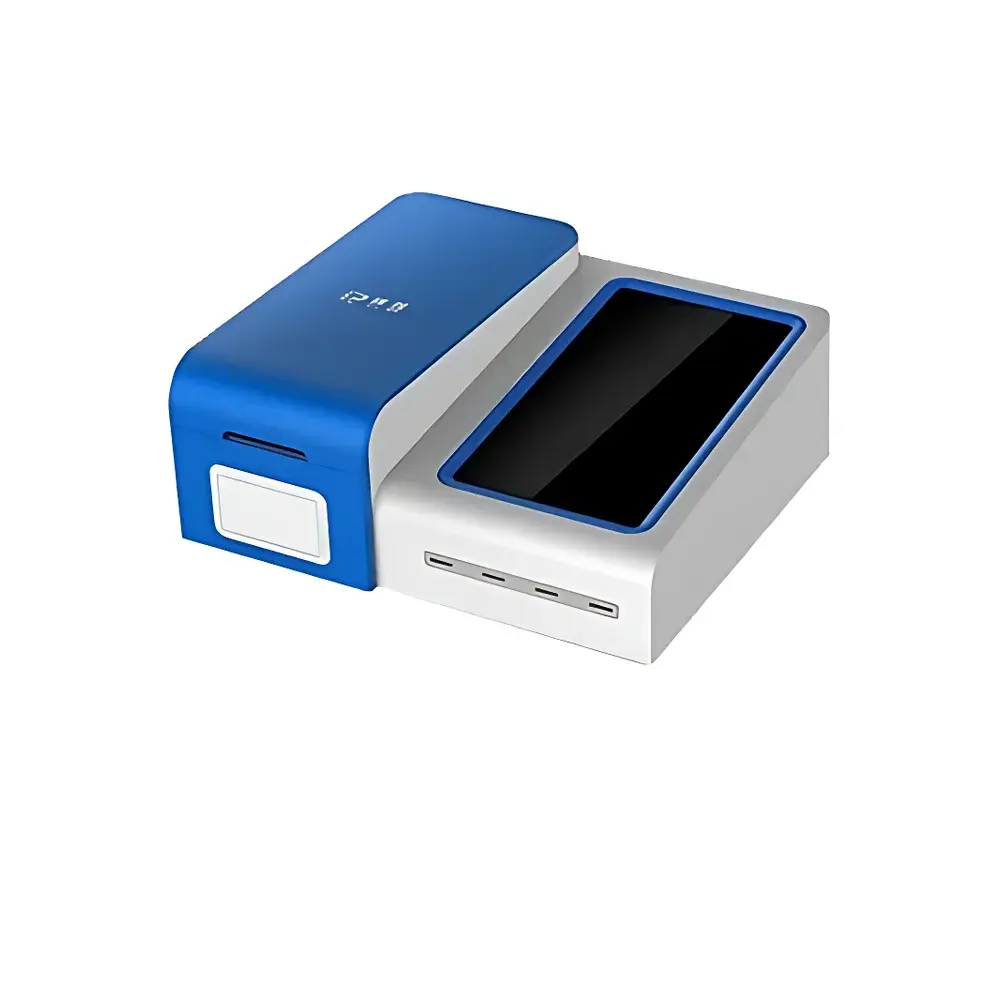
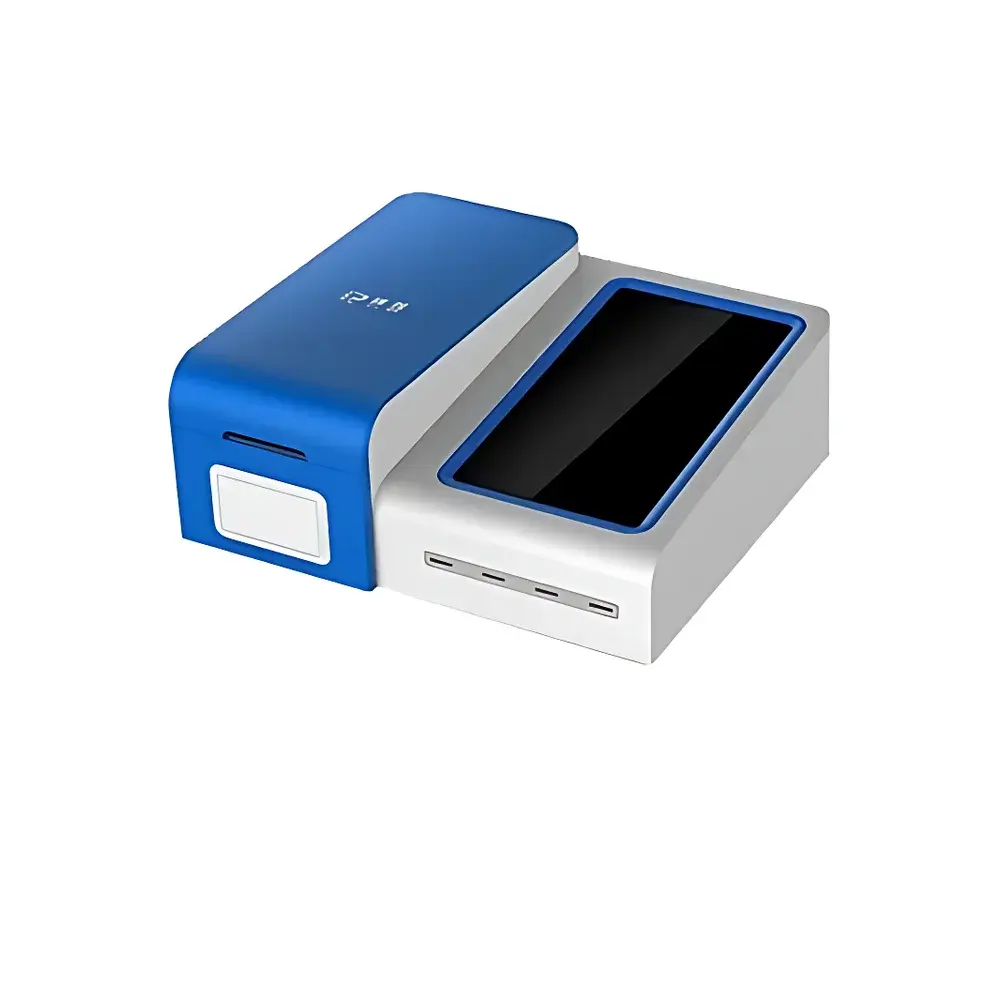
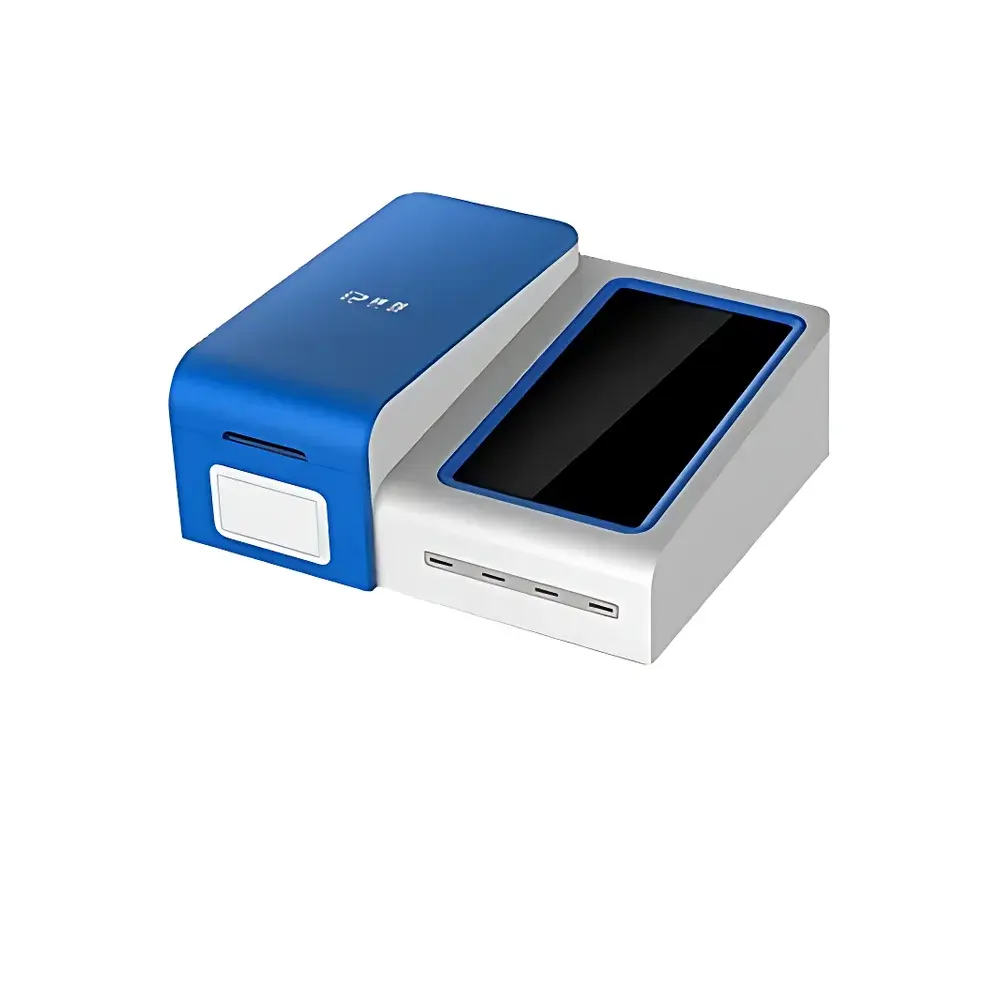
Ruixin CNY-1218C Intelligent Pesticide Residue Rapid Tester
| Brand | Ruixin |
|---|---|
| Origin | Shanghai, China |
| Model | CNY-1218C |
| Detection Method | Enzyme Inhibition Rate (Spectrophotometric) |
| Measurement Range | 0–100% inhibition |
| Number of Channels | 12 |
| Measurement Error | <10% |
| Limit of Detection (LOD) | 0.2 ppm |
| Absorbance Range | 0.000–4.000 A |
| Transmittance Range | 0.00–100.00% T |
| Transmittance Resolution | 0.01% T |
| Absorbance Resolution | 0.001 A |
| Photometric Accuracy (T) | ±1.5% |
| Photometric Repeatability (T) | ≤0.2% |
| Photocurrent Drift | ≤0.2% (3 min) |
| Power Supply | AC 220 V ±10% |
| Display | 10.1-inch capacitive touchscreen (1024 × 600), IP65-rated front panel, 400 cd/m² brightness |
| OS | Android 7.0, quad-core 1.8 GHz CPU, 2 GB RAM, 16 GB internal storage + microSD expansion |
| Connectivity | Dual USB 2.0, Wi-Fi (802.11 b/g/n), RJ45 Ethernet, optional 3G/4G/5G module, GPS/AGPS |
| Data Export | Excel (.xlsx) via USB drive |
Overview
The Ruixin CNY-1218C Intelligent Pesticide Residue Rapid Tester is a dedicated benchtop spectrophotometric analyzer engineered for field-deployable and laboratory-grade screening of organophosphorus and carbamate pesticide residues in agricultural commodities. It operates on the principle of enzyme inhibition—specifically, acetylcholinesterase (AChE) or butyrylcholinesterase (BChE) activity suppression—quantified via absorbance changes at 412 nm using standard Ellman’s reagent chemistry. This method is standardized under China’s national food safety regulation GB 5009.199–2016 (replacing 2003) and agricultural industry standard NY/T 448–2021 (updated from 2001), aligning with internationally recognized rapid screening paradigms for regulatory pre-screening and surveillance programs. Designed for high-throughput operation in decentralized environments—including municipal food safety inspection stations, smart farmers’ markets, county-level market supervision bureaus, and tea quality control laboratories—the CNY-1218C delivers quantitative inhibition rate results (%I) directly correlated to residual concentration, enabling pass/fail decisions without requiring off-site GC-MS confirmation for routine monitoring.
Key Features
- 12 independent optical detection channels with synchronized measurement capability—enabling up to 120 sample tests per hour under standard protocol conditions;
- 10.1-inch industrial-grade capacitive touchscreen (1024 × 600 resolution), IP65-rated front panel, 400 cd/m² luminance, and integrated stylus support with digital signature capture for audit-compliant reporting;
- Embedded Android 7.0 operating system (quad-core 1.8 GHz CPU, 2 GB RAM, 16 GB eMMC storage + microSD slot) ensuring stable multi-tasking, local database management, and seamless firmware updates;
- Real-time cloud connectivity via dual-path networking: built-in Wi-Fi (802.11 b/g/n) and Gigabit Ethernet (RJ45), with optional LTE/5G modem and GPS/AGPS geotagging for traceability-critical deployments;
- Automated workflow logic—including auto-detection of sample presence in cuvettes, real-time inhibition calculation, pass/fail classification per regulatory thresholds, and on-device thermal report printing;
- Self-diagnostic subsystem with embedded instructional video library accessible offline—reducing dependency on technical support during field operation;
- Dual USB 2.0 ports supporting direct export of test records, calibration logs, and metadata in native Excel (.xlsx) format; no external PC required for data retrieval or system configuration.
Sample Compatibility & Compliance
The CNY-1218C is validated for homogenized extracts from fresh produce (leafy vegetables, fruits, herbs), cereal grains, drinking water, and processed tea leaves. Sample preparation follows standardized homogenization, centrifugation, and supernatant dilution protocols outlined in GB 5009.199–2016. While not intended for definitive quantification per ISO/IEC 17025, its performance meets the precision and repeatability requirements specified for rapid screening instruments under China’s Administrative Measures for Food Safety Rapid Testing Methods (SAMR Order No. 13). Instrument-level photometric accuracy (±1.5% T) and repeatability (≤0.2% T) satisfy minimum performance criteria for Class II rapid testers as defined by CNAS-CL01:2018 (equivalent to ISO/IEC 17025:2017) when operated within controlled ambient conditions (15–30°C, RH ≤80%). All firmware and data handling modules comply with China’s Regulations on the Management of Agricultural Product Quality and Safety Traceability Information Systems, supporting full-chain traceability integration with provincial food safety cloud platforms.
Software & Data Management
The onboard software provides a GLP-aligned environment with user role-based access control (administrator/operator), time-stamped audit trails for all critical actions (calibration, sample entry, result modification), and immutable record generation. Each test entry includes operator ID, sample ID, location coordinates (GPS), instrument serial number, and environmental timestamp. Data synchronization employs TLS 1.2–encrypted HTTPS POST requests to configurable cloud endpoints, supporting both public SaaS platforms (e.g., provincial Agri-Safety Cloud) and private on-premise servers. Local storage retains ≥50,000 test records with automatic rollover; exported Excel files include raw absorbance values, calculated inhibition rates, pass/fail flags, and QC control status. The system supports CSV/Excel import of reference sample libraries and institutional databases (e.g., vendor lists, commodity categories), enabling intelligent pinyin-based search for sample names or testing entities—reducing input errors and accelerating batch processing.
Applications
- Routine surveillance testing at wholesale markets, supermarket QA labs, and border inspection points for imported produce;
- On-farm residue monitoring during harvest windows to support GAP compliance documentation;
- Emergency response screening following pesticide misuse incidents or regional contamination alerts;
- Training and capacity-building for grassroots food safety inspectors in rural administrative units;
- Integration into municipal “Smart Food Safety” dashboards for real-time risk mapping and hotspot identification;
- Pre-screening triage prior to confirmatory analysis by HPLC-MS/MS or GC-MS in reference laboratories.
FAQ
What pesticides does the CNY-1218C detect?
It detects organophosphorus (e.g., chlorpyrifos, diazinon, malathion) and carbamate (e.g., carbaryl, methomyl, carbofuran) compounds based on cholinesterase inhibition kinetics—not individual analytes. Results reflect total inhibitory activity relative to control.
Is calibration required before each use?
Yes. A two-point calibration (blank and positive control) is mandatory per batch to normalize inter-channel variability and compensate for reagent lot differences. Auto-calibration routines are embedded in the assay protocol.
Can the instrument be used without internet connectivity?
Yes. All core functions—including measurement, data storage, report generation, and local database search—operate fully offline. Cloud upload occurs only upon network availability.
Does it meet international regulatory standards such as AOAC or Codex?
The method principle aligns with AOAC Official Method 992.13 and Codex Alimentarius CXG 63-2007 for rapid enzyme inhibition screening. However, formal AOAC Performance Tested Method (PTM) certification is not held; validation is conducted per national Chinese standards.
How is data integrity ensured during transmission to cloud platforms?
All uploads include SHA-256 hash signatures, sequence numbering, and server-side receipt acknowledgment. Failed transmissions trigger local retry queues with exponential backoff, preserving chain-of-custody continuity.






