
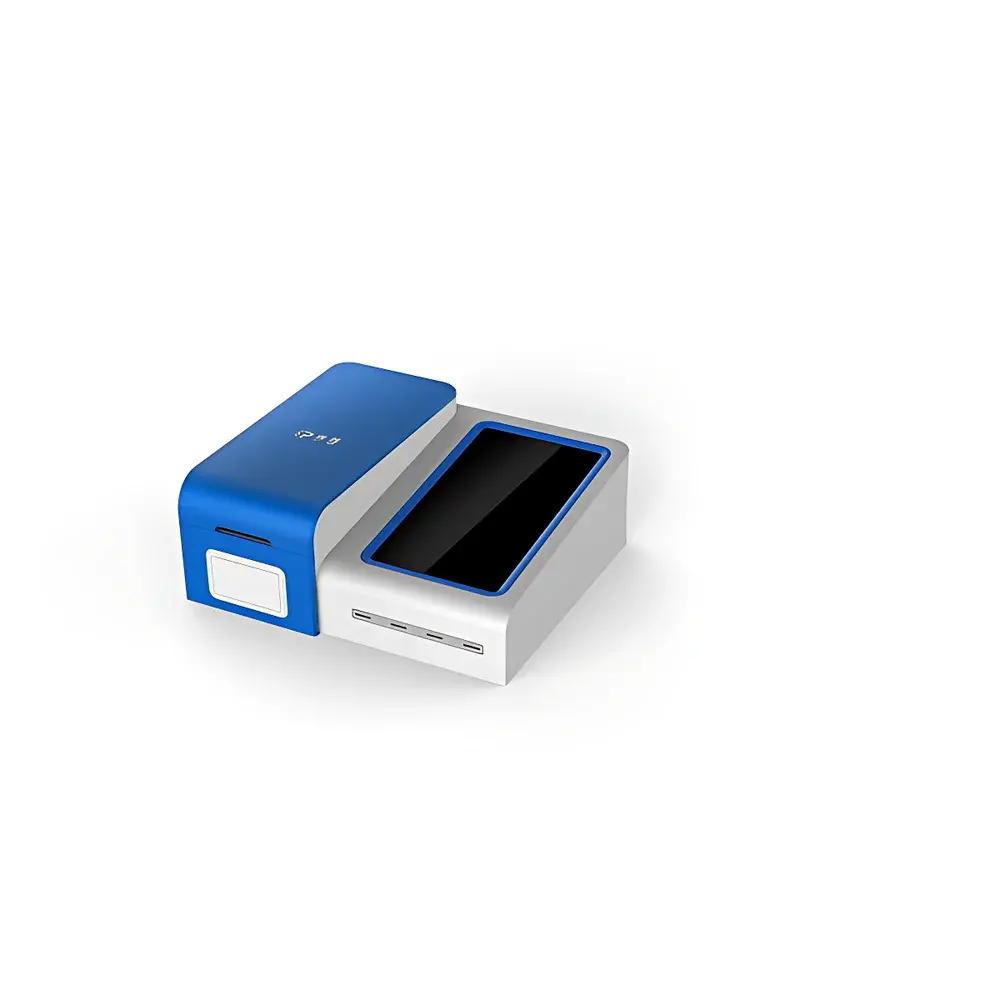
Ruixin CNY-1618 16-Channel Intelligent Pesticide Residue Analyzer
| Brand | Ruixin |
|---|---|
| Origin | Shanghai, China |
| Model | CNY-1618 |
| Detection Method | Enzyme Inhibition Assay |
| Measurement Range | 0–100% Inhibition |
| Number of Channels | 16 |
| Measurement Error | ±10% |
| Limit of Detection (LOD) | 5% Inhibition |
| Display | 10.1-inch TFT LCD Touchscreen (1024×600) |
| Absorbance Range | 0.000–4.000 A |
| Transmittance Range | 0.00–100.00% T |
| Transmittance Resolution | 0.01% T |
| Absorbance Resolution | 0.001 A |
| Photometric Accuracy | ±1.5% T |
| Photometric Repeatability | ≤0.2% T |
| Dark Current Drift | ≤0.2% (3 min) |
| Power Supply | AC 220 V ±10% |
| Connectivity | Dual USB, Wi-Fi, RJ45 Ethernet, Optional 3G/4G/5G Module, GPS/AGPS |
| Operating System | Android 7.0 (Quad-Core, 1.8 GHz, 2 GB RAM, 16 GB Storage) |
| IP Rating | IP65 (Front Panel) |
| Data Export | Excel via USB or SD card |
| Throughput | Up to 180 samples/hour |
Overview
The Ruixin CNY-1618 16-Channel Intelligent Pesticide Residue Analyzer is a dedicated benchtop photometric instrument engineered for rapid, on-site screening of organophosphorus and carbamate pesticide residues in fresh agricultural commodities. It operates on the well-established enzyme inhibition principle—measuring the degree of acetylcholinesterase (AChE) activity suppression caused by residual inhibitors in extracted samples. This method is standardized under GB 5009.199–2003 (National Food Safety Standard – Determination of Organophosphorus and Carbamate Pesticide Residues in Foods) and NY/T 448–2001 (Agricultural Industry Standard – Rapid Detection of Pesticide Residues in Vegetables), ensuring regulatory alignment with Chinese food safety surveillance frameworks. Designed for high-throughput field and laboratory deployment, the CNY-1618 delivers quantitative inhibition percentage readings across 16 independent optical channels, enabling parallel analysis without cross-contamination or manual repositioning delays.
Key Features
- 16-channel simultaneous detection architecture with independent LED light sources and photodiode detectors per channel, minimizing inter-channel interference and supporting up to 180 sample tests per hour under routine operation.
- 10.1-inch industrial-grade capacitive touchscreen (1024 × 600 resolution, 400 cd/m² brightness) with IP65-rated front panel—resistant to dust ingress and water splashes during market or mobile lab use.
- Embedded Android 7.0 OS (quad-core 1.8 GHz CPU, 2 GB RAM, 16 GB internal storage + microSD expansion slot) enabling local data management, signature capture, and offline protocol execution.
- Integrated dual communication stack: IEEE 802.11 b/g/n Wi-Fi and 10/100 Mbps RJ45 Ethernet, with optional LTE/5G modem and GPS/AGPS modules for geotagged, time-stamped data transmission.
- Automated result interpretation: real-time pass/fail classification based on preset inhibition thresholds (e.g., ≥50% inhibition = positive), with auto-printed compliance reports via integrated thermal printer interface.
- Self-diagnostic firmware and embedded instructional video library—reducing dependency on external technical support and accelerating operator onboarding.
- Comprehensive database management: searchable sample name registry with intelligent pinyin-based indexing and configurable testing unit profiles for traceability and audit readiness.
Sample Compatibility & Compliance
The CNY-1618 is validated for homogenized extracts from leafy vegetables (e.g., spinach, cabbage), fruits (e.g., apples, strawberries), cereals, tea leaves, and aqueous rinse solutions. Sample preparation follows standardized homogenization and centrifugation protocols outlined in GB 5009.199–2003. While not certified to ISO/IEC 17025 or FDA 21 CFR Part 11 out-of-the-box, its data export capability (Excel-formatted .csv files with timestamps, operator ID, location metadata, and raw absorbance values) supports integration into GLP-compliant laboratory information management systems (LIMS). The instrument’s photometric performance—±1.5% transmittance accuracy and ≤0.2% repeatability—meets minimum requirements for rapid screening instrumentation as referenced in AOAC Official Method 2007.01 and EU Commission Regulation (EU) No 519/2014 Annex II.
Software & Data Management
Data acquisition, visualization, and reporting are handled through a purpose-built Android application with role-based access control (administrator/operator modes). All measurements are timestamped and associated with user login credentials, sample ID, batch number, and GPS coordinates when enabled. Raw absorbance (A) and transmittance (%T) values are stored locally with checksum verification; exports include full metadata headers compliant with FAO/WHO Codex Alimentarius traceability guidelines. Cloud synchronization uses TLS 1.2–encrypted HTTPS endpoints, supporting RESTful API integration with municipal food safety dashboards or national monitoring platforms such as China’s National Food Safety Risk Assessment Center (CFSA) infrastructure. Audit logs record all configuration changes, calibration events, and report generation actions—facilitating internal QA reviews and third-party inspections.
Applications
- Routine surveillance at wholesale markets, smart farmers’ markets, and supermarket quality control labs.
- Regulatory field testing by municipal market supervision bureaus and county-level agricultural extension stations.
- Pre-harvest screening in cooperative farms and tea plantations to guide harvest timing and post-harvest handling decisions.
- Verification testing in food processing facilities receiving raw produce inputs—supporting HACCP prerequisite programs.
- Educational use in agricultural vocational schools and university food science laboratories for method validation training.
FAQ
What pesticides does the CNY-1618 detect?
It detects organophosphorus (e.g., chlorpyrifos, malathion) and carbamate (e.g., carbaryl, methomyl) compounds that inhibit acetylcholinesterase. It does not detect neonicotinoids, pyrethroids, or glyphosate.
Is calibration required before each test?
No daily calibration is needed; however, blank correction using buffer solution is performed automatically at startup and prior to each batch. Periodic verification with certified reference standards (e.g., dichlorvos-spiked control samples) is recommended weekly.
Can data be exported without internet connectivity?
Yes—results are saved internally and can be exported to USB flash drives or microSD cards in Excel-compatible CSV format, including raw absorbance values and calculated inhibition percentages.
Does the instrument comply with international standards like ISO or AOAC?
The methodology aligns with AOAC Official Method 2007.01 and EU Regulation 519/2014 for rapid screening. Full ISO/IEC 17025 accreditation requires lab-specific validation per ISO/IEC 17025:2017 Clause 7.2.2.
What maintenance is required?
Routine cleaning of cuvette holders and optical windows with lint-free ethanol wipes; annual photometric verification using NIST-traceable neutral density filters is advised for sustained accuracy.




