
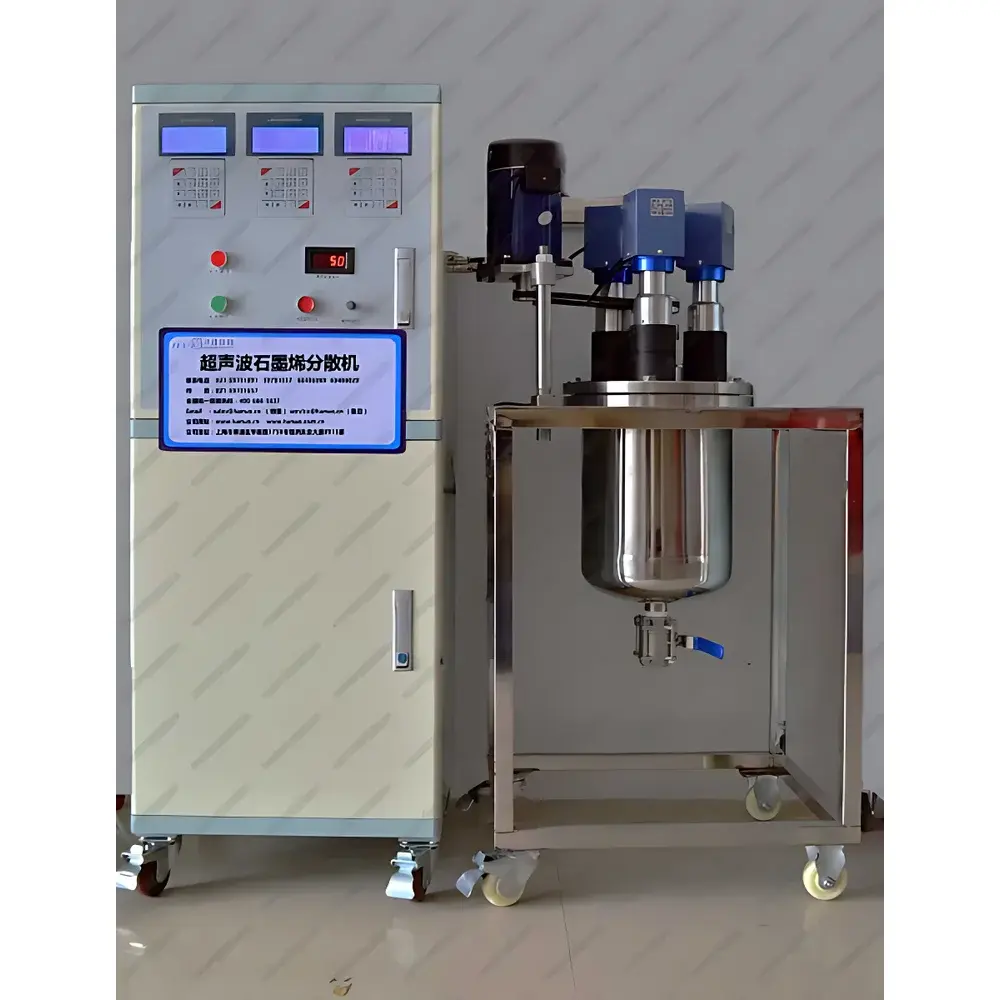
Hanuo HN-CSB10L High-Power Circulating Ultrasonic Graphene Dispersion System
| Brand | Hanuo |
|---|---|
| Origin | Shanghai, China |
| Manufacturer Type | Authorized Distributor |
| Country of Origin | China |
| Model | HN-CSB10L |
| Price Range | USD 1,400–7,200 (FOB) |
| Ultrasonic Power | 5 kW |
| Ultrasonic Frequency | 28 kHz or 40 kHz (selectable) |
| Heating Power | Optional jacketed cooling/heating system (max. 1.5 kW electric heater, ±0.5 °C control accuracy) |
| Temperature Range | Ambient to 100 °C (with optional temperature-controlled jacket) |
| Vessel Capacity | 10 L (usable volume: 3–8 L for optimal cavitation efficiency) |
| Stirring Motor Power | 100 W |
| Stirring Speed | 0–1200 rpm (digital PID-controlled) |
| Probe Tip Diameter | 30 mm |
| Material | ASTM A240 Grade SUS304 stainless steel |
| Compliance | CE-marked per 2014/30/EU (EMC) and 2014/35/EU (LVD) |
Overview
The Hanuo HN-CSB10L is a bench-to-pilot-scale high-intensity circulating ultrasonic dispersion system engineered for reproducible exfoliation and stabilization of graphene nanosheets in liquid-phase media. It operates on the principle of controlled acoustic cavitation—where high-amplitude ultrasonic waves (28 or 40 kHz) generate transient microbubbles in the solvent that collapse violently, producing localized pressures exceeding 1000 atm and temperatures above 5000 K. This hydrodynamic shear environment enables efficient delamination of graphite stacks while minimizing structural defects, making the HN-CSB10L suitable for R&D labs developing conductive inks, battery anode slurries, polymer nanocomposites, and functional coatings. Unlike bath-type or low-power probe systems, the HN-CSB10L integrates focused energy delivery via a 30 mm titanium alloy horn coupled with continuous recirculation through a jacketed reactor vessel—ensuring uniform energy distribution across the entire sample volume and eliminating thermal hotspots or sedimentation zones.
Key Features
- High-efficiency focused ultrasonics: 5 kW nominal output power delivered through a precision-machined 30 mm diameter titanium alloy probe, optimized for maximum cavitation density in viscous or particulate-laden suspensions.
- Circulating flow path architecture: Integrated peristaltic or centrifugal pump (optional) enables closed-loop recirculation at adjustable flow rates (0.5–3 L/min), enhancing mass transfer and preventing particle settling during prolonged sonication.
- Dual-mode operation: Programmable continuous or pulsed ultrasonic duty cycles (e.g., 5 s ON / 2 s OFF), allowing precise thermal management and reduction of free radical-induced degradation in sensitive dispersions.
- Temperature-regulated reaction chamber: Optional double-walled SUS304 vessel with external glycol or chilled water circulation (−10 °C to +100 °C), integrated with PT100 sensor and digital PID controller (±0.5 °C stability).
- Mechanical agitation synergy: Independent 100 W DC motor drives axial impeller (0–1200 rpm), ensuring homogenous suspension prior to and during sonication—critical for high-solid-content graphene slurries (>5 wt%).
- Robust construction: Full SUS304 wetted parts (per ASTM A240), IP54-rated electronics enclosure, and vibration-damped mounting frame compliant with ISO 10816-3 for industrial equipment.
Sample Compatibility & Compliance
The HN-CSB10L accommodates both volatile (e.g., IPA, NMP, DMF) and non-volatile solvents (e.g., ethylene glycol, PVP aqueous solutions), with compatibility validated per ISO 15528 for coating material testing and ASTM D4290 for pigment dispersion assessment. Its sealed reactor design meets Class II biosafety requirements for handling nanomaterials under OECD Test Guideline 125 (nanomaterial dispersion protocols). All electrical subsystems comply with CE directives (2014/30/EU EMC and 2014/35/EU LVD), and mechanical integrity adheres to PED 2014/68/EU for pressure equipment up to 0.5 bar gauge. Documentation supports audit readiness for GLP environments per OECD Principles of Good Laboratory Practice (Annex III) and facilitates traceability for FDA 21 CFR Part 11–aligned electronic records when paired with optional data-logging software.
Software & Data Management
The system includes an embedded 7-inch capacitive touchscreen HMI with real-time monitoring of ultrasonic amplitude (%), power draw (kW), temperature (°C), stirring speed (rpm), and elapsed time. All operational parameters are timestamped and exportable via USB 2.0 as CSV files. Optional Hanuo Ultrasonics Control Suite (v3.2) provides remote configuration, multi-step protocol scheduling, alarm logging (e.g., overtemperature, probe overload), and automated calibration verification reports. The software architecture supports integration into LIMS platforms via Modbus TCP or OPC UA interfaces, enabling full traceability for regulated QA/QC workflows in battery materials development or pharmaceutical excipient processing.
Applications
- Graphene oxide (GO) and reduced graphene oxide (rGO) dispersion in aqueous and organic media for conductive film fabrication.
- Preparation of stable few-layer graphene (FLG) suspensions for inkjet-printed electronics and flexible sensors.
- Exfoliation-assisted synthesis of graphene quantum dots (GQDs) from bulk graphite precursors.
- Dispersion of carbon nanotubes (CNTs) and MXenes in polymer matrices for EMI shielding composites.
- Cellulose nanocrystal (CNC) de-agglomeration and surface functionalization in green solvent systems.
- Scale-up validation from lab-scale (100 mL) to pilot-scale (10 L) dispersion protocols prior to GMP manufacturing transfer.
FAQ
What is the recommended maintenance interval for the ultrasonic transducer and probe?
Routine inspection every 200 operating hours; ultrasonic horn tip replacement advised after 1,000 hours of cumulative use or visible pitting/cavitation erosion.
Can the HN-CSB10L be integrated into an inert atmosphere glovebox?
Yes—customized feedthroughs for power, cooling lines, and sensor cables are available; standard unit requires N₂ purge capability for oxygen-sensitive graphene reduction steps.
Is the system compatible with abrasive or high-viscosity media such as epoxy-resin/graphene pastes?
With optional high-torque stirring (up to 200 W) and low-shear rotor-stator geometry, viscosities up to 15,000 cP can be processed; however, ultrasonic transmission efficiency decreases above 5,000 cP without dilution or pre-shearing.
Does the temperature control system support cryogenic operation below 0 °C?
Standard configuration supports ambient to +100 °C; sub-zero operation requires external chiller (−20 °C minimum) and insulated jacket upgrade—quoted separately.
How is ultrasonic amplitude calibrated and verified?
Calibration uses a NIST-traceable calorimetric method per ASTM E2884-13; factory certificate includes amplitude linearity test (20–100% setpoint) and thermal drift assessment over 60-minute dwell.



