
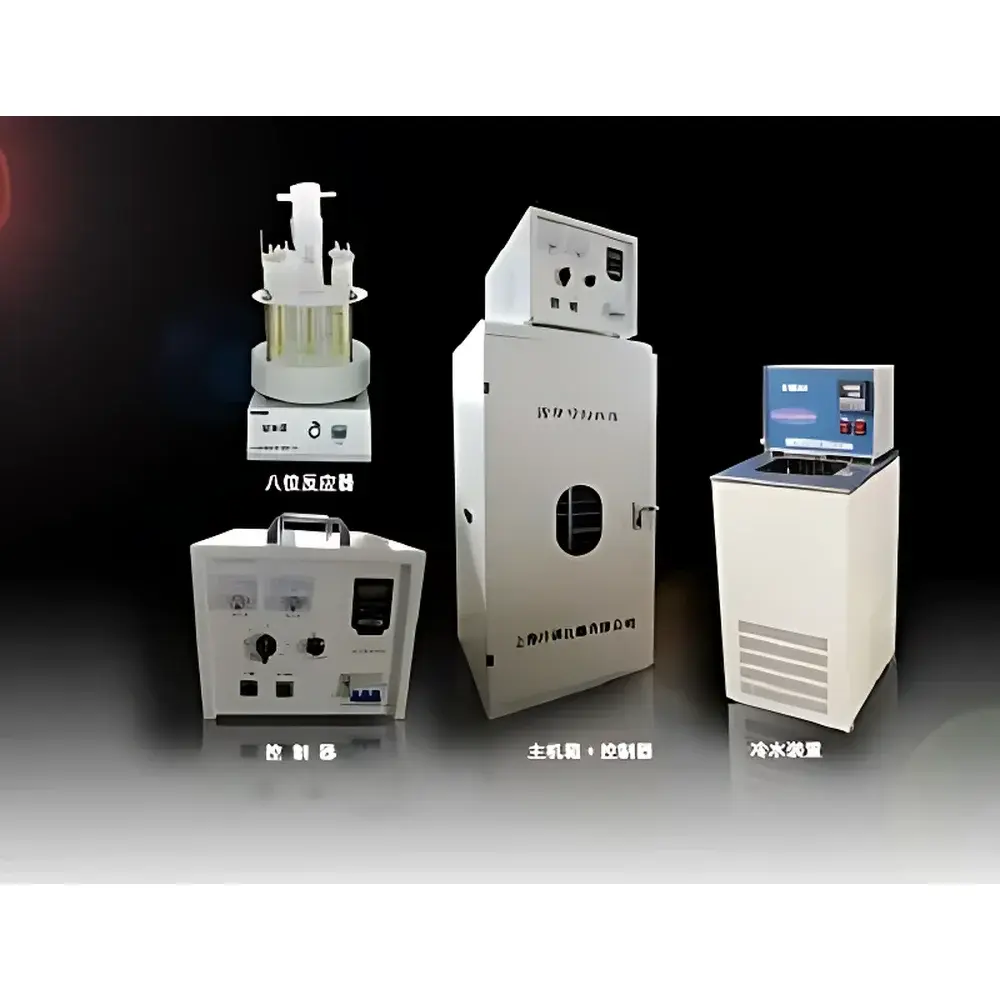
Hanuo HANUO-V Photoreactor System with Xenon and Mercury Lamp Light Sources
| Brand | Hanuo |
|---|---|
| Origin | Shanghai, China |
| Manufacturer Type | Distributor |
| Product Origin | Domestic |
| Model | HANUO-V |
| Price | USD 5,300 (approx.) |
| Light Source Type | Xenon Lamp |
| Illumination Mode | External Irradiation |
| Lamp Compatibility | Xenon, Mercury, Metal Halide |
| Power Adjustment Range (Xenon/Mercury) | 100–1000 W (continuous) |
| Power Adjustment Range (Metal Halide) | 100–450 W (continuous) |
| Quartz Reactor Vessels | 30 mL & 50 mL (16 pcs total, 8 each) |
| Sample Capacity | Up to 8 parallel reactors |
| Stirring | 8-channel magnetic stirring with independent speed control |
| Cooling System | Integrated recirculating chiller (cooling capacity >1000 W, casters + drain valve) |
| Quartz Cold Finger | 1 unit |
| Reaction Chamber | Light-tight dark box |
| Mobility | Equipped with mobile cart |
Overview
The Hanuo HANUO-V Photoreactor System is a benchtop, multi-source photochemical reaction platform engineered for controlled irradiation experiments in homogeneous and heterogeneous catalytic systems. It operates on the principle of external irradiation—where light from high-intensity arc lamps (xenon, mercury, or metal halide) is delivered through a quartz cold finger into sealed reaction vessels housed within a light-tight dark chamber. This architecture ensures precise photon flux delivery while enabling thermal management via active cooling, critical for maintaining reaction integrity during prolonged UV–vis exposure. Designed for reproducible quantum yield determination, kinetic profiling, and radical trapping studies, the system supports investigations across gas-phase photolysis, liquid-phase photocatalysis (e.g., TiO2-mediated oxidation), and photoinduced synthetic transformations. Its modular design conforms to standard laboratory infrastructure and integrates seamlessly with analytical workflows involving GC-MS, HPLC, and EPR spectroscopy.
Key Features
- Tri-lamp compatibility: Independent, continuous power regulation (100–1000 W for Xe/Hg; 100–450 W for metal halide) via integrated digital lamp controller—enabling spectral flexibility across UV-C (254 nm Hg line), near-UV/visible (Xe continuum), and broad-band visible (metal halide).
- Parallel reaction capability: Eight-position magnetic stirrer with individual speed control (0–1500 rpm) ensures uniform mass transfer and consistent irradiance distribution across all reactors.
- Thermal stabilization: Recirculating chiller (cooling capacity >1000 W) coupled with quartz cold finger maintains reactor temperature within ±1.5 °C over 8-h continuous operation—minimizing thermal side reactions and enabling Arrhenius-compliant kinetic analysis.
- Optical containment: Aluminum-alloy dark box with electromagnetic shielding and interlocked access door meets IEC 61000-4-3 compliance for ambient light exclusion and operator safety during UV exposure.
- Modular quartz reactor set: Includes sixteen high-purity fused silica tubes (eight 30 mL and eight 50 mL), rated for full UV transmission (190–2500 nm) and resistant to ozone degradation under intense irradiation.
- Lab-scale mobility: Integrated stainless-steel mobile cart with locking casters and cable management supports reconfiguration between fume hoods, gloveboxes, and analytical instrument suites.
Sample Compatibility & Compliance
The HANUO-V accommodates diverse sample formats—including aqueous/organic solutions, gas-saturated liquids, slurry-phase photocatalysts (e.g., P25 TiO2, g-C3N4), and immobilized thin-film reactors. Vessel sealing options support inert-atmosphere operation (N2/Ar purging) and pressure-rated configurations (up to 0.3 MPa). All electrical components comply with CE marking requirements (EN 61000-6-3, EN 61000-6-4), and optical safety features conform to ANSI Z136.1 (2022) Class 3B laser-equivalent hazard classification for unenclosed UV sources. The system is routinely deployed in laboratories adhering to ISO/IEC 17025 quality management frameworks and supports audit-ready documentation for GLP-regulated environmental photolysis studies (e.g., OECD TG 316).
Software & Data Management
While the HANUO-V operates via hardware-based lamp control (no embedded firmware), it is fully compatible with third-party data acquisition systems. Analog voltage outputs (0–10 V) from the lamp controller interface with DAQ modules (e.g., National Instruments USB-6009) for time-synchronized logging of irradiance (via calibrated photodiode), temperature (PT100 sensor input), and stir speed. Optional integration with LabVIEW or Python-based automation scripts enables closed-loop control of lamp intensity based on real-time spectrophotometric feedback (e.g., UV-Vis absorbance decay monitoring). All operational parameters—including lamp runtime, power setpoints, and chiller status—are manually recorded in lab notebooks compliant with 21 CFR Part 11 when paired with electronic signature-capable ELN platforms (e.g., LabArchives, Benchling).
Applications
- Photocatalytic degradation kinetics of micropollutants (pharmaceuticals, pesticides) in simulated wastewater matrices.
- Quantum yield measurement of singlet oxygen (1O2) generation using chemical actinometry (e.g., furfuryl alcohol probe).
- Photoinduced C–H functionalization and cross-coupling reactions under tunable UV–vis spectra.
- Accelerated photostability testing of pharmaceutical formulations per ICH Q1B guidelines.
- Gas-phase photolysis studies of volatile organic compounds (VOCs) in atmospheric simulation chambers.
- Time-resolved radical detection via spin-trapping EPR using in situ irradiated samples.
FAQ
Can the HANUO-V accommodate custom reactor geometries or volumes?**
Yes—quartz tube dimensions and port configurations can be customized upon request; minimum order quantity applies.
Is the quartz cold finger replaceable, and what is its typical service life under continuous UV exposure?**
The cold finger is field-replaceable; with proper cleaning (dilute HNO3, followed by DI water rinse), it maintains >95% UV transmittance after 2000 h of 300-W xenon operation.
Does the system include radiometric calibration certificates for lamp output?**
No—calibration is performed externally using NIST-traceable spectroradiometers; Hanuo provides mounting fixtures and alignment templates for third-party characterization.
What safety interlocks are implemented to prevent accidental UV exposure?**
The dark box features dual mechanical–electrical interlocks: door opening immediately cuts lamp power and triggers chiller standby mode.
How is lamp aging compensated during long-term kinetic experiments?**
Users are advised to monitor irradiance decay via inline photodiode (not included) and adjust power setpoints accordingly; recommended recalibration every 50 h for quantitative quantum yield work.






