
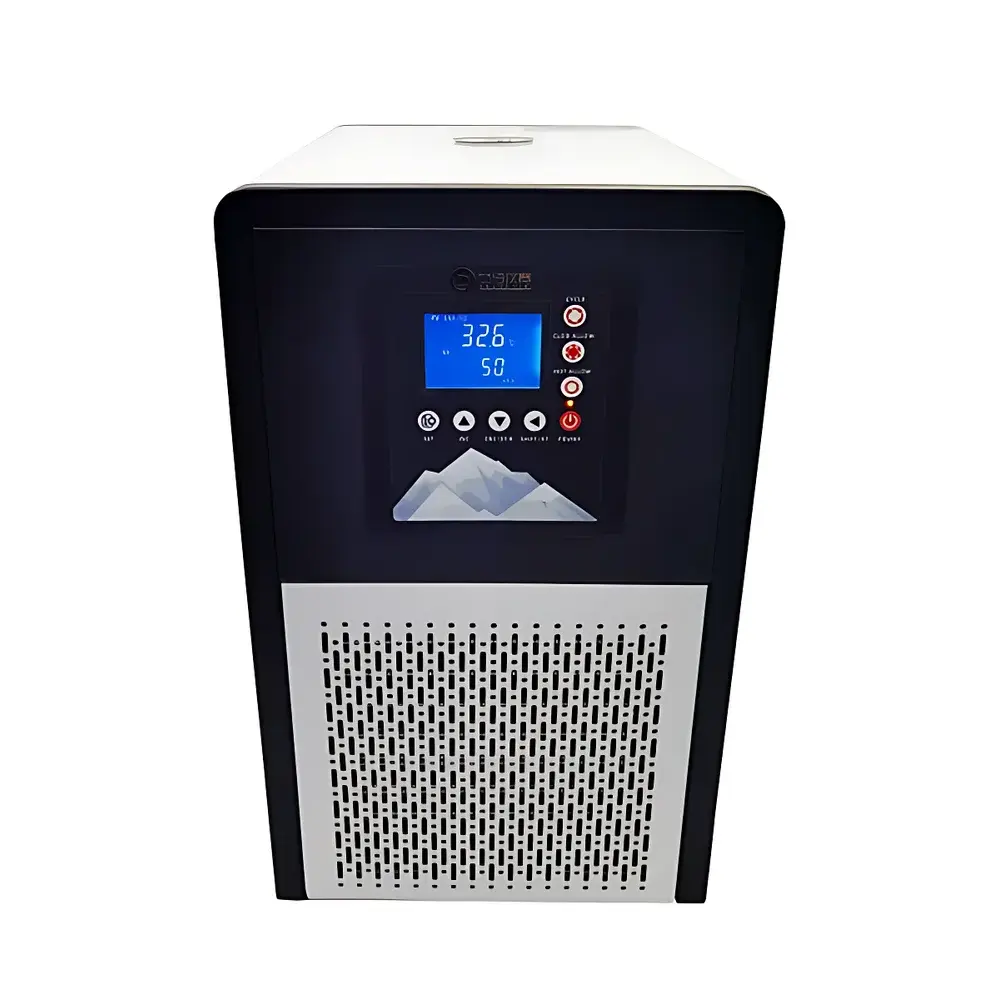
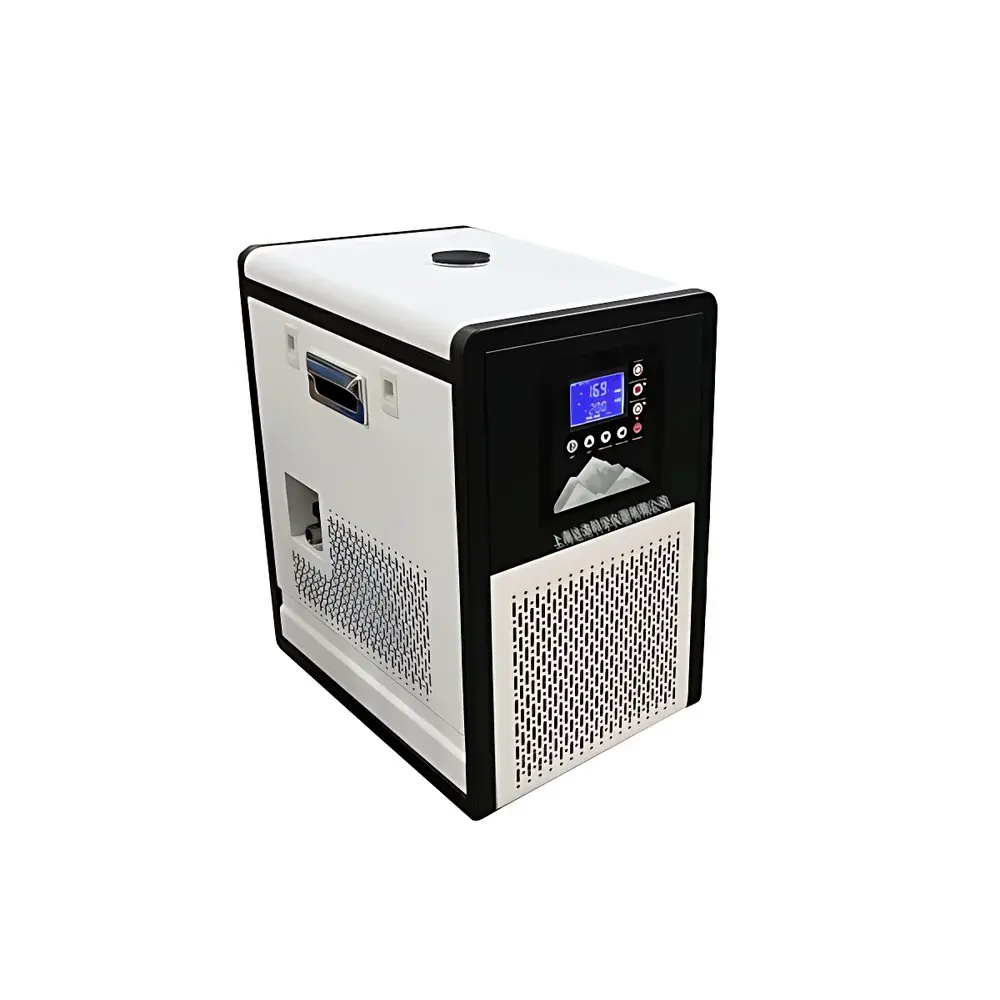
Daxluot DLM-2003 Integrated Air-Cooled Circulating Chiller
| Brand | Daxluot |
|---|---|
| Origin | Shanghai, China |
| Model | DLM-2003 |
| Cooling Method | Air-Cooled |
| Temperature Range | −20 to 100 °C |
| Temperature Stability | ±0.5 °C |
| Refrigeration Capacity | 1200 W |
| Circulation Pressure | 0.7 bar |
| Flow Rate | 8 L/min |
| Reservoir Volume | 3.5 L |
| Operation Mode | Continuous |
| Display Resolution | 0.1 °C |
| Power Supply | 220 V / 50 Hz |
| Housing Material | ABS Molded Enclosure |
| Pump Type | Hermetically Sealed, Low-Heat, Low-Noise Motor |
| Safety Features | Overtemperature Alarm, Low-Liquid-Level Protection, Compressor Overheat & Overcurrent Protection, Power-Fail Memory |
Overview
The Daxluot DLM-2003 is an integrated, air-cooled circulating chiller engineered for precision temperature control in laboratory and pilot-scale applications. It employs a hermetically sealed, high-efficiency rotary compressor paired with a microprocessor-based PID temperature controller to deliver stable thermal management across a wide operational range of −20 °C to +100 °C. Unlike water-cooled chillers requiring external cooling towers or tap water supply, the DLM-2003 utilizes ambient-air heat rejection—making it ideal for benchtop placement in fume hoods, analytical instrument enclosures, or compact reaction setups where utility infrastructure is limited. Its thermodynamic architecture supports both active cooling and electric heating functions, enabling bidirectional thermal regulation without external accessories. The unit is designed for continuous-duty operation, maintaining setpoint stability within ±0.5 °C under dynamic load conditions—critical for reproducible chromatography column conditioning, spectrophotometer detector cooling, or controlled exothermic synthesis.
Key Features
- Microprocessor-controlled XMT-series digital PID algorithm with backlit LCD interface; displays real-time setpoint, actual bath temperature, and system status (cooling/heating/standby) at 0.1 °C resolution
- Compact ABS molded housing (440 × 300 × 510 mm) optimized for benchtop or fume hood integration; side panels removable without tools for rapid access to internal components
- Hermetically sealed, low-heat circulation pump delivering 8 L/min flow at 0.7 bar pressure—engineered for minimal thermal drift and acoustic noise (<52 dB(A)) during extended operation
- Dual-mode thermal management: independent selection of cooling-only, heating-only, or simultaneous heating/cooling via integrated PTC heater and refrigeration circuit
- Integrated safety architecture including compressor overheat protection, motor overcurrent cutoff, low-level liquid detection with dry-run prevention for heating elements, and audible/visual overtemperature alarm
- Stainless steel 304 quick-connect fittings (Baba-type) for inlet/outlet ports and built-in drain valve; transparent level window with calibrated scale and overflow port for safe fluid management
- Standard accessories include silicone circulation tubing, thermal insulation sleeve, and drainage short pipe—ready for immediate deployment with reactors, condensers, or analytical instrumentation
Sample Compatibility & Compliance
The DLM-2003 is compatible with common heat-transfer fluids including deionized water, 30% ethylene glycol/water mixtures, and silicone oils rated for −30 °C to +120 °C service. Its sealed reservoir and corrosion-resistant wetted parts (304 stainless steel, EPDM seals, borosilicate viewing window) ensure long-term compatibility with mildly aggressive solvents used in pharmaceutical synthesis or polymer processing. While not certified to UL/CSA or CE for medical device use, the unit conforms to IEC 61010-1:2010 safety requirements for laboratory electrical equipment. Its temperature logging capability (via optional RS485 interface) supports basic GLP documentation needs, and the dual-stage safety interlocks align with general laboratory risk mitigation practices per ISO/IEC 17025 Annex A.3 guidelines on equipment qualification.
Software & Data Management
The DLM-2003 operates autonomously via its embedded controller and does not require proprietary software for basic function. However, it supports optional serial communication (RS485, Modbus RTU protocol) for integration into centralized lab monitoring systems. When connected, users may remotely read real-time temperature, status flags (compressor ON/OFF, heater active, alarm condition), and initiate emergency shutdown via external SCADA or LIMS platforms. No onboard data storage or audit trail is provided—consistent with Class II standalone thermal management devices. For regulated environments requiring FDA 21 CFR Part 11 compliance, third-party validated data loggers (e.g., Omega OM-DAQPRO-5300) are recommended for independent traceable recording.
Applications
- Temperature stabilization of HPLC columns, GC injectors, and mass spectrometer ion sources
- Cooling of laser diodes, CCD detectors, and NMR probe preamplifiers
- Heat removal from rotary evaporators, jacketed glass reactors, and falling-film crystallizers
- Constant-temperature conditioning of viscometers, rheometers, and calorimeters
- Support of accelerated stability testing chambers (ICH Q1A) via secondary coolant loops
- Process validation studies in API manufacturing where precise thermal ramping and hold profiles are required
FAQ
What types of heat-transfer fluids are compatible with the DLM-2003?
Deionized water, aqueous glycol solutions (up to 50% v/v), and silicone oils meeting ASTM D5275 specifications are suitable. Avoid halogenated solvents or strong acids/bases due to seal compatibility limitations.
Can the unit maintain temperature stability during rapid load changes?
Yes—the PID controller’s adaptive tuning and 1200 W refrigeration capacity enable recovery to setpoint within ≤3 minutes after a 500 W step-load increase, assuming standard glycol/water mixture and nominal flow rate.
Is external calibration required for routine use?
No. The factory-calibrated platinum RTD sensor meets ASTM E74-22 accuracy requirements (±0.2 °C from 0–100 °C). Users may perform periodic verification using a NIST-traceable reference thermometer.
Does the chiller support remote start/stop via digital I/O?
Not natively. Only RS485 Modbus communication is available. Discrete control requires external relay interfacing through optional accessory modules.
What maintenance intervals are recommended?
Compressor oil and refrigerant charge require no servicing under normal operation. Clean air-intake filters every 3 months; inspect silicone tubing for swelling or cracking annually; verify level-sensor function during quarterly preventive maintenance.



