
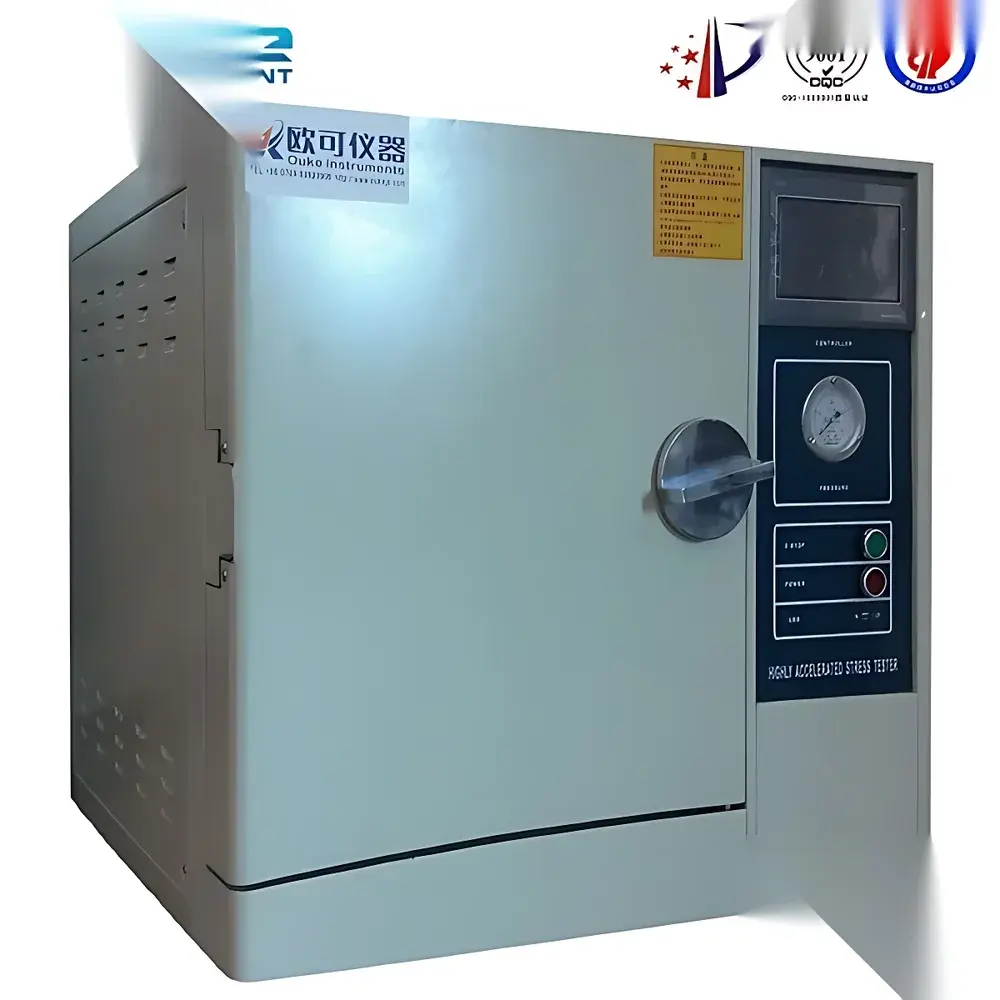
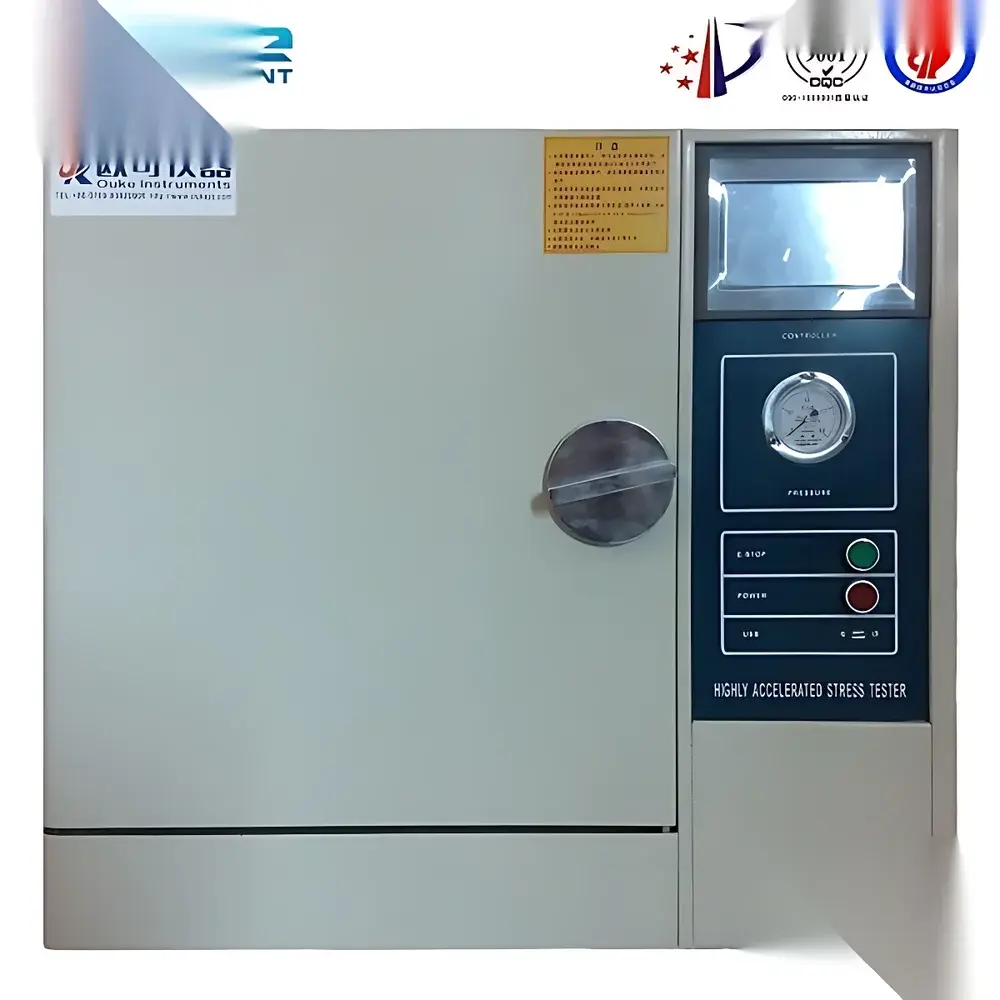
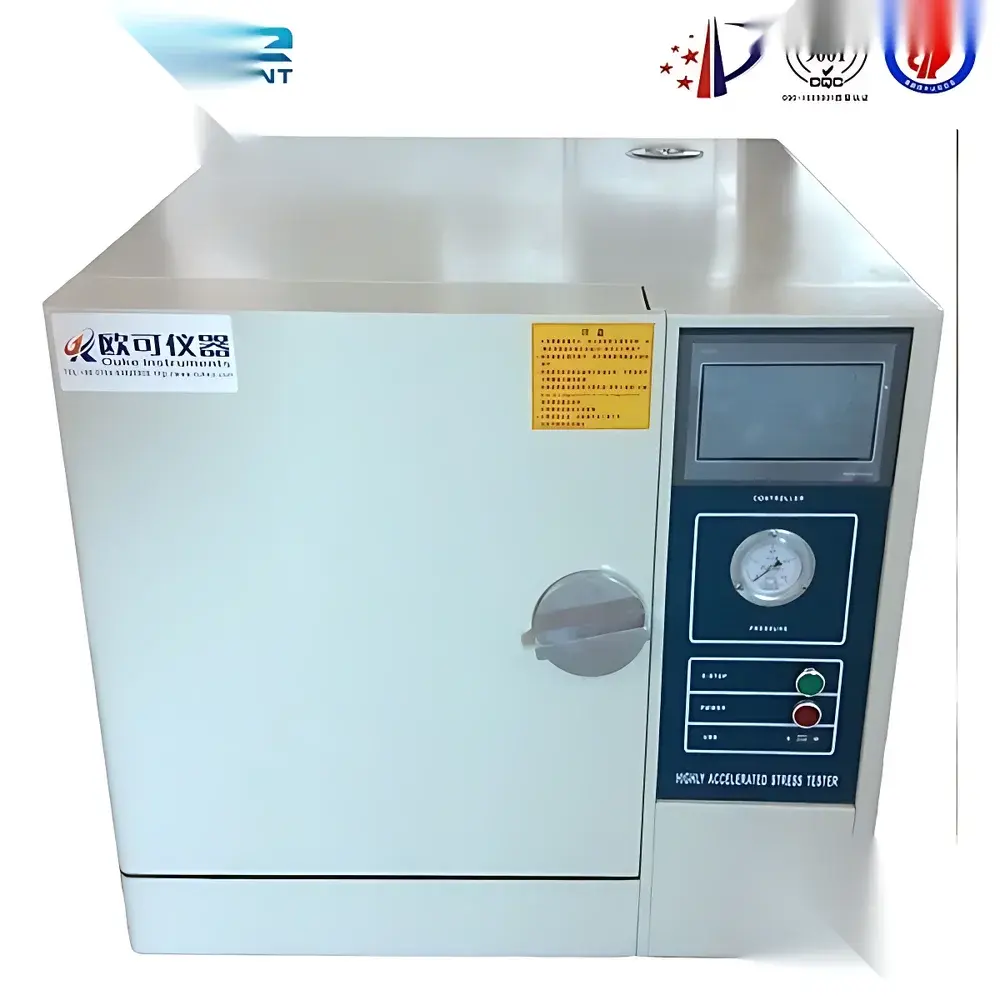
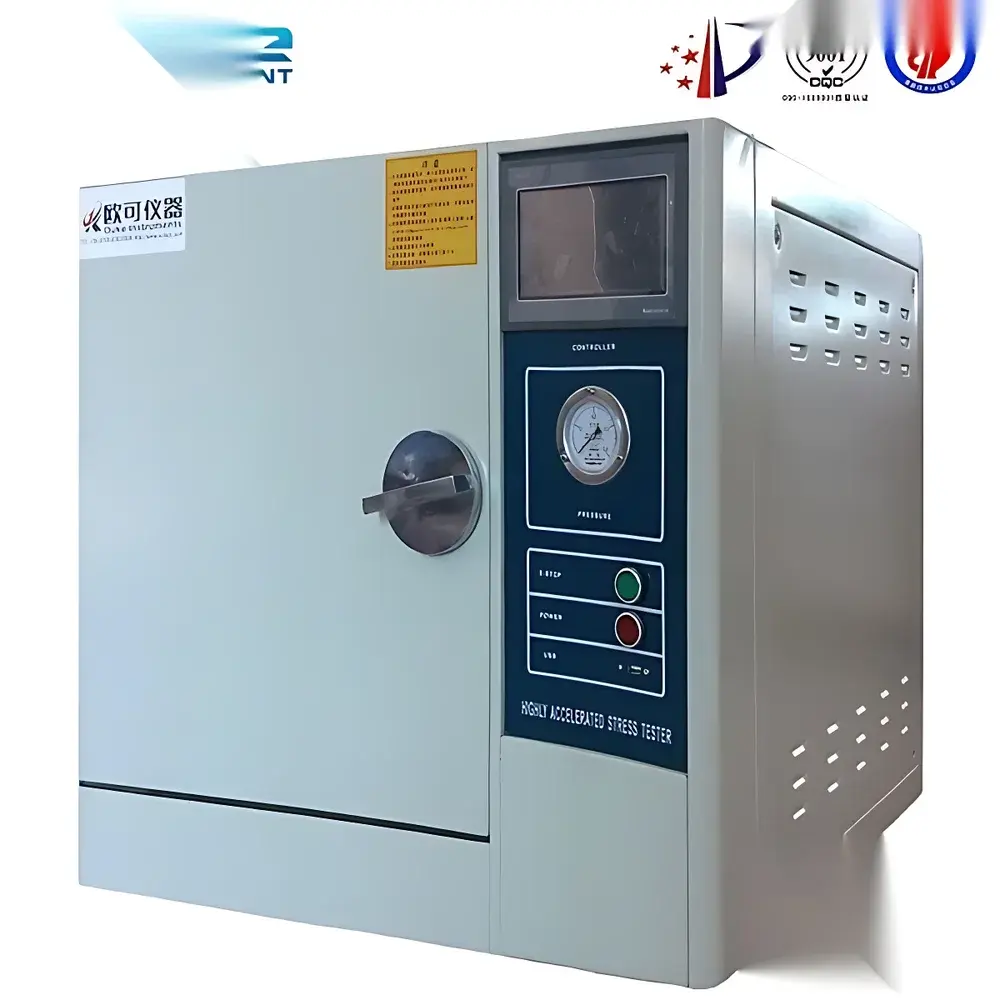
Saturated Steam Aging Test Chamber
| Brand | Other Brands |
|---|---|
| Origin | Imported |
| Manufacturer Type | General Distributor |
| Price | USD 4,100 (approx.) |
| Internal Dimensions (Φ×D, cm) | 30×45 / 40×55 / 50×55 / 60×65 |
| External Dimensions (W×H×D, cm) | 65×100×65 / 75×110×75 / 85×110×75 / 85×120×90 |
| Temperature Range | 121 °C, 132 °C (143 °C optional) |
| Humidity | 100 % RH (saturated steam) |
| Operating Pressure | 0–200 kPa(g) [0–2.0 kgf/cm²(g)] (300 kPa[g] optional) |
| Temp. Uniformity | ≤ ±2 °C |
| Humidity Uniformity | ≤ ±3 % RH |
| Circulation | Natural convection of saturated steam |
| Safety Protections | Low-water cutoff, overpressure relief, overtemperature shutdown, auto/manual water replenishment, pressure-actuated safety interlock |
| Standard Accessories | Two-tier stainless-steel sample racks |
| Power Supply | AC 220 V ±5 %, 50 Hz ±0.5 Hz |
Overview
The Saturated Steam Aging Test Chamber is a precision-engineered environmental stress test system designed to perform accelerated aging and hermeticity evaluation under controlled saturated steam conditions. It operates on the fundamental principle of exposing test specimens to elevated temperature and 100 % relative humidity at defined gauge pressures—conditions that thermodynamically correspond to saturated steam states per the IAPWS-IF97 formulation. This enables reproducible simulation of long-term moisture ingress, hydrolytic degradation, and seal integrity failure mechanisms in a compressed timeframe. The chamber is widely deployed in reliability engineering workflows for electronic assemblies (e.g., multilayer PCBs, IC packages, LCD modules), automotive sensors, medical device housings, and aerospace-grade polymer components—particularly during design validation and qualification phases where early detection of latent defects, delamination, or vapor-phase corrosion is critical.
Key Features
- Microprocessor-based PID temperature control with digital LED display ensures stable saturation point maintenance at 121 °C, 132 °C, or optionally 143 °C—aligned with industry-standard accelerated test profiles such as JESD22-A102 (Pressure Cooker Test) and MIL-STD-202 Method 108.
- Cylindrical stainless-steel inner chamber (AISI 304) engineered to ASME BPVC Section VIII Div. 1 requirements for pressure vessels; seamless construction eliminates crevices and supports uniform condensate drainage—preventing localized thermal shock or non-uniform aging.
- Radially contoured internal liner deflects latent heat flux away from samples, minimizing direct impingement of condensing steam and improving thermal homogeneity across the test volume.
- Integrated pressure-activated safety interlock: door latch mechanism engages automatically when internal pressure exceeds ambient; increased differential pressure enhances gasket compression—extending silicone sealing life and eliminating traditional clamp-style mechanical wear.
- Self-regulating water management system with float-level sensor, automatic refill function, and overflow protection—enabling uninterrupted operation up to 200 hours per fill cycle under typical test loads.
- Dual-function digital instrumentation: independent LED displays for real-time chamber temperature and absolute pressure, synchronized with a start-on-temperature timer to eliminate pre-heat bias in test duration accounting.
- Steam purity optimization via continuous venting of non-condensable gases and sub-saturated vapor fractions—ensuring consistent thermodynamic state and eliminating air pockets that compromise test validity.
Sample Compatibility & Compliance
The chamber accommodates a broad range of sample geometries via adjustable stainless-steel multi-tier racks (included). Its cylindrical cavity design supports uniform exposure of irregularly shaped components—including stacked PCBs, hermetically sealed MEMS packages, LED modules, and molded plastic enclosures—without shadowing or stagnation zones. The system complies with key international test standards including JEDEC JESD22-A102 (PCT), IPC-TM-650 2.6.25.1, and ASTM F1929 (dye penetration verification support). All safety-critical functions—including pressure relief valve actuation (ASME-certified set point), redundant temperature limiters, and low-water cut-off—are independently validated and documented for GLP/GMP audit readiness. Electrical architecture conforms to IEC 61000-6-2/6-4 for EMC immunity and emission compliance.
Software & Data Management
While hardware-controlled for operational robustness and regulatory simplicity, the chamber supports external data logging via analog 4–20 mA outputs for temperature and pressure signals (optional interface module available). For laboratories requiring full traceability, integration with validated LIMS or MES platforms is enabled through Modbus RTU (RS-485) protocol—supporting time-stamped parameter records, operator ID tagging, and electronic signature capture compliant with FDA 21 CFR Part 11 Annex 11 requirements. Audit trails include all safety event logs (e.g., pressure excursions, water level alarms, door interlock status), ensuring full alignment with ISO/IEC 17025 clause 7.7 and ICH Q5C stability testing guidelines.
Applications
- Accelerated moisture sensitivity level (MSL) screening of surface-mount devices prior to reflow soldering.
- Hermeticity validation of microelectronic packages using steam-induced delamination (SID) as a failure indicator.
- Long-term reliability assessment of conformal coatings, potting compounds, and adhesive bonds under cyclic saturated steam exposure.
- Qualification testing of medical device seals (e.g., IV connectors, diagnostic cartridges) per ISO 11607-1 Annex B.
- Evaluation of corrosion resistance in automotive ECU housings exposed to under-hood humid environments.
- Stability studies for pharmaceutical primary packaging materials under high-humidity accelerated aging per ICH Q1A(R2).
FAQ
What standards does this chamber support for pressure cooker testing?
It meets the environmental parameters specified in JEDEC JESD22-A102, IPC-TM-650 2.6.25.1, and MIL-STD-202 Method 108—covering temperature, pressure, and humidity tolerances required for valid PCT execution.
Is the chamber suitable for testing lithium-ion battery cells?
No—this unit is not rated for flammable or explosive atmospheres. Battery cell testing requires specialized explosion-proof chambers with gas monitoring and forced ventilation per UL 1642 and UN 38.3 requirements.
Can the chamber operate continuously for 200 hours without manual intervention?
Yes—under nominal load and ambient inlet water temperature (15–25 °C), the integrated reservoir and auto-refill system sustain uninterrupted operation for up to 200 hours, contingent upon proper initial calibration and absence of external steam leaks.
How is steam quality maintained during extended runs?
A dedicated venting circuit continuously purges non-condensable gases and sub-saturated vapor fractions, maintaining thermodynamic equilibrium and preventing air entrapment that could skew local RH or temperature readings.
Does the system provide electronic data export capability?
Standard configuration includes analog outputs; optional RS-485 Modbus interface enables real-time parameter streaming, event logging, and electronic record generation compatible with 21 CFR Part 11-compliant systems.



