
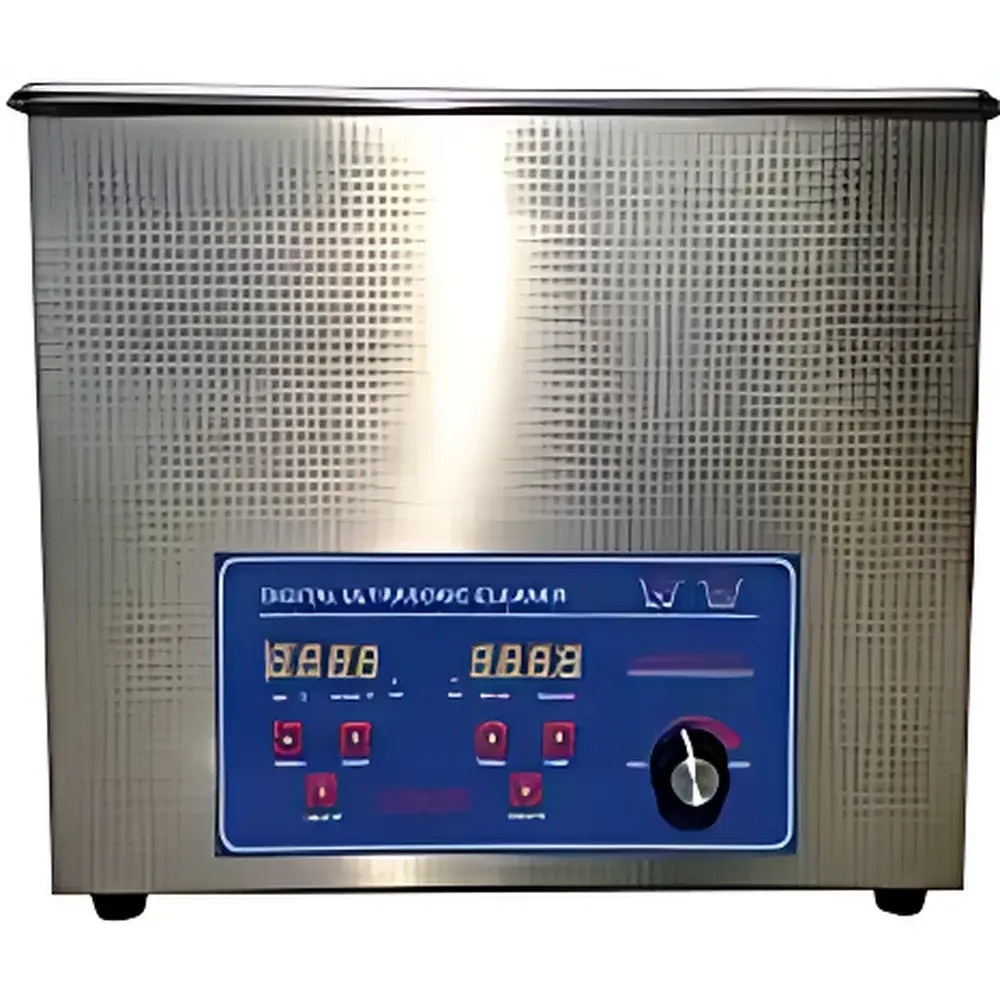
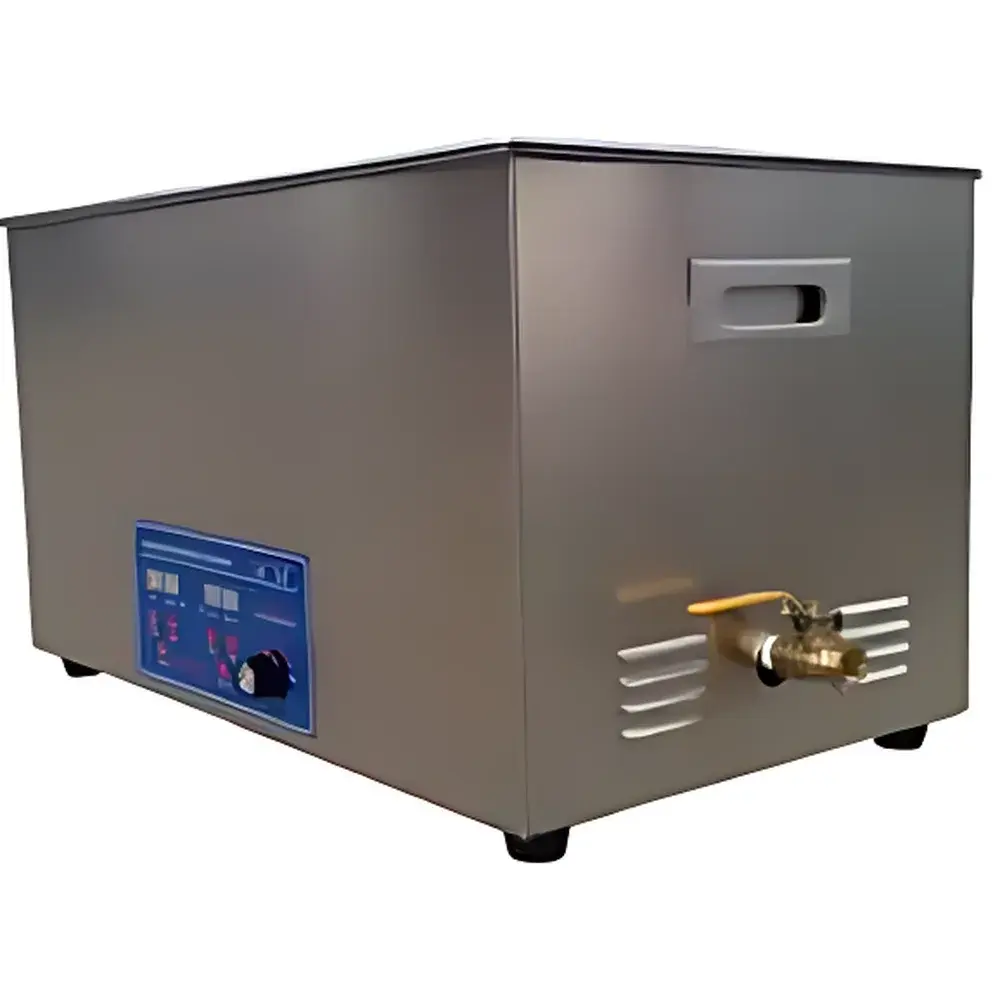
Hanuo HN-22AL Adjustable-Power Ultrasonic Cleaner
| Brand | Hanuo |
|---|---|
| Origin | Shanghai, China |
| Model | HN-22AL |
| Capacity | 22 L |
| Ultrasonic Frequency | 40 kHz |
| Ultrasonic Power | 480 W |
| Power Adjustment | Yes (40–100% stepless) |
| Temperature Control | Yes (20–80 °C) |
| Timer | Yes (0–30 min) |
| Sound-Dampening Lid | Included |
| Drain Valve | Manual |
| Heating Power | 600 W |
| Internal Tank Dimensions | 500 × 300 × 150 mm |
| External Dimensions | 530 × 330 × 280 mm |
| Net Weight | 15.8 kg |
| Compliance | CE-marked for laboratory use per IEC 61010-1 |
Overview
The Hanuo HN-22AL Adjustable-Power Ultrasonic Cleaner is a benchtop laboratory-grade ultrasonic cleaning system engineered for precision, repeatability, and operational flexibility in demanding scientific and industrial environments. It operates on the principle of cavitation—generating high-frequency (40 kHz) acoustic pressure waves in liquid media to produce transient microbubbles that collapse with localized energy release. This physical mechanism enables non-contact, uniform removal of particulate contaminants, organic residues, oils, fluxes, and biofilms from complex geometries—including blind holes, crevices, and porous surfaces—without mechanical abrasion or chemical aggression. Designed for routine use in QC labs, R&D facilities, and production support settings, the HN-22AL delivers consistent cleaning performance across diverse sample types while maintaining full compliance with IEC 61010-1 safety standards for electrical equipment used in laboratory environments.
Key Features
- Stepless ultrasonic power adjustment (40–100%) allows precise optimization of cavitation intensity for sensitive or heavily soiled samples—critical for preserving delicate optics, microfluidic components, or coated substrates.
- Programmable digital timer (0–30 minutes) with auto-shutdown ensures process reproducibility and eliminates operator dependency in routine cleaning protocols.
- Integrated heating system (600 W) with PID-controlled temperature regulation (20–80 °C) enhances cleaning efficacy by lowering surface tension and accelerating dissolution of waxy, greasy, or polymeric residues.
- Acoustically insulated stainless-steel tank (500 × 300 × 150 mm internal dimensions) constructed from 304 stainless steel resists corrosion from aqueous and mild solvent-based cleaning solutions.
- Sound-dampening lid reduces ambient noise to ≤55 dB(A) at 1 m distance, supporting safe operation in shared lab spaces without requiring dedicated acoustic enclosures.
- Manual drain valve enables rapid, residue-free solution exchange—essential for multi-step cleaning sequences involving rinse, acid etch, or enzymatic treatment stages.
Sample Compatibility & Compliance
The HN-22AL accommodates a broad range of laboratory and industrial components, including but not limited to: glassware (volumetric flasks, cuvettes, pipettes), optical elements (lens assemblies, microscope slides, quartz cuvettes), electronic subassemblies (PCBs, SMD components, connectors), medical devices (surgical instruments, dental handpieces, endoscope parts), and precision mechanical parts (bearings, gears, watch movements). All wetted materials meet USP Class VI biocompatibility requirements for indirect contact with pharmaceutical processing equipment. The unit complies with CE marking under Directive 2014/30/EU (EMC) and 2014/35/EU (LVD), and supports documentation traceability required for GLP and ISO/IEC 17025-accredited laboratories. While not sterilizing per ISO 17664, it meets pre-sterilization cleaning validation benchmarks when paired with validated cleaning agents and cycle parameters.
Software & Data Management
The HN-22AL features an embedded microcontroller-based interface with real-time display of setpoint and actual values for time, temperature, and power level. Though not equipped with PC connectivity or data logging hardware, its parameter retention architecture preserves last-used settings across power cycles—supporting SOP-driven workflows in regulated environments. Users may integrate the device into broader lab informatics systems via external environmental monitoring sensors (e.g., temperature loggers compliant with FDA 21 CFR Part 11) and manual entry into ELN platforms. Calibration verification procedures—including frequency stability checks using calibrated hydrophones and temperature uniformity mapping per ASTM E2251—are documented in the included technical manual and supported by Hanuo’s ISO 9001-certified service network.
Applications
- Pre-analytical sample preparation: Degassing solvents prior to HPLC or GC analysis; dispersing nanoparticle suspensions for DLS or TEM sample prep.
- Instrument maintenance: Cleaning nebulizers, autosampler needles, and ICP-MS cones to prevent spectral interferences and signal drift.
- Electronics manufacturing: Post-reflow flux removal from high-density PCBs without damaging thermal pads or conformal coatings.
- Medical device reprocessing: Removing proteinaceous debris from reusable laparoscopic instruments prior to autoclaving—validated per AAMI ST79 guidelines.
- Materials science: Surface activation of polymers and metals prior to coating or bonding; deagglomeration of ceramic slurries for tape-casting processes.
- Optics fabrication: Final cleaning of anti-reflective coated lenses and laser cavity mirrors where particle counts must remain below ISO 14644-1 Class 5 limits.
FAQ
What cleaning solutions are compatible with the HN-22AL?
Aqueous alkaline, neutral, and mildly acidic formulations are recommended. Avoid halogenated solvents (e.g., chloroform, carbon tetrachloride) and strong oxidizers (e.g., concentrated nitric acid) due to tank material compatibility and cavitation efficiency limitations.
Can the HN-22AL be used for passivation of stainless steel parts?
No—it lacks the controlled chemistry delivery and temperature ramping required for ASTM A967-compliant passivation. However, it serves as an effective pre-passivation cleaning step to remove free iron and organic residues.
Is the 40 kHz frequency fixed, or does it vary with load?
The generator maintains nominal 40 kHz output within ±1.5% across all power levels and typical load conditions, verified per IEC 60118-7 sweep testing methodology.
How often should the ultrasonic transducers be recalibrated?
Transducer performance is stable over >10,000 operating hours. Annual verification of acoustic output intensity using a calibrated hydrophone is advised for GMP-regulated applications.
Does the unit include a degassing function?
Yes—the “degas” mode initiates low-power (40%), low-frequency pulsing for 3 minutes to remove dissolved air from cleaning baths, improving cavitation onset and consistency for critical applications.



