
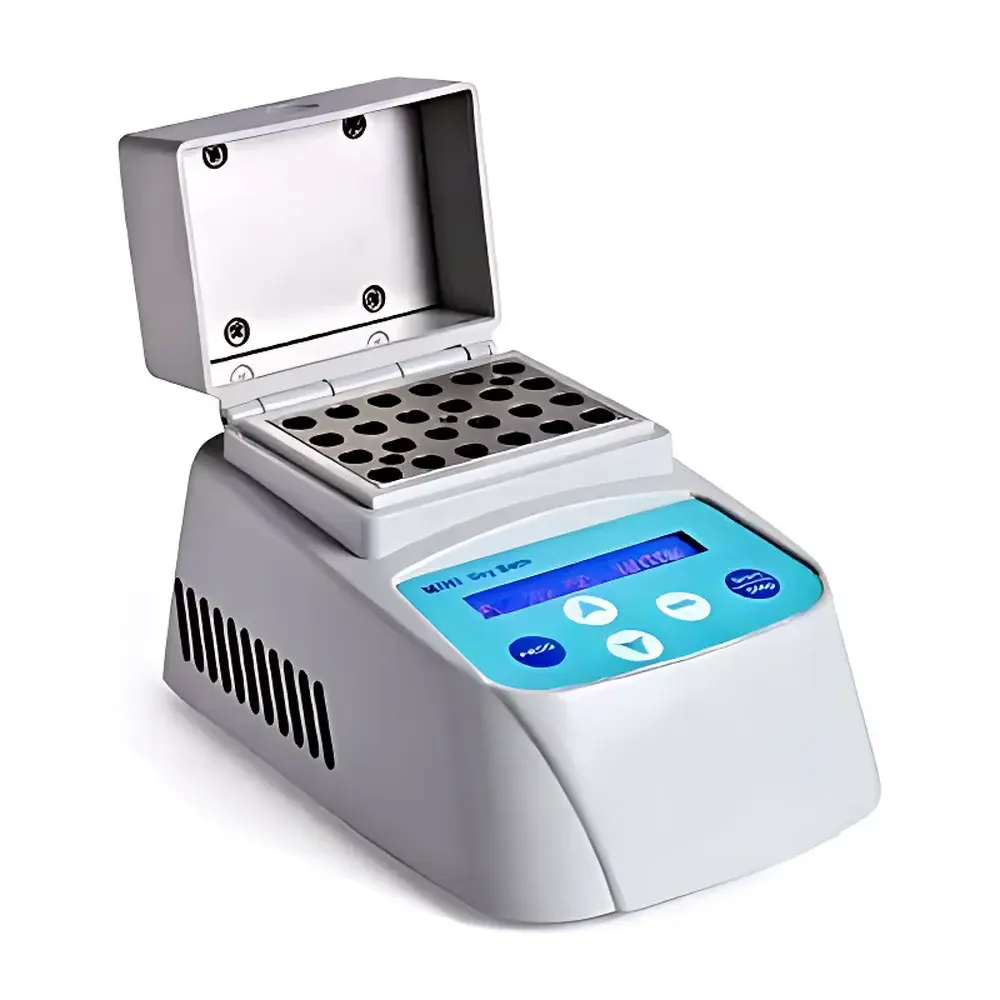
Hanuo HNESC1000 Mini Heated Metal Block Bath
| Brand | Hanuo |
|---|---|
| Origin | Shanghai, China |
| Model | HNESC1000 |
| Temperature Range | 0–100 °C |
| Temperature Accuracy | ±0.3 °C (at 37 °C) |
| Heating Time | ≤12 min (25 °C → 100 °C) |
| Cooling Capability | −10 °C to 100 °C (refrigerated variant) |
| Thermal Lid Range | OFF to +10 °C |
| Thermal Lid Accuracy | ±0.5 °C |
| Dimensions | 300 × 200 × 210 mm |
| Net Weight | 4.7 kg |
| Power Input | AC 220 V, 50–60 Hz |
| Rated Power | 150 W |
| Timer Range | 1 s to 99 h 59 min or ∞ |
| Multi-point Programming | 5 setpoints, up to 99 cycles |
| Auto-restart after Power Failure | Yes |
| 4 °C Hold Post-Run | Yes |
| Calibration | User-accessible temperature offset adjustment per module type |
Overview
The Hanuo HNESC1000 Mini Heated Metal Block Bath is a compact, semiconductor-based thermal incubation system engineered for precise, stable, and reproducible temperature control of sample tubes and microplates in life science, clinical diagnostics, and analytical laboratories. Unlike conventional water baths, this metal block design eliminates evaporation, condensation, and cross-contamination risks while delivering rapid thermal response and uniform heat distribution across the aluminum heating block. Its core architecture integrates PID-controlled semiconductor thermoelectric modules (Peltier elements) for both heating and active cooling—enabling operation from −10 °C to 100 °C with high stability and minimal overshoot. The unit is optimized for applications requiring tight thermal regulation over extended durations, including enzyme reactions, nucleic acid hybridization, protein denaturation/renaturation, and cell lysis protocols. With its low thermal mass and intelligent thermal lid management, the HNESC1000 ensures consistent sample integrity without requiring external chillers or recirculating coolant systems.
Key Features
- Wide operational range: −10 °C to 100 °C (refrigerated configuration), with standard heating-only mode spanning 0–100 °C
- High-precision PID temperature control: ±0.3 °C accuracy at 37 °C; ±0.5 °C thermal lid accuracy
- Thermal uniformity ≤±0.3 °C across the block surface (measured at 37 °C, using calibrated reference probe)
- Programmable multi-point operation: Up to five independent temperature/time setpoints with configurable cycle count (1–99 cycles)
- Intelligent thermal lid: Adjustable lid temperature (OFF to +10 °C) to minimize evaporation in low-volume tubes (e.g., 0.2 mL PCR strips)
- Dual-mode timer: Selectable resolution—1 second to 99 hours 59 minutes, or continuous (∞) operation
- Post-run 4 °C hold function: Automatically transitions to refrigerated preservation upon protocol completion
- Robust safety architecture: Dual hardware and software overtemperature protection, fuse-rated circuit (250 V, 3 A), and auto-recovery after power interruption
- User-configurable calibration: Independent offset correction per module type (e.g., 0.2 mL, 0.5 mL, 1.5 mL, 2.0 mL, 96-well plate)
- Auto-start functionality: Resumes pre-saved protocol on power-up
- Front-panel LCD with real-time display of setpoint, actual block temperature, elapsed time, remaining time, and lid status
Sample Compatibility & Compliance
The HNESC1000 accommodates interchangeable aluminum blocks designed for common lab consumables—including 0.2 mL PCR strips, 0.5 mL, 1.5 mL, and 2.0 mL microcentrifuge tubes, as well as 96-well plates. Custom blocks are available upon request to support non-standard tube geometries or high-throughput formats. All blocks undergo thermal mapping validation per ISO/IEC 17025 guidelines to ensure spatial uniformity. The device meets electromagnetic compatibility (EMC) requirements per IEC 61326-1 and electrical safety standards per IEC 61010-1. While not certified for GMP manufacturing environments, its logging-capable firmware supports GLP-compliant workflows when paired with validated external data capture systems. It is suitable for use in ISO 15189-accredited clinical labs for non-regulated pre-analytical incubation steps.
Software & Data Management
The HNESC1000 operates via embedded firmware with no external PC dependency. All protocols—including multi-step programs, timer settings, and calibration offsets—are stored in non-volatile memory and retained during power loss. Audit trail functionality is limited to internal event logging (e.g., power-on, temperature deviation alerts, lid activation), viewable only through service mode. For full traceability in regulated environments, integration with laboratory information management systems (LIMS) or electronic lab notebooks (ELN) requires external USB or RS-232 data logging adapters (sold separately). The unit does not comply with FDA 21 CFR Part 11 out-of-the-box; however, third-party validation packages are available to establish electronic record integrity for QC/QA departments operating under GxP frameworks.
Applications
- Enzymatic assays requiring strict thermal consistency (e.g., restriction digests, ligations, phosphorylations)
- PCR setup and pre-amplification incubation (hot-start activation, touchdown cycling prep)
- Nucleic acid purification steps involving protease or RNase treatment
- Cell culture reagent equilibration (e.g., pre-warmed media, trypsin solutions)
- Standard curve preparation in ELISA and immunoassay workflows
- Stability testing of biologics and small-molecule formulations at defined temperatures
- Controlled denaturation studies of recombinant proteins and antibodies
- Low-volume sample storage during assay pauses (via 4 °C hold mode)
FAQ
What is the difference between the HNESC1000 and the HNES1000 model?
The HNESC1000 includes active semiconductor cooling capability (−10 °C to 100 °C), whereas the HNES1000 is heating-only (0–100 °C). Both share identical block dimensions, control logic, and firmware features.
Can the thermal lid be disabled during operation?
Yes—the lid temperature can be set to OFF, allowing passive thermal isolation or manual lid removal for rapid access.
Is calibration traceable to NIST standards?
The unit supports user-performed offset calibration using an external NIST-traceable thermometer; however, factory calibration certificates are not included by default and must be requested at time of order.
Does the device support external temperature probes for sample-level monitoring?
No—temperature sensing is internal to the aluminum block only. Sample-level measurement requires insertion of a separate calibrated probe into a dedicated well or use of a thermocouple-equipped module (custom option).
What maintenance is required for long-term reliability?
Annual verification of thermal uniformity and accuracy is recommended. Clean the block surface with isopropyl alcohol before each use; avoid abrasive cleaners or immersion. Ensure ventilation grilles remain unobstructed to maintain Peltier module efficiency.



