
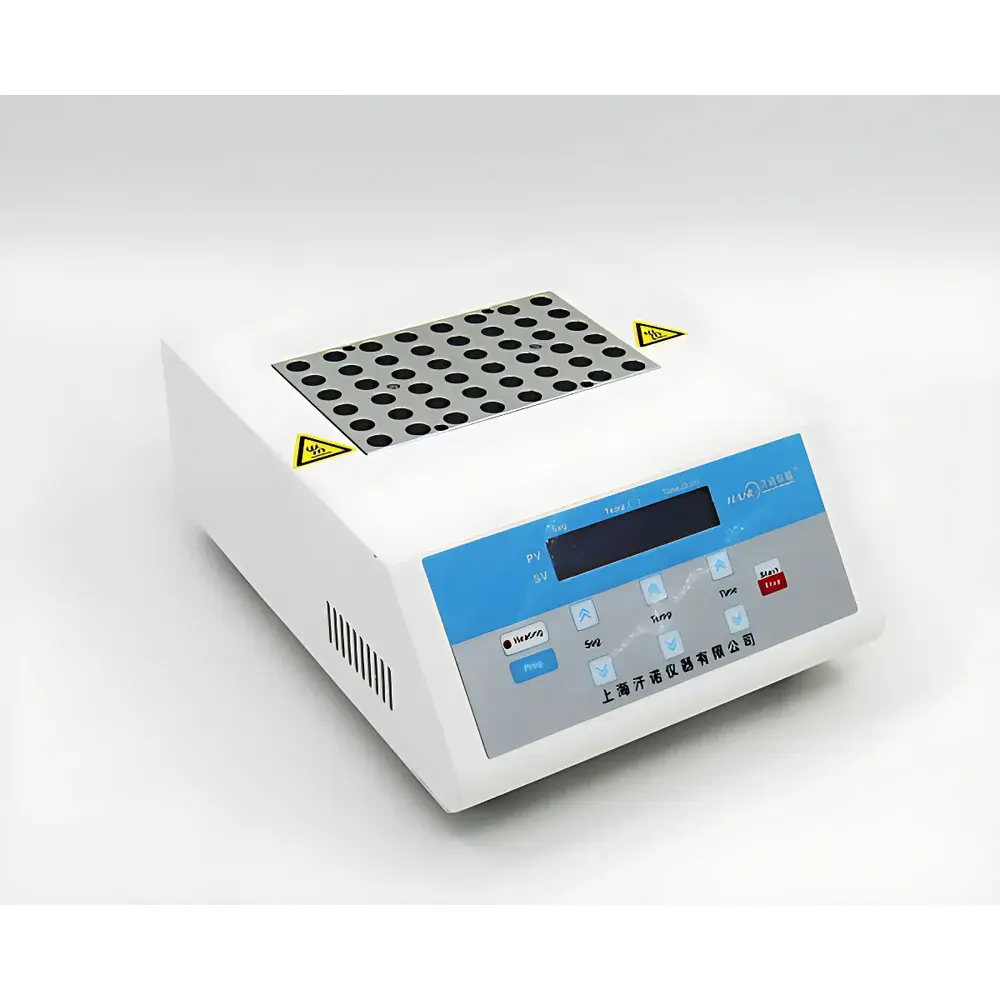
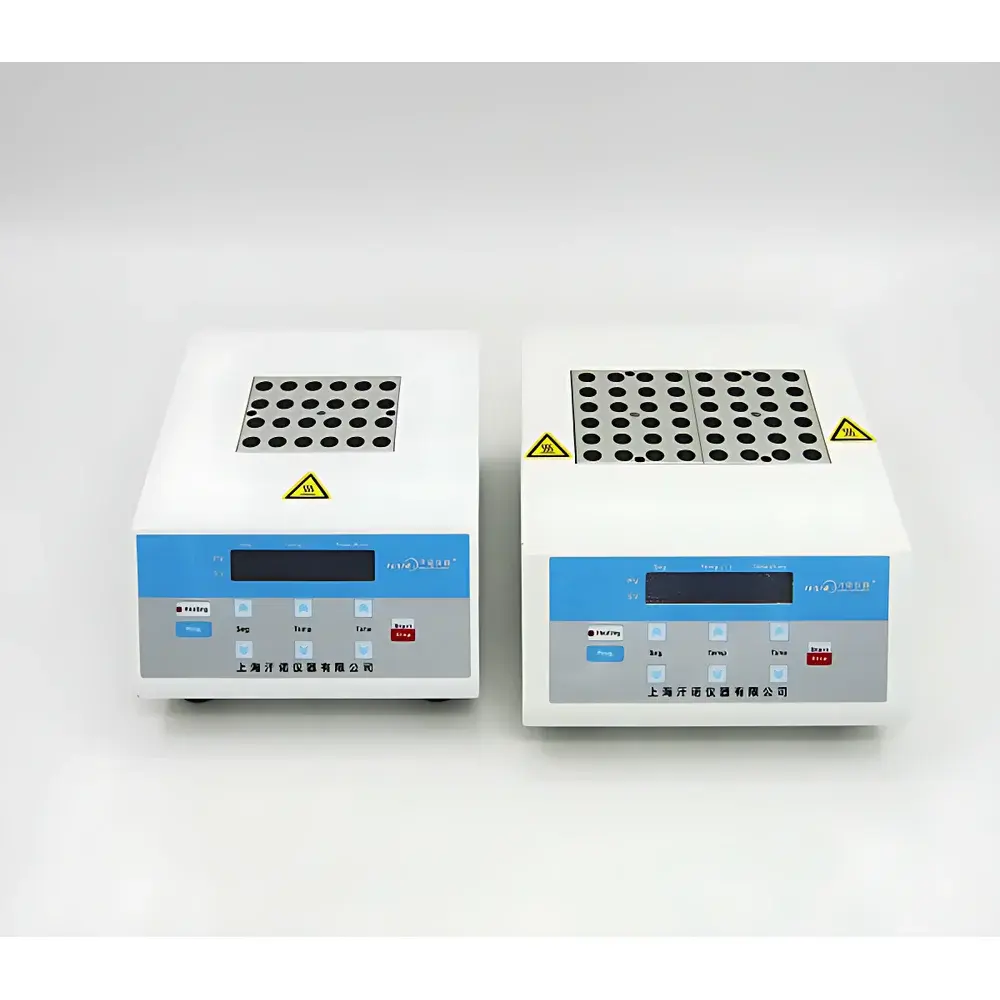
Hanuo HNDKT200-4 Precision Dry Block Heater
| Brand | Hanuo |
|---|---|
| Origin | Shanghai, China |
| Model | HNDKT200-4 |
| Temperature Range | Ambient +5 to 150 °C |
| Temperature Accuracy | ±0.5 °C |
| Display Resolution | 0.1 °C |
| Heating Time | ≤12 min (20 °C to 100 °C) |
| Block Uniformity | ≤±0.5 °C |
| Module Delta T @40 °C | 0.3 °C |
| Power Rating | 600 W |
| Programmable Stages | 5-segment ramp/soak |
| Safety | Integrated overtemperature cutoff, fuse (250 V, 3 A, Φ5×20 mm), auto-fault detection with audible alarm |
Overview
The Hanuo HNDKT200-4 Precision Dry Block Heater is a microprocessor-controlled thermal incubation system engineered for high-reproducibility sample heating in molecular biology, clinical diagnostics, and analytical chemistry laboratories. Unlike water baths—prone to contamination, evaporation, and inconsistent thermal transfer—the HNDKT200-4 employs solid aluminum heating blocks with embedded resistive heating films to deliver rapid, uniform, and contamination-free temperature control across multiple sample vessels simultaneously. Its operational range spans from ambient +5 °C up to 150 °C, making it suitable for applications requiring precise thermal activation, enzyme inactivation, serum coagulation, DNA denaturation prior to PCR, and pre-electrophoresis sample conditioning. The device complies with fundamental safety and electromagnetic compatibility requirements per IEC 61010-1 for laboratory electrical equipment and supports routine GLP-compliant workflows through traceable calibration and programmable thermal profiles.
Key Features
- High-resolution 0.1 °C digital display with real-time temperature readout and countdown timer
- Dual independent parameter setting: simultaneous configuration of target temperature and dwell time
- Five-stage programmable controller enabling complex thermal protocols (e.g., ramp-soak-cool sequences)
- Automatic self-diagnostic system with audible alarm and on-screen error code indication for sensor failure, open-circuit heater, or overtemperature events
- User-accessible temperature offset calibration function to maintain traceability against NIST-traceable reference thermometers
- Modular block design with quick-release mechanism—compatible with interchangeable aluminum blocks for tubes (0.2 mL, 0.5 mL, 1.5 mL, 2.0 mL), PCR strips, and microplates (96-well)
- Integrated thermal cutoff protection activated at ≥160 °C, plus certified fast-blow fuse (250 V, 3 A, Φ5×20 mm) for primary circuit safety
- Optimized thermal architecture: aluminum block mass and heating film geometry ensure ≤0.5 °C inter-well uniformity at 40 °C and ≤12-minute ramp from 20 °C to 100 °C
- Low-noise, zero-maintenance operation with no moving parts or fluid media—ideal for laminar flow hoods and cleanroom-adjacent environments
Sample Compatibility & Compliance
The HNDKT200-4 accommodates standard laboratory consumables without adapter modification, including conical-bottom microcentrifuge tubes (1.5–2.0 mL), thin-wall PCR tubes (0.2 mL), 8-strip PCR racks, and flat-bottom 96-well plates. All contact surfaces are anodized aluminum, resistant to common disinfectants (70% ethanol, 1% sodium hypochlorite) and autoclavable (blocks only; unit body not autoclavable). The instrument meets essential performance criteria outlined in ISO/IEC 17025 for calibration traceability and supports audit-ready documentation when used in conjunction with external validation procedures per ASTM E2251 (Standard Practice for Calibration of Thermometers Used in Laboratory Applications). It is routinely deployed in QC/QA labs performing USP endotoxin testing preparation steps and CLSI EP23 validation protocols requiring stable, non-aqueous heat sources.
Software & Data Management
While the HNDKT200-4 operates as a standalone benchtop instrument with tactile touch-key interface, its thermal program logs—including setpoint, duration, actual block temperature history, and fault events—are retained in non-volatile memory for post-run review. For integration into networked lab environments, optional RS-232 or USB-to-serial adapters enable connection to LIMS or ELN platforms via ASCII command protocol (SCPI-compatible syntax). All programmable parameters support electronic signature capture under FDA 21 CFR Part 11–compliant software extensions when paired with validated third-party data acquisition systems. Audit trails include timestamped operator ID, parameter changes, and calibration adjustments—fully exportable as CSV or PDF reports.
Applications
- Pre-PCR thermal denaturation of genomic DNA templates at 95 °C for 5 minutes
- Controlled coagulation of serum samples at 37 °C for clinical immunoassay preparation
- Inactivation of restriction enzymes or phosphatases post-digestion (65–80 °C, 10–20 min)
- Accelerated solvent evaporation from small-volume extracts (e.g., LC-MS sample prep at 40–60 °C)
- Standardization of viscosity reference materials prior to rheological measurement
- Stabilization of antibody conjugates during labeling reactions (37 °C, humidity-controlled ambient)
- Thermal stress testing of polymer-based diagnostic cartridges (ISO 11137 radiation sterilization pre-conditioning)
FAQ
What is the maximum recommended operating temperature for continuous use?
The HNDKT200-4 is rated for sustained operation up to 150 °C; however, for optimal long-term stability of heating film integrity and block thermal fatigue resistance, continuous use above 120 °C is discouraged beyond 4 hours per session.
Can the unit be calibrated in-house using standard reference thermometers?
Yes—the built-in temperature offset function allows user calibration against a NIST-traceable probe inserted into a designated calibration well (included with optional calibration kit HN-CAL-KIT-1). Full calibration certificates require third-party accredited service.
Is the aluminum block compatible with organic solvents such as chloroform or DMSO?
Anodized aluminum exhibits good resistance to short-term exposure to most polar aprotic solvents; however, prolonged contact with strong acids, bases, or halogenated hydrocarbons may degrade the oxide layer. Wipe-clean only—do not soak.
Does the device support external temperature feedback from a sample probe?
No—the HNDKT200-4 regulates based solely on integrated PT100 sensor readings within the block. For sample-core temperature monitoring, use an independent thermocouple reader synchronized manually or via external DAQ.
What maintenance is required to sustain accuracy over time?
Annual verification of temperature uniformity and setpoint accuracy is recommended. Clean block wells with lint-free swabs and isopropanol; inspect fuse and ventilation grilles quarterly for dust accumulation. No lubrication or internal servicing is required.



