
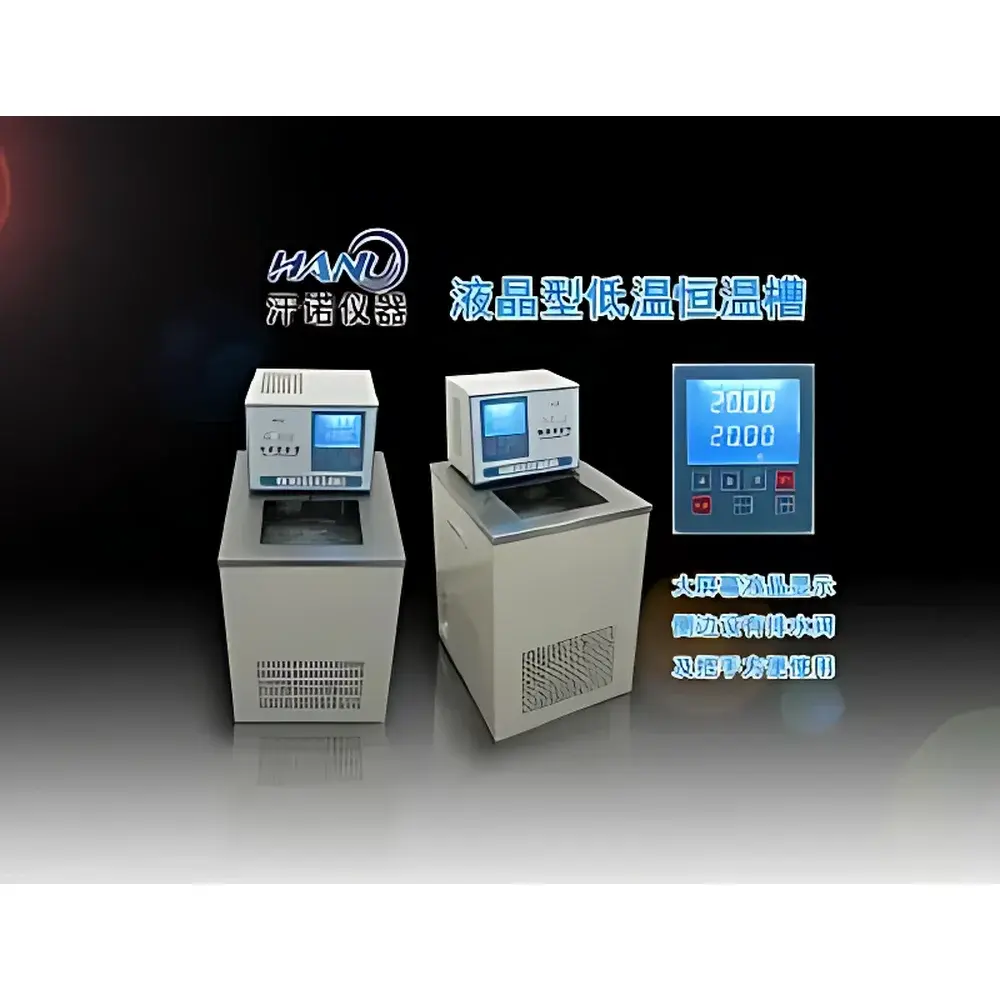
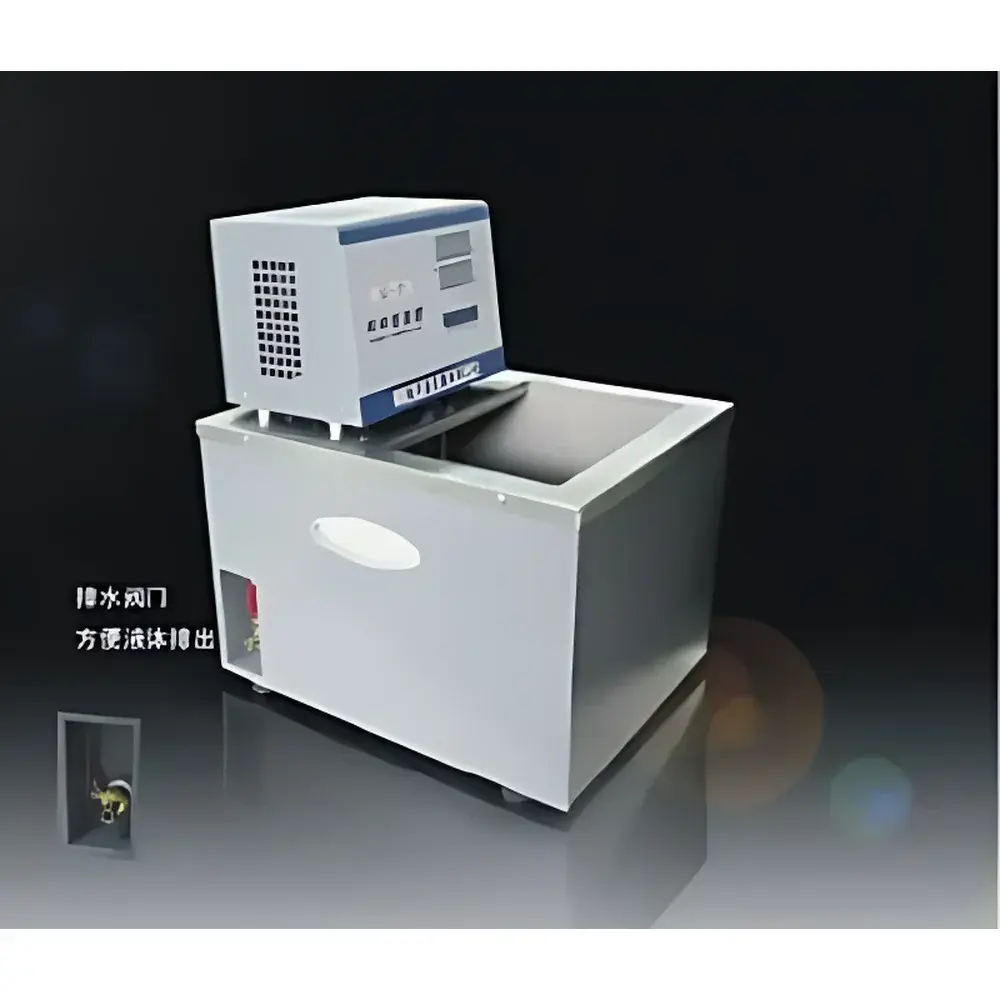
Hanuo HX-2030 Low-Temperature Circulating Chiller
| Brand | Hanuo |
|---|---|
| Origin | Shanghai, China |
| Model | HX-2030 |
| Temperature Range | −40 °C to 105 °C |
| Temperature Stability | ±0.05 °C |
| Display Resolution | 0.01 °C |
| Bath Volume | 30 L |
| Circulation Flow Rate | 16 L/min |
| External Dimensions (W×D×H) | 440 mm × 550 mm × 1000 mm |
| Price | USD 3,100 (approx.) |
Overview
The Hanuo HX-2030 Low-Temperature Circulating Chiller is an engineered thermal management system designed for precise, stable temperature control across demanding laboratory and industrial applications. Operating within a wide thermal envelope of −40 °C to +105 °C, the unit employs a dual-stage cascade refrigeration architecture coupled with high-efficiency electric heating elements to achieve seamless transition between cryogenic and elevated temperature regimes. Its core function is to circulate thermally conditioned fluid—typically water, water–glycol mixtures, or low-viscosity silicone oils—through external devices such as rotary evaporators, spectrophotometer jackets, reaction calorimeters, or material testing chambers. The system maintains setpoint accuracy via PID-controlled refrigeration compression, proportional heating modulation, and real-time feedback from a calibrated Pt100 sensor immersed in the bath reservoir. This architecture ensures consistent thermal loading capacity, minimal overshoot during ramping, and long-term stability essential for kinetic studies, crystallization protocols, and calibration traceability.
Key Features
- Wide operational range: −40 °C to +105 °C, enabling both cryogenic synthesis support and high-temperature process validation
- High-precision temperature control: ±0.05 °C stability at setpoint, with 0.01 °C digital resolution for reproducible experimental conditions
- 30-liter stainless steel bath reservoir with integrated circulation pump delivering up to 16 L/min at ≤2.5 bar pressure head
- Dual-stage cascade refrigeration system using environmentally compliant R-404A/R-23 refrigerant blend for reliable sub-zero performance
- Intelligent safety suite including over-temperature cutoff, low-level fluid alarm, dry-run protection, and refrigerant pressure monitoring
- Ergonomic front-panel interface with backlit LCD display, programmable ramp/soak profiles, and manual override capability
- Robust mechanical construction: powder-coated steel chassis, corrosion-resistant internal wetted parts, and vibration-damped compressor mounting
Sample Compatibility & Compliance
The HX-2030 is compatible with a broad spectrum of external equipment requiring external coolant circulation. It supports standard 1/4″–3/8″ quick-connect fittings and accommodates flow resistances typical of jacketed reactors (≤10 m head), UV-Vis cuvette holders, and differential scanning calorimetry (DSC) cells. While not certified to ISO/IEC 17025 or ASTM E2917 for metrological traceability out-of-the-box, its temperature stability and repeatability meet common requirements for GLP-compliant environments when operated within validated SOPs. Users may implement external NIST-traceable calibration verification per ISO/IEC 17025 Clause 6.5. The unit complies with CE electromagnetic compatibility (EMC) directives (2014/30/EU) and low-voltage safety standards (2014/35/EU). For FDA-regulated laboratories, audit-ready operation requires integration with validated data logging systems supporting 21 CFR Part 11 electronic signatures and audit trails.
Software & Data Management
The HX-2030 operates autonomously via its embedded microcontroller and does not include proprietary PC software or USB/Ethernet connectivity as standard. However, analog output (0–10 V or 4–20 mA) is available for integration into centralized SCADA or LIMS platforms, enabling remote monitoring of bath temperature and system status. Optional RS485 Modbus RTU communication module (sold separately) permits bidirectional control and parameter readout—including actual temperature, setpoint, compressor state, and fault codes—within third-party automation frameworks. All operational logs (e.g., run time, max/min temperature excursions) are retained in non-volatile memory for post-experiment review. For GxP environments, users are advised to pair the chiller with validated external data loggers meeting IEC 62304 and 21 CFR Part 11 requirements for electronic records integrity.
Applications
- Temperature control of rotary evaporation systems during solvent removal under reduced pressure
- Stabilization of laser sources, CCD detectors, and optical benches requiring thermal drift suppression
- Cooling of exothermic catalytic reactions in jacketed glass reactors (up to 5 L working volume)
- Calibration of thermocouples, RTDs, and infrared thermometers across extended ranges
- Material testing: tensile, impact, and rheological characterization at controlled sub-ambient temperatures
- Pharmaceutical stability testing per ICH Q1A(R3) guidelines for accelerated and long-term storage condition simulation
- Support of chromatographic systems, including column ovens and detector cooling for HPLC and GC-MS instrumentation
FAQ
What fluids are compatible with the HX-2030 bath?
Deionized water, 30–50% aqueous ethylene glycol solutions (for sub-zero operation), and low-viscosity silicone oils (e.g., DC200 series) are recommended. Avoid chlorinated solvents, acetone, or highly corrosive media.
Can the unit maintain temperature while circulating through a 10-meter closed loop?
Yes—provided total system pressure drop remains below 2.5 bar and ambient heat load is minimized. Insulation of external tubing is strongly advised to reduce thermal loss.
Is the temperature sensor calibrated and traceable to NIST?
The factory-installed Pt100 sensor is calibrated against reference standards; however, end-user NIST-traceable recalibration must be performed externally per ISO/IEC 17025 accredited procedures.
Does the HX-2030 support remote start/stop via digital input?
Not natively—but optional dry-contact relay interface (HX-IO-KIT) enables external PLC or timer-based activation/deactivation.
What maintenance intervals are recommended?
Compressor oil and refrigerant levels should be verified annually; air filter cleaning every 3 months; bath fluid replacement every 6–12 months depending on usage and contamination risk.



