
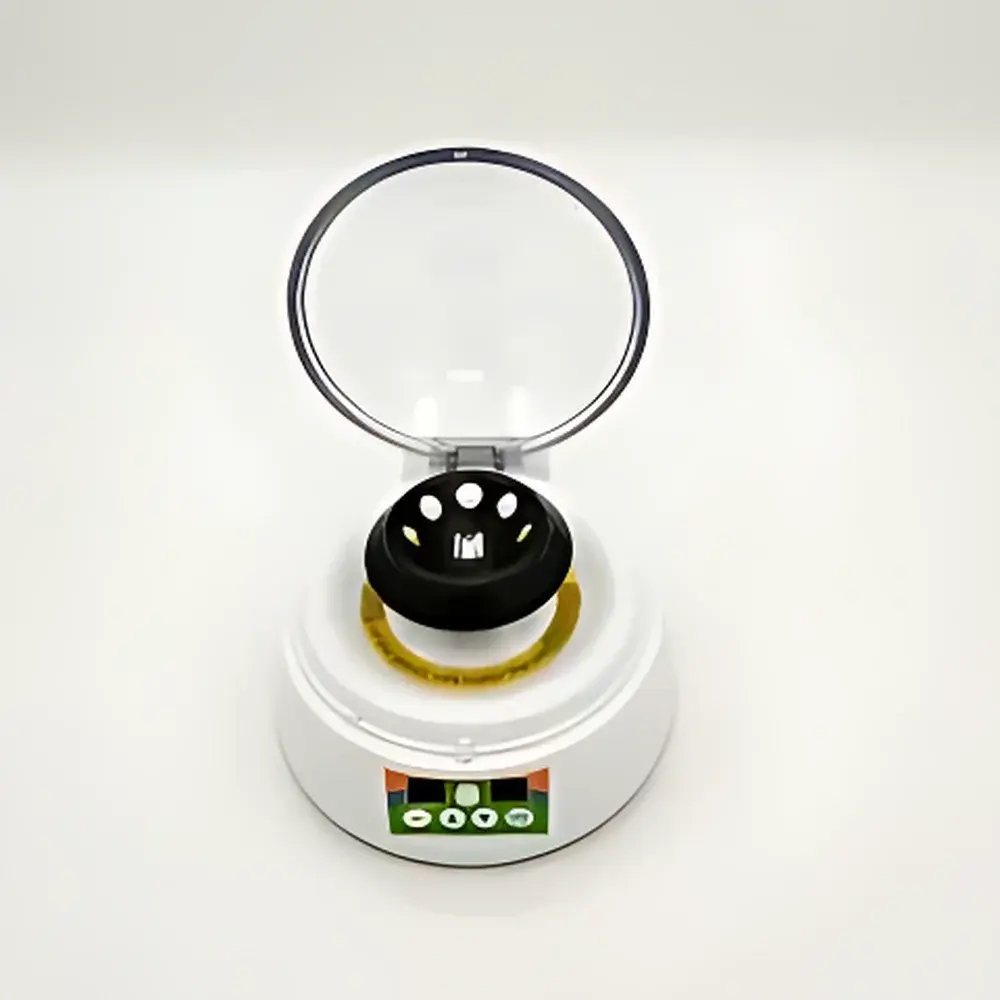
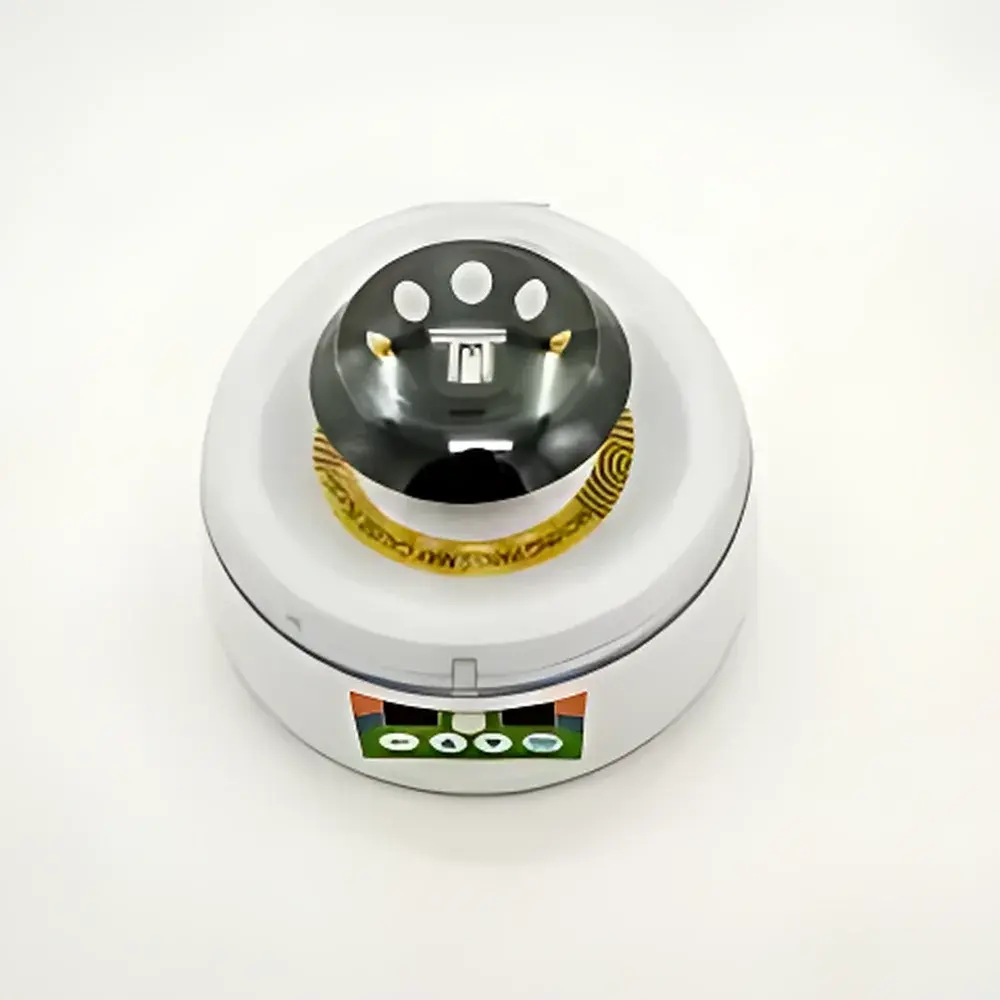
Hanuo Mini-4K Benchtop Microcentrifuge
| Brand | Hanuo |
|---|---|
| Model | Mini-4K |
| Type | Palm-Sized Microcentrifuge |
| Max Speed | 4000 rpm |
| Max RCF | 1200 × g |
| Capacity | 8 × 1.5 mL tubes (also compatible with 0.5 mL, 0.2 mL, and 2 × 8-strip PCR tubes) |
| Dimensions | 175 × 156 × 125 mm |
| Weight | ≤1.5 kg |
| Noise Level | ≤45 dB(A) |
| Power Supply | 220 V / 110 V, 50–60 Hz |
| Rotor Type | Fixed-angle horizontal rotor with quick-lock mechanism |
| Safety | Auto-stop on lid opening, transparent polycarbonate lid, electronic timer (on select models) |
| Compliance | Designed for GLP-compliant routine lab workflows |
Overview
The Hanuo Mini-4K Benchtop Microcentrifuge is an engineered solution for rapid, low-speed sedimentation tasks in molecular biology, clinical diagnostics, and quality control laboratories. Operating on the principle of centrifugal force generation via high-inertia rotor rotation, the Mini-4K delivers reproducible separation performance at up to 4000 rpm—sufficient for pelleting cellular debris, clarifying lysates, isolating serum from whole blood, and consolidating PCR reaction components. Its compact footprint and fixed-angle horizontal rotor design optimize space efficiency without compromising mechanical stability or thermal dissipation. Unlike high-speed or refrigerated centrifuges, the Mini-4K is purpose-built for routine, non-critical separations where speed, safety, and ease-of-use outweigh ultra-high g-force requirements. It conforms to IEC 61010-1 safety standards for laboratory electrical equipment and integrates passive thermal management to ensure continuous operation under ambient conditions.
Key Features
- Fixed-angle 8-position rotor with large-radius geometry—engineered to maximize relative centrifugal force (RCF) at moderate rotational speeds, achieving up to 1200 × g at 4000 rpm.
- One-touch lid actuation system: convex lid switch enables single-hand operation; lid opens automatically to 95° upon button press and halts rotation immediately upon detection of lid displacement.
- Tool-free rotor exchange via precision-machined snap-fit locking mechanism—ensures repeatable positioning and eliminates cross-contamination risk during frequent rotor swaps.
- Transparent polycarbonate lid with integrated safety interlock—provides real-time visual monitoring while meeting optical clarity and impact resistance requirements per ISO 13485 Annex A.
- Brushless DC motor architecture—designed for >10,000-hour service life, zero maintenance intervals, and stable torque delivery across voltage fluctuations (110–220 V, 50–60 Hz).
- Acoustically damped housing reduces operational noise to ≤45 dB(A), enabling use in open-bench environments including biosafety cabinets and shared core facilities.
Sample Compatibility & Compliance
The Mini-4K accommodates standard microcentrifuge formats including 1.5 mL, 0.5 mL, and 0.2 mL conical tubes, as well as dual-row 8-strip PCR tube racks (2 × 8 configuration). All rotor cavities are chemically resistant to common solvents (e.g., ethanol, isopropanol, diluted acids/bases) and autoclavable at 121°C for 20 minutes (rotor only). Device firmware and mechanical design support traceable operation under Good Laboratory Practice (GLP) frameworks: no data logging is embedded, but manual recordkeeping of run parameters (speed, duration) aligns with FDA 21 CFR Part 11 Annex B expectations for non-regulated benchtop instrumentation. CE marking (EMC Directive 2014/30/EU and LVD Directive 2014/35/EU) and RoHS compliance are certified per manufacturer documentation.
Software & Data Management
The Mini-4K operates as a standalone electromechanical instrument without onboard software or connectivity interfaces. Timing is managed via a tactile push-button interface with LED feedback (on Mini-10K variant); the Mini-4K uses a mechanical timer with ±5% accuracy over 0–99 minute range. No firmware updates, cloud synchronization, or audit trail functionality is implemented—consistent with its classification as a Class I general-purpose laboratory device under ISO/IEC 17025 Clause 5.5. Users maintain procedural consistency through documented SOPs specifying speed, duration, and tube loading patterns—critical for method transfer between shifts or sites.
Applications
- Serum/plasma isolation from whole blood samples prior to ELISA or immunoassay analysis.
- Clarification of bacterial, yeast, or mammalian cell lysates following lysis buffer treatment.
- Rapid pelleting of precipitated nucleic acids or proteins during ethanol/isopropanol wash steps.
- Compaction of microbial pellets for downstream DNA extraction or Gram staining protocols.
- Equilibration and consolidation of multiplex PCR master mixes into strip tubes before thermal cycling.
- Pre-centrifugation of capillary tubes or microvolume assay plates to eliminate air bubbles and ensure uniform meniscus formation.
FAQ
Is the Mini-4K suitable for centrifuging hazardous biological materials?
Yes—when used with sealed tubes and operated inside a certified biosafety cabinet, it meets containment requirements for BSL-2 agents per CDC/NIH guidelines.
Can the rotor be sterilized in an autoclave?
Yes—the aluminum rotor is rated for autoclaving at 121°C for 20 minutes; however, the main unit housing must never be autoclaved.
Does the Mini-4K support variable speed ramping or programmable acceleration/deceleration profiles?
No—it provides fixed-speed operation only; acceleration and deceleration occur passively without active braking or controlled ramping.
What is the recommended calibration interval for routine use?
Annual verification of speed accuracy using a calibrated tachometer is advised per ISO/IEC 17025 Section 6.5.2 for measurement traceability.
Is replacement rotor certification available from the manufacturer?
Hanuo provides OEM rotor serial numbers and material certifications (RoHS, REACH) upon request; third-party rotors are not supported or validated.
Related Products



