
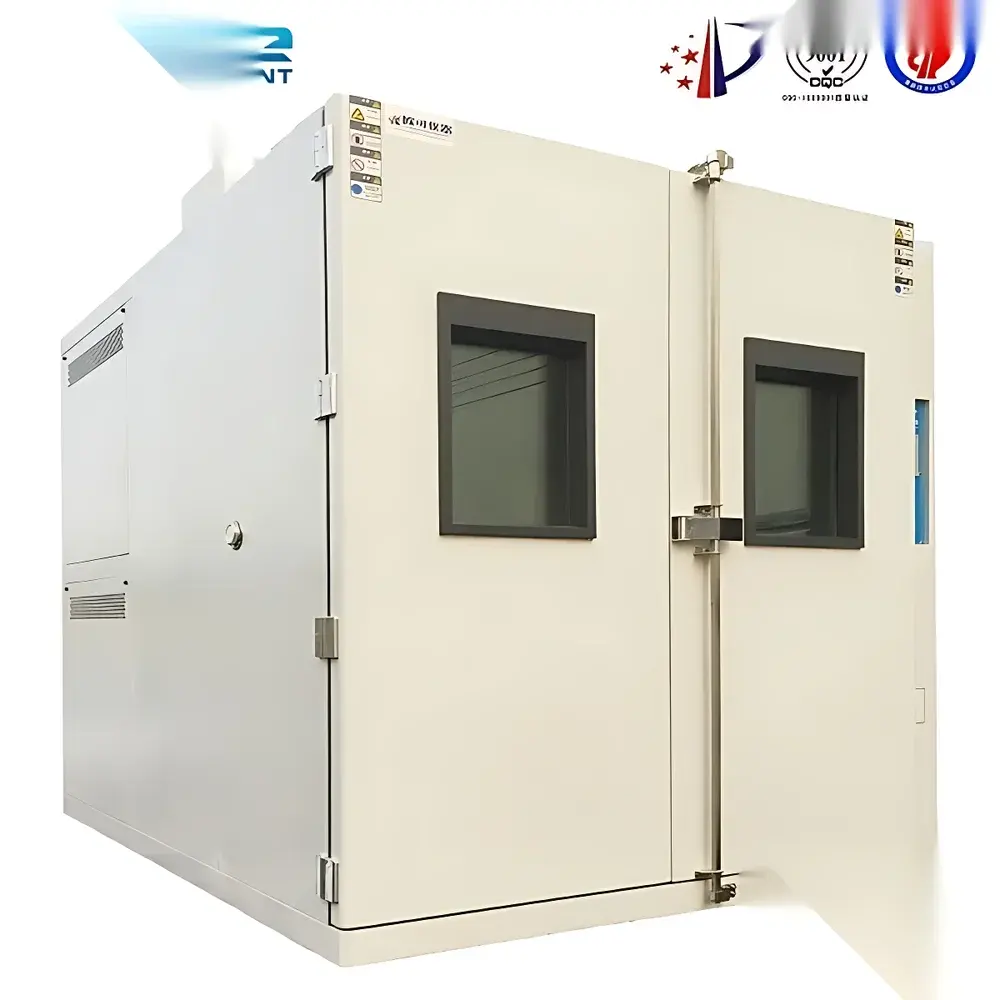
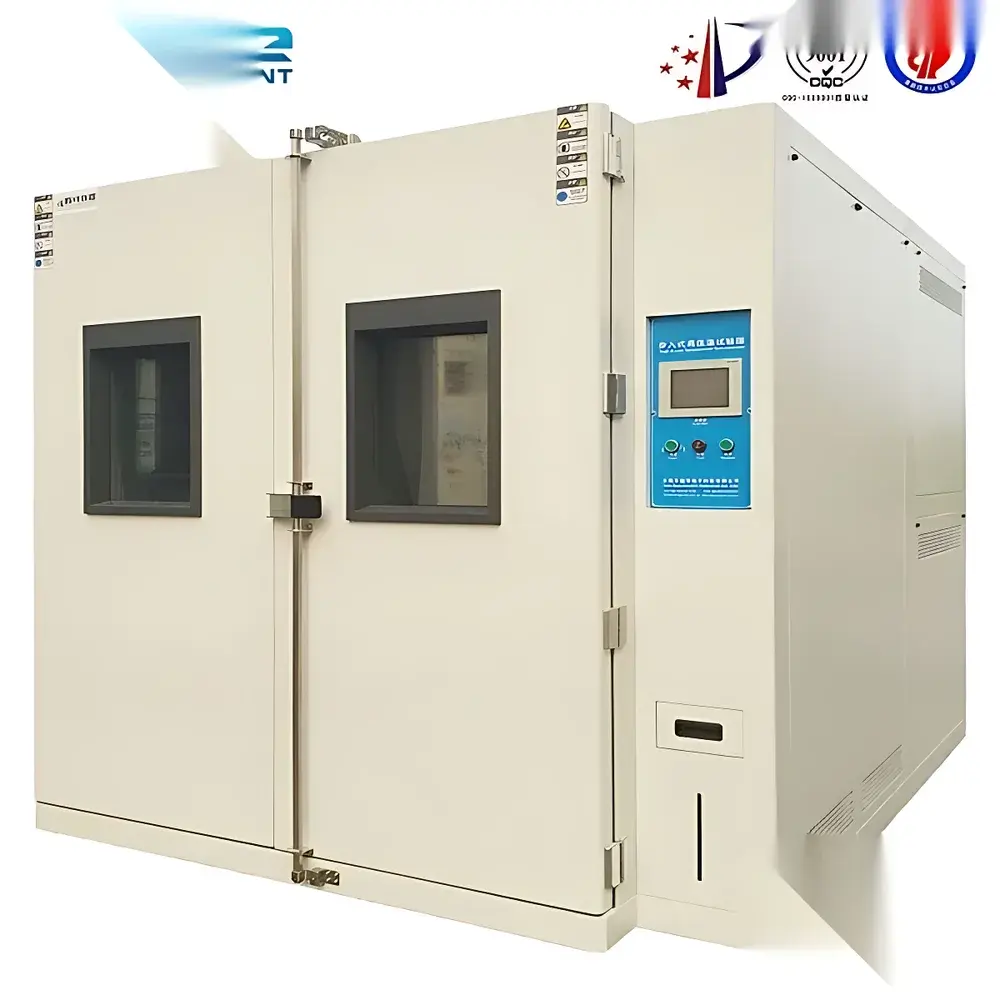
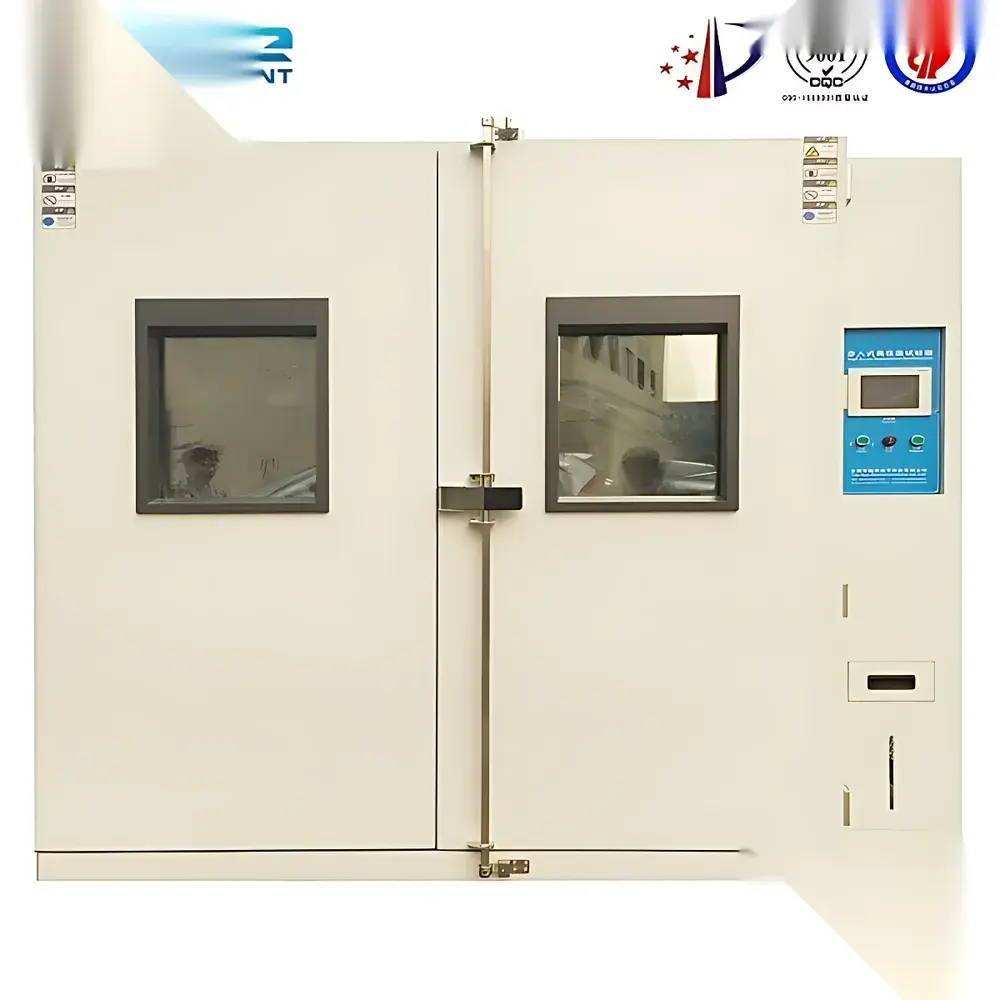
Walk-In Environmental Test Chamber for Temperature and Humidity Cycling
| Brand | Other Brands |
|---|---|
| Origin | Imported |
| Manufacturer Type | Authorized Distributor |
| Price | USD 11,200 (FOB) |
| Temperature Range | -20°C to +150°C / -40°C to +150°C / -60°C to +150°C / -70°C to +150°C |
| Temperature Uniformity | ≤ ±2.0°C (optional down to ±0.5°C) |
| Temperature Stability | ≤ ±0.5°C (optional down to ±0.1°C) |
| Humidity Range | 30–98% RH (customizable) |
| Humidity Accuracy | +2% / –3% RH |
| Heating Rate | 2–3°C/min (up to ≥10°C/min optional) |
| Cooling Rate | 0.7–1.0°C/min (up to ≥10°C/min optional) |
| Noise Level | ≤65 dB(A) |
| Refrigeration System | Single-stage hermetic compressor (Tecumseh/Tecumseh-certified) |
| Control System | PID self-tuning controller with Pt100 RTD sensors |
| Compliance | Designed per IEC 60068-2, ASTM D4332, MIL-STD-810H (environmental test methods), GLP/GMP-ready data logging |
Overview
The Walk-In Environmental Test Chamber for Temperature and Humidity Cycling is an engineered climatic simulation system designed for full-scale, long-duration reliability validation under controlled thermal and hygrothermal stress conditions. Based on forced-air convection with dual-loop airflow architecture, it employs a single-stage hermetic refrigeration circuit—powered by Tecumseh-certified compressors—combined with ceramic-sheathed heating elements and precision Pt100 resistance temperature detectors (RTDs). Its structural design supports ISO/IEC 17025-aligned test integrity, enabling reproducible exposure profiles across temperature ranges from –70°C to +150°C and relative humidity from 30% to 98% RH. The chamber is purpose-built for qualification testing of large-format components, subsystems, and finished goods in aerospace, automotive electronics, medical device manufacturing, and defense R&D environments where spatial uniformity, temporal stability, and traceable calibration are mandatory.
Key Features
- Robust walk-in enclosure with double-wall insulated construction (polyurethane foam core, ≥100 mm thickness) and reinforced stainless-steel interior lining for corrosion resistance and thermal inertia control
- Dual-circulation air management system comprising three axial fans and three multi-blade stainless-steel centrifugal impellers, ensuring vertical airflow stratification (top discharge, bottom intake) and minimizing thermal gradients
- High-efficiency refrigeration subsystem featuring finned-tube air-cooled condenser, segmented finned evaporator, and electronic expansion valve (EEV) for dynamic capacity modulation—reducing energy consumption and compressor cycling wear
- Advanced control interface with PID auto-tuning, ramp-soak programming, multi-point alarm thresholds, parameter masking, and user-defined profile storage (≥100 cycles)
- Optically clear, conductive-coated double-glazed observation window with integrated low-temperature lighting, enabling real-time visual monitoring without thermal leakage or condensation interference
- Hermetically sealed door assembly using high-durometer silicone gasketing and magnetic latching mechanism, validated for leak rate <1.0 × 10⁻³ mbar·L/s per EN 14321
Sample Compatibility & Compliance
This chamber accommodates test specimens up to 2.5 m (W) × 2.2 m (D) × 2.4 m (H), including full-size EV battery modules, avionics racks, HVAC assemblies, and pharmaceutical packaging batches. Internal shelving is modular and load-rated to 150 kg/m². All materials conform to UL 94 V-0 flame retardancy and RoHS 2011/65/EU directives. The system meets functional requirements of IEC 60068-2-1 (cold), IEC 60068-2-2 (dry heat), IEC 60068-2-30 (damp heat cyclic), ASTM D4332 (conditioning of plastics), and MIL-STD-810H Method 502.7 (low temperature) and Method 503.7 (temperature shock). Optional NIST-traceable calibration certificates and IQ/OQ documentation packages support FDA 21 CFR Part 11-compliant validation workflows.
Software & Data Management
The embedded controller provides local operation via a 7-inch capacitive touchscreen with real-time trend graphs and event logging. For networked deployment, optional Ethernet/IP or Modbus TCP connectivity enables integration into centralized MES or LIMS platforms. Data export supports CSV and XML formats with timestamped metadata (sensor ID, setpoint, actual value, alarm status). Audit trail functionality records all parameter modifications, user logins, and system events with immutable timestamps—fully compliant with GLP and GMP Annex 11 requirements. Remote monitoring via secure HTTPS portal allows authorized personnel to access live chamber status, historical profiles, and alarm history without compromising firewall integrity.
Applications
- Accelerated aging studies of polymer-based enclosures, adhesives, and conformal coatings under combined thermal-hygric stress
- Thermal cycling qualification of power electronics (IGBT modules, DC-DC converters) per AEC-Q100 Grade 0/1 specifications
- Storage stability testing of sterile medical devices per ISO 11607-1 and USP guidelines
- Environmental stress screening (ESS) of printed circuit board assemblies prior to burn-in and final acceptance
- Validation of cold-chain logistics packaging performance across defined transport profiles (e.g., WHO PQS, PDA TR66)
- Material coefficient of thermal expansion (CTE) characterization via dimensional metrology inside chamber-integrated coordinate measuring arms
FAQ
What is the standard lead time for factory calibration and commissioning?
Standard lead time is 6–8 weeks from PO confirmation, inclusive of third-party calibration to ISO/IEC 17025 standards and on-site operational verification.
Can the chamber be configured for rapid temperature transition testing (e.g., MIL-STD-810H Method 503.7)?
Yes—optional high-capacity refrigeration upgrade and enhanced heater banks enable ramp rates exceeding 10°C/min, subject to chamber volume and thermal mass constraints.
Is remote firmware update supported?
Firmware updates require authenticated USB media and local administrative access; over-the-air updates are disabled by default for cybersecurity compliance (IEC 62443-3-3 SL2).
Does the system support automated pass/fail reporting against predefined acceptance criteria?
Yes—via optional software module that compares logged sensor data against user-defined tolerance bands and generates PDF reports with digital signature fields.
What maintenance intervals are recommended for the refrigeration system?
Compressor oil analysis and filter-drier replacement every 24 months; full refrigerant circuit integrity check every 36 months, per ASHRAE Guideline 3-2021.



