
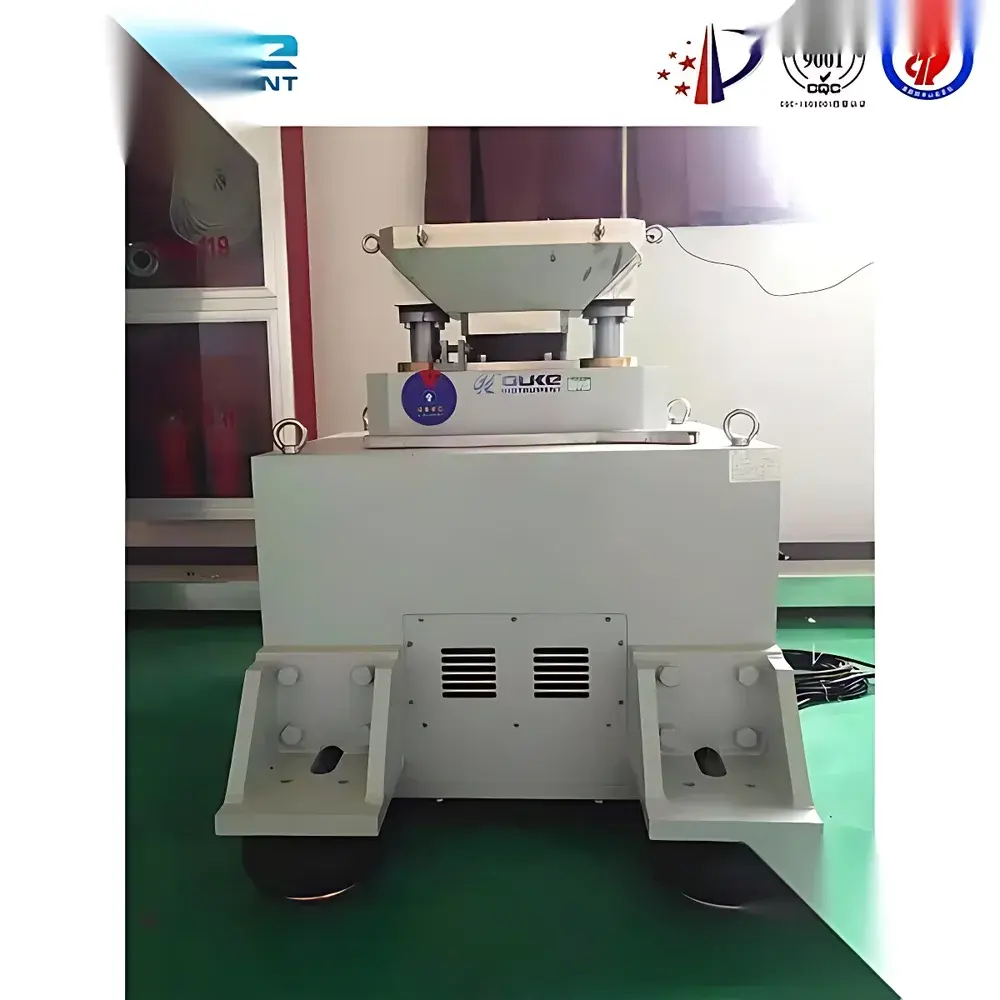
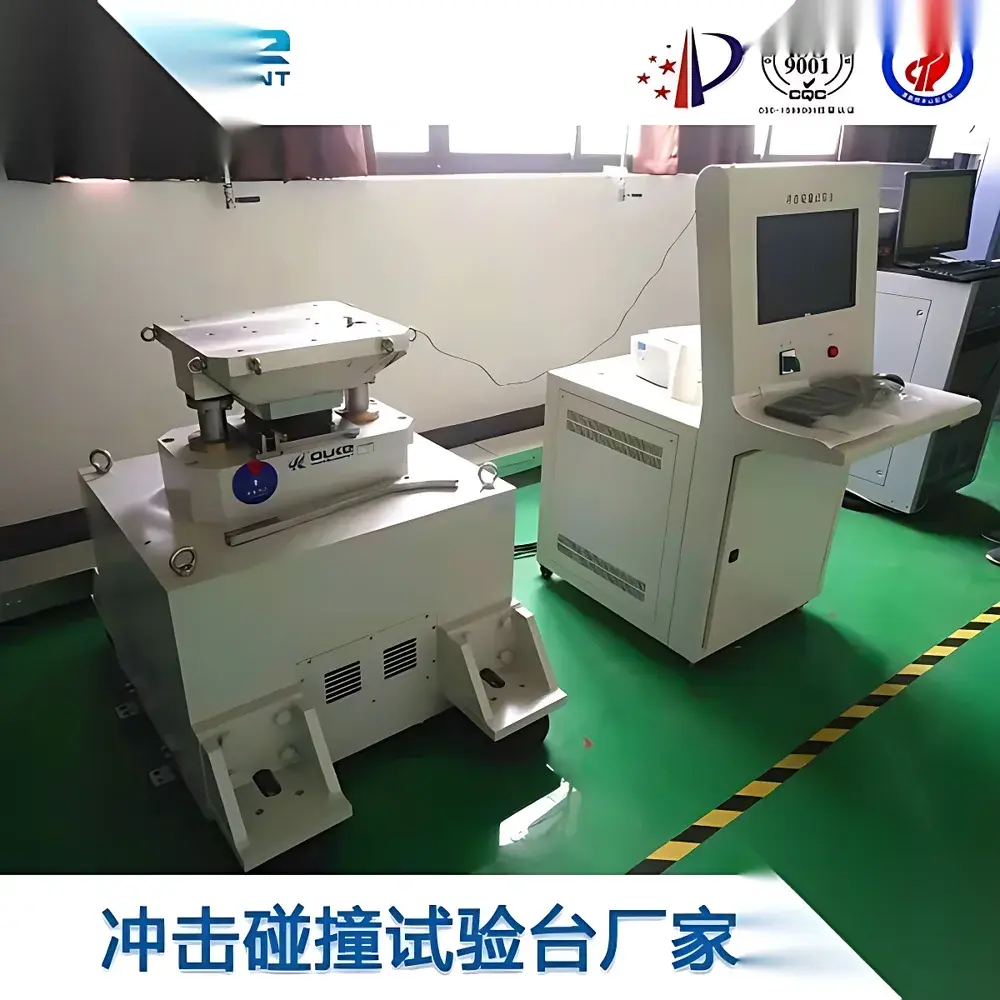
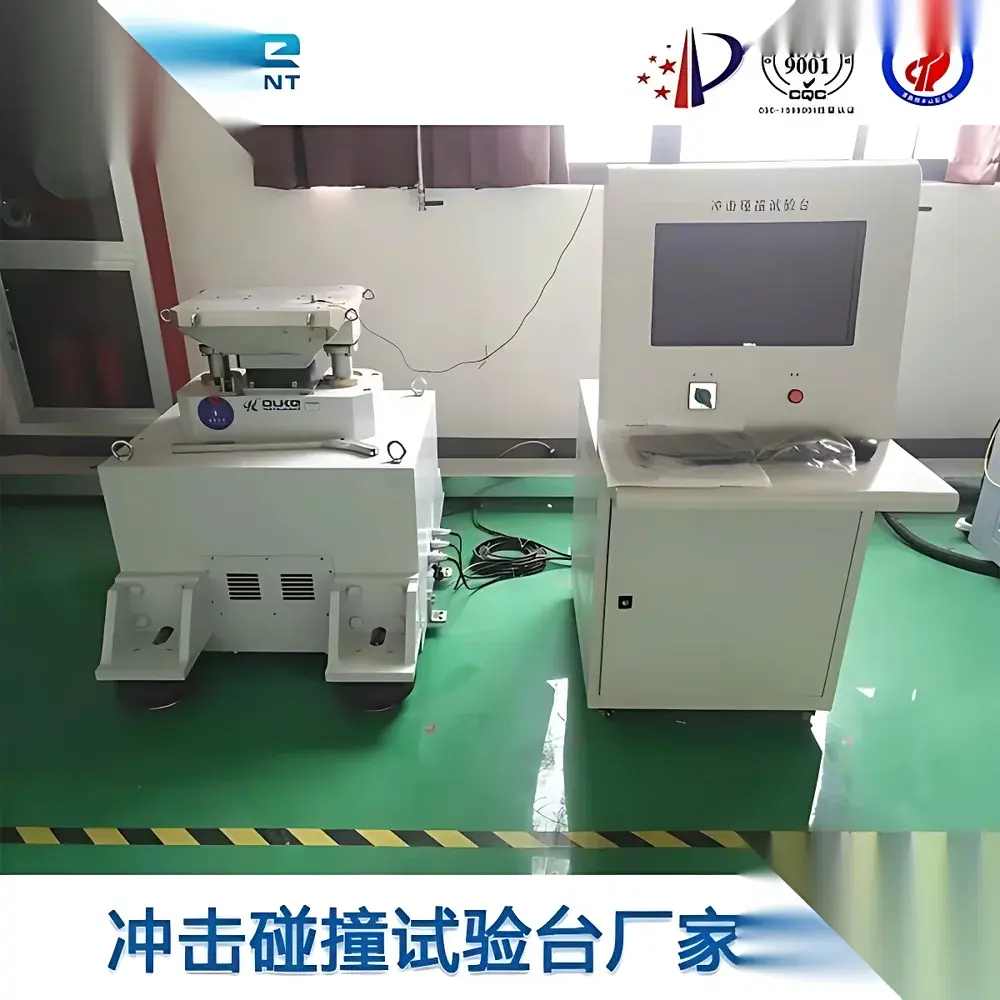
OKPZ-50 Fully Automated Electromechanical Shock Test System
| Brand | Other Brands |
|---|---|
| Origin | Imported |
| Supplier Type | Authorized Distributor |
| Power Supply | 220 VAC ±10%, 50 Hz / 380 VAC ±10%, 50 Hz |
| Operating Duration | 8 h continuous |
| Environmental Conditions | Temperature 40–50 °C, Humidity <85% RH (at 25 °C) |
| Compliance | GB/T 2423.5–1995, GB/T 2423.6–1995, IEC 60068-2-27, IEC 60068-2-29, JJG 497–2000 |
| Control System | Windows-based PC control with real-time waveform acquisition |
| Safety Features | Interlocked door safety, runaway vehicle protection, zero-signal validation |
| Packaging | Reinforced wooden crate |
| Impact Height Resolution | Digital preset with servo-assisted lift mechanism |
| Peak Acceleration Range (with optional high-g module) | 5,000–50,000 m/s² |
| Pulse Duration (with optional high-g module) | 0.2–1 ms |
| Repeatability | High reproducibility under controlled drop-height and cushioning conditions |
Overview
The OKPZ-50 Fully Automated Electromechanical Shock Test System is a precision-engineered shock testing platform designed for laboratory and industrial qualification of electronic components, automotive modules, aerospace subassemblies, and packaging systems under defined mechanical shock environments. It operates on the principle of controlled free-fall impact, where a test specimen mounted on a rigid platform is elevated to a user-defined height and released onto a calibrated shock pulse generator—typically a pneumatic or elastomeric waveform shaper. The system conforms to classical half-sine, trapezoidal, and sawtooth shock pulse profiles as specified in IEC 60068-2-27 and MIL-STD-810H Method 516.6. Unlike hydraulic or servo-hydraulic shock machines, the OKPZ-50 employs an electromechanical lift-and-drop architecture optimized for repeatable energy delivery, minimal maintenance, and integration into GLP/GMP-aligned test workflows. Its modular design supports both standard low-to-moderate g-level qualification (e.g., 25–200 g) and high-acceleration regimes when equipped with the optional high-g acceleration amplifier module.
Key Features
- Windows-based real-time control interface with intuitive parameter entry, automatic test configuration, and synchronized data logging
- Digital height presetting with servo-driven vertical positioning—ensuring ≤±0.5 mm repeatability in drop height across consecutive cycles
- Integrated anti-rebound hydraulic braking system that arrests platform motion immediately after first impact, eliminating secondary oscillations and preserving waveform fidelity
- Passive multi-stage base isolation and tuned mass damping to suppress structural transmission—enabling installation on standard concrete floors without reinforced foundations
- Real-time acquisition of acceleration-time waveforms via integrated piezoelectric transducers and 16-bit DAQ hardware, with live display and export in CSV/UNI format
- Comprehensive safety interlocks including electromagnetic door lock, emergency stop circuitry, zero-signal validation prior to release, and over-travel limit switches
Sample Compatibility & Compliance
The OKPZ-50 accommodates specimens up to 500 mm × 500 mm × 300 mm (L×W×H) and supports mounting fixtures for PCBs, ECUs, sensors, battery packs, and small enclosures. With the high-g add-on module, it delivers calibrated half-sine pulses meeting IEC 60068-2-27, Annex B (Shock), and US Department of Defense standards for functional survivability testing. All test reports include timestamped metadata, operator ID, environmental readings, and raw waveform files—supporting audit readiness per ISO/IEC 17025, FDA 21 CFR Part 11 (when deployed with compliant e-signature and audit trail software), and internal quality management systems requiring traceable test evidence.
Software & Data Management
The bundled OKPZ-Control Suite runs natively on Windows 10/11 and provides full test sequencing, waveform analysis (peak g, velocity change Δv, pulse duration, rise time), comparative overlay, and pass/fail threshold evaluation against user-defined limits. Data exports are compatible with MATLAB, Python (NumPy/Pandas), and industry-standard statistical process control (SPC) platforms. Audit trails record all parameter changes, start/stop events, calibration actions, and user logins—enabling compliance with GLP and GMP documentation requirements. Optional integration with LIMS or MES systems is supported via OPC UA or RESTful API.
Applications
- Functional shock qualification of avionics units per RTCA DO-160 Section 8
- Drop-test simulation for handheld medical devices under IEC 60601-1 Clause 9.4.2
- Package integrity validation for pharmaceutical primary containers (vials, syringes) per ISTA 3A and ASTM D4169
- Reliability screening of solder joints and MEMS accelerometers using controlled half-sine shocks
- Pre-compliance testing for automotive electronics per ISO 16750-3 and LV 124
- Research-grade transient dynamics studies in materials science laboratories
FAQ
What shock pulse profiles does the OKPZ-50 support?
Standard configurations deliver half-sine, trapezoidal, and initial-peak sawtooth pulses per IEC 60068-2-27. Custom waveform generation requires optional firmware upgrade and third-party pulse shaper calibration.
Is floor anchoring required for operation?
No. The system’s integrated passive damping and low center-of-gravity design allow stable operation on standard 150 mm-thick reinforced concrete flooring without anchor bolts or pit installation.
Can test data be exported for regulatory submission?
Yes. Raw acceleration waveforms, metadata logs, and summary reports export in CSV, PDF/A-2, and XML formats—fully traceable and compatible with FDA 21 CFR Part 11–compliant validation protocols when paired with validated software configuration.
What is the maximum specimen weight the system can handle?
The standard platform supports up to 25 kg. For heavier loads (up to 50 kg), optional reinforced load frame and upgraded lift motor are available upon request.
Does the system include calibration certification?
Each unit ships with NIST-traceable accelerometer calibration certificate (valid for 12 months) and mechanical alignment verification report. Annual recalibration services are offered through authorized service centers worldwide.
Related Products



